Thursday, August 8, 2013

A fibre-filled way to start your day: Eid Mubarak!


Species name: Phoenix dactylifera

Common name: date palm

Location: first 5 images from Dave's Garden user palmbob, last image from Dave's Garden user QCHammy

Date palms are magnificent trees (although, they're not truly trees because they're monocots and can't produce true wood), and not just because of their genus name (seriously? How cool is the genus Phoenix?!). And to be named after a dinosaur (the pterodactyl)? Awesome! OK, so I don't actually know for sure the date palm was named after a giant mythological bird that can be reborn multiple times and a flying dinosaur, but a girl can dream. The date palm was likely first domesticated to be an edible palm species in Iraq (most palm fruit you do not want to eat; many produce pretty potent fruit that would make you very sick very quickly), although a closely-related species was also domesticated in and around Brazil. They are now becoming very popular ornamental species in tropical locations because of a few ideal characteristics: they are long-lived, they are drought tolerant, are highly wind tolerant, and are tolerant of salt spray on their trunks and leaves (even when young).

Dates have been eaten as fruit for thousands of years. There's even evidence of date fruit being left as an offering in ancient Egyptian burial sites and in mummy sarcophaguses (sarcophagi? You get what I mean). No one is quite sure what the symbolism of leaving such fruit represents, as date pits are present with some bodies but not others. There is the suggestion that it might have to do with the time of year the body was buried (more on this later). Date palms are dioecious, meaning they have completely separate male and female plants. In order to have a date palm plantation, one must plant both male and female trees in order to get a crop (the male tree only provides the pollen, the female tree is where the fruit are produced). Unfortunately, the male plants are simply a waste of space in the plantation and so are usually not planted (sorry to all the men out there!), and instead alternate pollination methods are used. In certain areas, date palms are such important crop species that male flowers complete with pollen are often sold in jars in outdoor markets around the time that pollination would be occurring. If you were a date palm farmer, you would buy a jar and sprinkle the pollen in front of a large fan that would blow it across your plantation. I'm sure seeing this in person would be absolutely wild; not to mention it would really wreak havoc on your seasonal allergies if you had them! There are other ways to hand-pollinate female date palm flowers; in Iraq there are highly trained pollination personnel that climb the trunks using only a rope and pollinate the flowers using either a hand-fan or paint brush.

The fruits of these trees are remarkably nutritious, and are one of the best sources of potassium of any edible plant. They also contain a surprisingly high amount of protein, are a good source of dietary fibre,  and a good source of zinc (an element very important in the proper functioning of many of the enzymes and proteins in the body). Aside from eating the whole fruit (which may be eaten stuffed with a variety of yummy things like almonds, cream cheese or a more savoury version with tahini or hummus), there is a beverage called "palm wine" that is produced from the sap of the plant in India. It is fermented using traditional methods dating back thousands of years (even today!), and consumed at special occasions. In Pakistan, there is a syrup-like substance that is harvested from the plants and used to seal leatherwares and to prevent pipes from leaking. The sweet sap of the trees might also be condensed and evaporated to produce palm sugar, also called jaggery.

Date palms also have a significant role in religious symbolism. Christians use the leaves of this tree to make crosses on Palm Sunday, a symbol to represent the palm leaves that were scattered on the ground for Jesus' entry to Jerusalem. But, of course, I wouldn't have chosen to profile this plant today if I wanted to talk about its symbolism to the Christian faith; I would have done that near Easter!

Dates are traditionally the first food eaten at the breaking of the fast at the end of Ramadan, a month-long religious fast from sun up to sun down performed by Muslims worldwide, consumed with a drink of water or weak tea. After morning prayers, it is the beginning of Eid al-Fitr (the Sweet Festival), often celebrated with Eid ul-Adar (the Feast of the Sacrifice, traditionally approximately 70 days after the end of Ramadan). The timing of Ramadan changes yearly, but is based on the lunar calendar. The first day of Ramadan is the first day of the ninth month of the lunar calendar, and the first day is determined by the sighting of the crescent moon (if the moon is clouded then by default the month starts the following day). During the month of Ramadan no food items (or other pleasurable things in life) are consumed between sun up and sun down. At the end of the month, the breaking of the fast is celebrated with a big feast and the day of Eid al-Fitr. You would go around wishing your neighbours Eid Mubarak, which (roughly translated) means "Happy Ramadan." Guess what today is? Eid al-Fitr! :)

Eid Mubarak, Happy Ramadan, to all of my Muslim readers!

Wednesday, August 7, 2013

Sisal here, sisal there, everywhere a sisal sisal...


Species name: Agave sisilana

Common name: agave, sisal

Location: teaching lab at Western

So once again we have a plant in a pot (the next few blogs will all be plants in pots) from my favourite course ever. This plant is from the same lab exercise as the previous one, flax (which you can read all about HERE). The point of this lab was to introduce students to five major fibres and where the come from, as well as providing them with visual representations of what the plants actually look like since most are pretty foreign concepts to the average undergrad student. The five plants we feature are hemp (not as a plant, but we have a huge display about hemp cultivation and harvesting, as well as products commonly made, and some uncommonly made, from hemp), flax/linen, banana/musa, sisal/agave, and cotton. We also feature products made from each of these plants so the students actually get to touch the fibres to see what they feel like, and why one might be used for one thing over another (for example, it would be extremely unlikely for you to want to wear a pair of jeans made out of sisal, but some made out of hemp would be lovely).

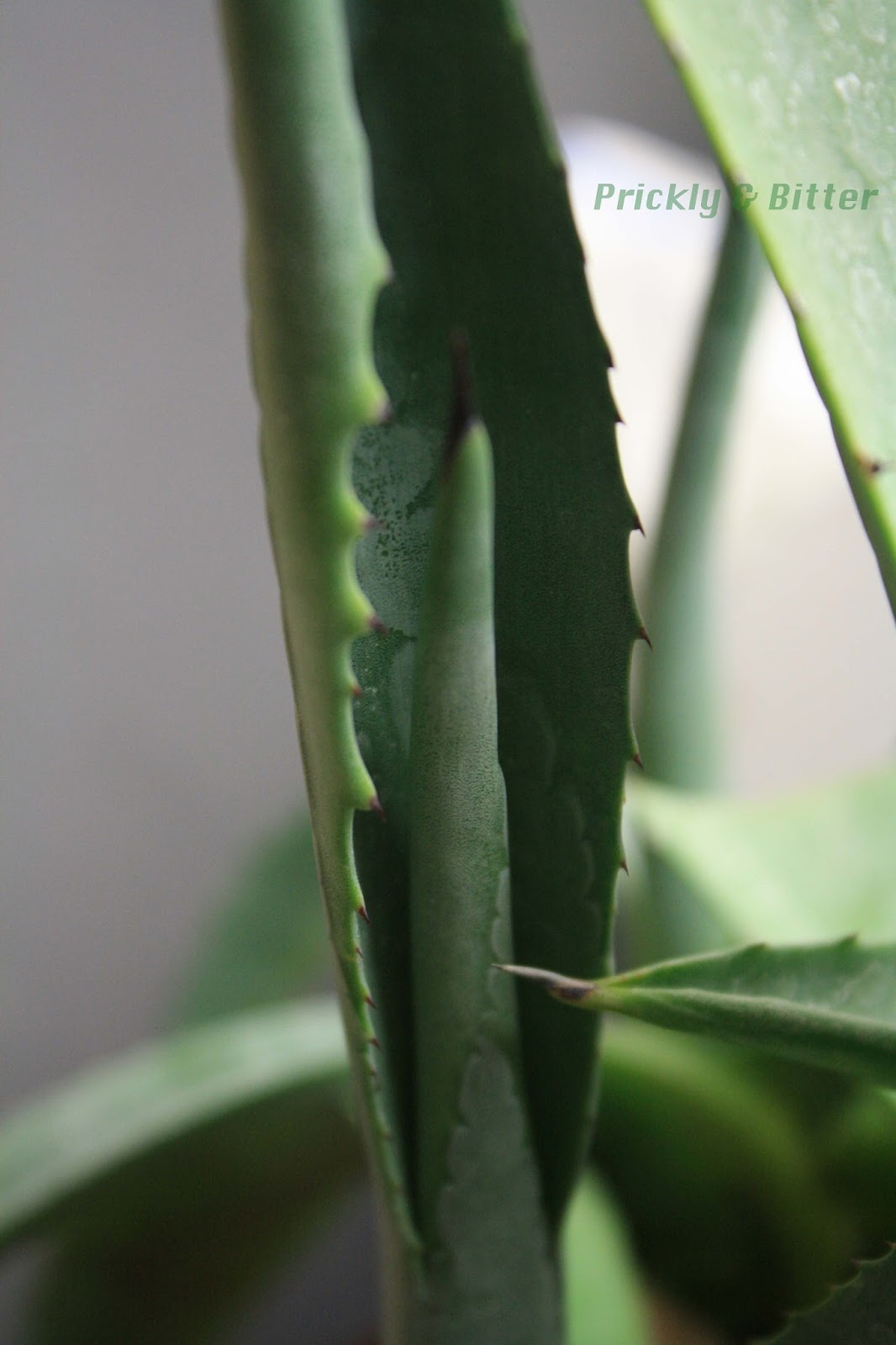
Sisal, also commonly called "agave" after it's Latin name, is native to the Yucatan area in Mexico where it is still commonly cultivated (and found in the wild) today. There are many, many other countries that cultivate this plant for its fibres, not the least of which being my favourite country to visit in the whole wide world: Cuba. The story of how they started farming sisal is actually a funny one! Back in the "good old days" (the 1600s and 1700s, not the 1980s), world exploration was quite the hot topic everywhere in the world. Cuban people, whether it be immigrants to Cuba who have now called it home for decades or native Cubans who have lived there for centuries, were big into exploration after Christopher Columbus piqued their interest (he made landfall in Trinidad in Cuba, where he was attracted by all of the same plants he found in the Dominican Republic). They set sail for the west, hoping to come across something exciting and they did: Mexico. What they observed there was fascinating to them; people turning plants into beverages, and then singing and dancing after consuming those beverages. I don't know about you, but it sounds like a fun time to me! Cubans agreed, and offered to buy some of these plants off of their hands; Mexico refused. So what's a Cuban to do when you want to make the "happy drink" but they won't give you the plant to make it? Why you steal it, that's what you do. Minor detail: the plant in question was the plant called Agave tequilana, or perhaps even Agave americana, not Agave sisilana. Since pretty much all green spiky plants look the same after an over-indulgence of tequila, you can probably understand how they got the two mixed up. Once they brought the plants back to Cuba, grew them, and tried fermenting them into alcohol they were likely sorely disappointed since the resulting beverage would taste nothing like Mexican tequila (it's much more bitter, and would be a much darker brown). They quickly rectified their mistake by becoming one of the world's most important producers of sisal fibres around the world, used to make marine ropes and twine. At least it wasn't all for nothing!

Sisal has recently come back into fashion as an alternative plant to grow in an area, especially in tropical countries, when you're letting a field plot go to rehabilitate the soil as it out-competes weeds and animals avoid eating it because of its physical defenses. It will just happily grow, producing long strands of fibres in the leaves without any kind of human intervention. Even harvesting the plant for fibre is non-destructive; you simply cut the leaves from the stem and leave the stem to grow more leaves. Most commercial sisal varieties are sterile, meaning they will never produce the flower stalk that is so characteristic of other members of the genus Agave (which you can read all about HERE or a closely related plant in a different genus HERE). Should those flowers have been produced, the flower stalk could also be used as a source of fibre. Like with the tequila agave, once the flower stalk is produced and the flowers are pollinated, the entire plant dies so there is incentive for sterile varieties to be grown to prolong the life of the plant.

Aside from rope, there are many uses for sisal and even more are being discovered now that varieties of sisal can be produced in the lab that make longer, softer fibres. Sisal is now commonly used to make paper, dartboards, scouring cloths and sponges, filters, carpets, and even some texturized wall coverings (paints and wallpapers). Sounds like a great plant! The one major downside in using this plant as a fibre source is the amount of waste: only about 4% of the total mass of the plant are useable fibres. The rest is all waste that is composted (rarely) or burned (more likely). The odd time the burning of sisal waste will turn into a dirty fuel, but more often than not it's just set on fire in the field and the ashes are spread around after the pile has been burned off. There are now efforts into looking at how microbial decay by bacteria can be used to turn sisal wastes into biogas, or methane.

While not officially a state "tree" (not actually a tree, despite the ability to produce a stem that looks quite woody, as it is a monocot), it appears on the coat of arms of the state of Yucatan in Mexico, and Barquisimeto in Venezuela.

Sunday, August 4, 2013

A plant you eat and a plant you wear


Species name: Linum usitatissimum

Common name: linen, flax

Location: teaching lab at Western

One of the courses that I've been involved with as a TA (and sometimes a guest lecturer if I'm lucky; the professor of the course trusts me enough to "let me loose" on the students every so often and I LOVE it!) is called "Plants as a Human Resource", or the equivalent of the Western version of Economic Botany at other universities and colleges. It's a great course, and one where, if the students care enough to pay attention, the information is not only incredibly interesting but also applicable to everyday life. They learn about where paper comes from, where their clothing comes from, where their food comes from, where the drugs that they take come from, where their beverages of choice come from, and how agriculture first started (along with a bunch of other topics interspersed along the way). It's a really fantastic course! Flax is one of the plants that the students learn about because it has been an invaluable resource to people all over the world for thousands of years. It was domesticated in the Fertile Crescent, an area that extends from Saudi Arabia all the way to Pakistan and India. This crescent-shaped area has been responsible for the domestication of many of our invaluable crop species, both plants and animals, like wheat, rye, cotton, flax, oranges, grapes, and opium poppies. Yes, opium really is an invaluable crop species! Think about how awful surgery would be if you couldn't be prescribed morphine, or even codeine? Both come from the opium poppy!

So why is flax such an important crop? It's not just for its nutritional value, as many people in North America today are aware of. Flaxseed is a great source of omega-3 fatty acids, which have been shown in some clinical studies to lower blood cholesterol levels. The evidence for this claim isn't strong anymore, since some studies have shown that the effect is stronger for women, while others have shown this effect is only noted in men. When clinical trials don't agree with each other, it calls all of the evidence for a specific claim into question. There has been another study that has shown that the consumption of relatively high amounts of ground flaxseed can stunt the growth of prostate tumors in men, but this has never been demonstrated in other clinical trials. Yet another study has shown that ground flaxseed can help people suffering from diabetes because it can stabilize blood sugar levels (another medical claim that has never been shown in another clinical trial). One thing that flaxseed definitely can do is act as a laxative when taken with water. The seeds of this plant contain an incredible amount of fibre, which acts as a "cleanser" for the large intestine. If excessive amounts of flaxseed are consumed without water, it will instead lead to intestinal blockage. There are other, more effective natural products used in laxative medications because they don't rely so much on water intake (such as senna, carob and tamarind) so ground flaxseed is rarely the main ingredient in herbal medications for constipation. Using ground flaxseed as a home remedy is strongly discouraged; if not enough water is consumed for it to be effective and intestinal blockage occurs, it can lead to death if not caught in time. Pardon the pun, but that would be a...poopy way to die.

Aside from its nutritional value, flax has been used for millennia for its other main use and for its other common name: linen. The stems of this plant contain bundles of fibres that run the entire length of the stem (up to 90 cm of useable fibre). They are easily extracted using a microbial decomposition process known as "retting", where the stems are essentially left to rot in the field. Microbes will decompose the parts of the stem around the fibre bundles, but because they don't have the ability to digest the fibres themselves they leave them alone. After a few days, the long fibres can easily be separated from the rest of the plant and they can be cleaned, dyed, and spun into thread or yarn. Linen fibres are very strong but very light at the same time, and much more breathable than cotton. Because the fibres themselves are so long, linen garments also resist wrinkling which has made them historically desirable for "travel clothing". So how long have we been using this plant for cloth fibres? Well, the answer to that question is now up for debate after a discovery in a cave in the country of Georgia. It was originally thought that linen was domesticated about 10,000 years ago and used sparingly prior to that time (the plant was much shorter, so producing cloth from the fibres was much more labor-intensive; the domestication process imparted characteristics of longer, larger fibre bundles in a taller plant), but bundles of fibres that were spun into thread, dyed, and tied into bundles was dated from the Georgian cave to be over 30,000 years old! That's some old thread. Ancient Egyptians mastered the art of spinning linen fibres into thread and using that to make cloth; all Egyptian mummies were wrapped in linen cloth. Unfortunately, the paper-making process has stripped "unimportant" mummies of their post-mortem clothing, as the first pulps used to make paper used linen fibres (and where the name "rag bond paper" comes from). I can only imagine how important paper must have been for people to go into tombs to steal mummy rags! Sounds like a creepy and gross job.

Aside from food and fibres, this plant also has a role in traditional herbal medicine, especially in Austria. There, it was used either as a tea-like beverage or as a oily skin compress to treat a whole slew of disorders from gout and rheumatism to asthma and the common flu. None of these medicinal qualities have ever been demonstrated in clinical trials, but if you think rubbing some fresh-ground flax on your skin will treat your rheumatism, go for it. It certainly won't make it worse!

Flax flowers are the national emblem of Northern Ireland, and the national flower of Belarus.

Tuesday, July 30, 2013

Dr. Jane Bowles: a great botanist, friend, and mentor


Species name: Acacia tortilis

Common name: umbrella acacia, Israeli babool (in Swahili: mgunga, mugumba or munga)

Location: all photos from Dave's Garden (photo 1 by DMersh, photo 2 by DMersh, and photo 3 by palmbob)

You might be wondering why I'm featuring this plant in my blog today; for a full explanation you can scroll down to the bottom of this blog post past the next plant profile. Umbrella acacia trees are probably one of the first plants that come to mind when you think of Africa. They are for me at least! They have an enormous native range, reaching from the north all the way to the south of Africa and into the Middle East. When I think of the African savannah, this is by far the first tree (and sometimes the only tree; I'll be the first to admit that my African botany knowledge is quite limited!) that comes to mind.

The umbrella acacia actually looks rarely like an umbrella when grown in cultivation. Because it is so extremely drought tolerant, it is often grown in climates where the type of ecosystem that prevails for most of the year is a dry, sandy desert. Here, the umbrella acacia looks more like an acacia with a bad hair day, and is very straggly and wiry. It is only when the young seedlings are exposed to large amounts of rain that the trees end up developing into the typical umbrella-shape that is so characteristic of the African savannah. That, and grazing animals that force the tree into that shape couldn't hurt; this tree is one of the preferred food sources of giraffes. The "umbrella" of the canopy begins where the branches are just out of reach from the giraffes and everything below that point is eaten away. That's not the only animal that eats the umbrella acacia: humans have also used this tree as a source of gum arabic (added to many, many food items), and the seed pods are used for various herbal medicines. The seeds may be eaten by humans but are rich in tannins so are usually avoided (but may be used as a source of natural dye instead!), however other grazing animals like small mammals or birds eat these seeds as a rich (and rare) source of protein and fat.

There are quite a few products made from the wood of this tree, and is one of the reasons why it is grown so much in cultivation in Africa and the Middle East. The wood is very important for fine woodworking products like wagon wheels and furniture, as well as raw lumber for fenceposts and animal pens. The tabernacle, built by Israelites in the Old Testament, was also exclusively built from wood of the umbrella acacia so it has important religious significance as well. It also has very high significance to more than 20 different groups of people (either groups defined by language, linguistic dialects, country lines, or cultural beliefs), but the most important of which for the purposes of this blog post is that it's the National Tree of Kenya.


Species name: Stylophorum diphyllum

Common name: wood poppy, Celandine poppy

Location: Dave's Garden -- DaylilySLP

I think this is probably the only critically endangered wildflower species that I've ever personally seen in Ontario. When I saw it I didn't realize what it was or how important it was, so I didn't bother photographing it despite having my camera with me. Next time! There are only three populations in Ontario, which is the most northern part of its native range (which extends into the United States and is still quite limited; it is now only a small fragment of what it used to be), ranging in population size from 42 individual plants to about 270 individual plants (at last reassessment in 2007). It is a victim of land use change (converting forests to agricultural land) and invasive understory species (like garlic mustard, which you can read all about HERE), which continue to threaten the last three populations in Canada.

Wood poppies are similar to bloodroot, another native species which grows on the forest floor in southwestern Ontario (which you can read all about HERE), in that they produce a rhizome in their first year of growth, and use the sugars stored in that rhizome to produce leaves every spring. The rhizome of one plant isn't nearly as long-lived as in bloodroot, with the lifespan of the average rhizome only being about 5 years. The plant rarely produces flowers in its first year of growth (except in cultivation; it has become a popular garden plant over the last decade or so), so it is sometimes mistaken for other wildflower species during that first year. The seed pods that the plant produces are very unusual and are far larger than you would expect from a plant as small as this one (rarely growing more than 20 cm off the ground) and also share seed characteristics with bloodroot. The seeds are produced with a fleshy, fatty outer covering called an elaiosome which attracts ants. The ants take the small seeds and carry them away to their underground chambers where they use the elaiosome as a rich food source, then discard the seeds when they are finished. The seeds then germinate the next spring and grow up through the ground to produce new plants. This ant-plant dispersal relationship is called myrmecochory. Other animals, if given the chance, will also consume the seeds (seeds were found in great numbers in mouse droppings near one of the remaining populations in Ontario).

Medicinally, despite having close relatives that produce morphine and codeine, this plant has no value. It does contain some alkaloids that may prove useful in some medicinal sense in the future, but right now there is no documented medical use of this plant either currently or historically as an Native North American herbal medicine. The alkaloid cocktail in the plant is more than likely toxic to humans, so avoiding grazing on the leaves if you grow this plant in your garden would be strongly suggested. Wearing gloves when gardening around this plant is also suggested, as the sap from the plant may irritate sensitive skin.

Unfortunately, the fact that this plant is now grown in cultivation and the source of these plants is not a native source (which is actually a good thing; wild-harvesting of this plant in Canada is illegal and would be extremely detrimental to the few plants left in the wild) means there is now the risk of genetically contaminating the remaining plants. The populations in Canada had their DNA sequenced and compared to the US populations and it was shown that these three populations are genetically distinct from their American counterparts. This doesn't mean there was enough difference for them to be considered different species, but there was enough of a difference for it to be noteworthy. When the pollen of a foreign population mixes with the ova of a native population to make seeds, the foreign DNA from the pollen contaminates the native population, effectively creating "genetic hybrids" of both populations. Since plants in cultivation are usually much more susceptible to disease than their wild counterparts, this could be really bad news for our last three native populations.

_________________________________________________________________________________

So why these two plants, you might be wondering? Well, these were the two plants I could best think of to commemorate the loss of a great botanist, my friend and mentor, Dr. Jane M. Bowles.

Jane grew up in Kenya, and some of the stories she shared about her childhood there are out of this world and beyond belief for someone that has lived in Canada their whole life (can you imagine growing up with a lion living in your front yard?! Mind-boggling to me!). She went to school in England, then moved to Canada to complete her PhD in botany about sand dune ecology at Pinery Provincial Park. Since the completion of her PhD, Jane was an adjunct professor in both Biology and Geography at Western and, most recently, the curator of the herbarium and the director of the arboretum.

I first met Jane at the field station associated with Western when I was out there with my supervisor searching for fungi in the woodlot at the back of the property. My supervisor introduced Jane as the curator of the herbarium (assuming I knew what a herbarium was; I was thinking "herbari-what?!"), and we went on our merry way. It wasn't until a couple of months later that I realized that, aside from my supervisor, Jane would probably be the single most important person (well, aside from myself, too, obviously) involved in the successful completion of my PhD. I rely so heavily on herbarium loans to look at historical mushroom specimens that I would have been completely lost without her. Not to mention that Jane was universally loved and respected by all herbarium curators around the world; with her as my primary source of communication to other herbaria I would have no problem having a loan in my possession two, three, sometimes four times longer than the period of time I was actually given. If you think that's bad it's not; it's not unheard of to have herbarium loans for 10 years or more!

Over the last 6 years I would say that Jane and I had become friends. I always knew I could count on her to provide me with a laugh thanks to her biting sense of humour, I could count on her for a swift kick in the bum to get myself in gear when I asked for it, and give me some helpful tips on how not to lose my sanity along the way. I would also say that her love for plants inspired me to grow to love them (sorry for the pun...actually, not sorry. That was carefully planned!), too. She taught me about the importance of native species, and drilled into my head the dangers of invasive non-native species. She opened my eyes to a whole new world of Biology: being a naturalist, and helping preserve the world for what it currently is and not try to change it to be what we want it to become to "improve our life" (it's often too late when we realize that having a giant forest was perhaps a bit better than yet another strip mall...).

Earlier this year, Jane was diagnosed with cancer. On Saturday, July 27th 2013, Jane lost her fight at Victoria Hospital. There won't be a day that goes by where I won't think of her, not a week that goes by during the rest of my time at Western that I won't remember one of her tidbits she told me, and not a year that goes by where I won't be reminded of what an amazing lady Jane was.

Goodbye, Jane. May your memory live on, and may you continue to inspire young impressionable scientists such as myself to become one with nature forever.


Jane was known for her amazing artistic abilities; this is one of her drawings 
of the wood poppy, which she drew for her co-authored species status report 
(you can read the most recent version HERE)

Friday, July 26, 2013

An homage to the Royal Family

I know it's been a while; it's amazing how busy life gets during the summer during the "down time" (actually the busiest time for graduate students since undergrads are off for the summer and there's very few of us who have teaching duties during the summer; this means all of our time can be dedicated to research, or in my case, writing my thesis). 

Unless you've been living under a rock, you've probably heard all about the birth of the Royal Baby, and all of the hooplah that goes along with it. Some people on twitter are less than impressed about hearing about it all the time, but you know what? I don't care :) I think reading about how excited people are for the birth of the future King of England is awesome. Do you know why? It's happy news. People were overjoyed about hearing about the engagement of Will and Kate, then their wedding was just plain ridiculous with regards to how popular it was with people around the world, and now their first child (with a bunch of other special events mixed in the middle; us Canadians got all excited when they came on their first Canadian tour). Sure, there will be some people that will poo-poo when having to hear or read about the Royal Family, and they can poo-poo all they want. It is an opinion, after all, and everyone's entitled to their own. I, for one, love hearing about the Royal Family. I think it probably stems back to when I was a little girl dreaming about being Tinkerbell or Cinderella, and what little girl doesn't dream about being a princess at least once?! Even if they just dream about how much they would hate it :) I personally think hearing all about the Royal Family is a nice change from hearing about all of the sad and terrible other things going on in the world today.

So with that, prepare yourselves for a blog about (a very small part of) the Royal Wedding! Since I had not yet started this blog when Will and Kate got married, I figured a great way to get back into the blogging swing of things would be to pay homage to their relationship and the little bundle of joy they just welcomed into the world. Welcome to life in the spotlight, His Royal Highness Prince George Alexander Louis of Cambridge!

And without further adieu, a blog about...Kate Middleton's bouquet.

(image from HERE)

There are four plants featured in her bouquet: myrtle, Lily of the Valley (the most dominant flower type), Sweet William, and hyacinth.


Species name: Myrtus communis

Common name: myrtle

Location: Dave's Garden -- growin

The common myrtle is a very popular garden plant in Europe (it's just starting to become more popular in North America, especially in warmer climates) and is native to the southern European countries that border the Mediterranean and northern Africa. Because this plant flowers so late, it is popular in providing a splash of flower colour in the late summer months (as well as a source of pollen and nectar for summer pollinators) and the fruit for the birds and small mammals in the fall. It is very cold-sensitive, and requires protection from even a light frost so would be unsuitable for use as an outdoor ornamental in Canada.
This plant has a long history as a medicinal plant, with such legends as Hippocrates and Dioscorides swearing by it to treat sinus infections. There is, unfortunately, no evidence to suggest it actually has any effects on the body other than a pleasant smell, so don't get too excited. But both the leaves and the flowers were used and are featured heavily in decorative illustrations done by both Hippocrates and Dioscorides in their epic works. This still doesn't explain what it's doing in a wedding bouquet...

Myrtle flowers are also incredibly sacred to the Romans, as they were the flowers that represented both Demeter and Aphrodite. Further, a myrtle branch with flowers on it was often presented, before an olive branch "became popular," as a sign of peace and goodwill when welcoming new neighbours or new members of the family. From here, myrtle flowers have become important signs of unity and goodwill, two important qualities when it comes to joining two hands in marriage (no matter what kind of ceremony it is!). The specific plant chosen for the myrtle flowers is also significant to the Royal Family: Queen Victoria planted the sprig of myrtle she used in her bouquet in her garden, and every royal since then has taken a small clipping from this tree to use in their own bouquets. The cuttings are rooted and then planted alongside Queen Victoria's tree (I can imagine it would be a veritable myrtle forest by now!).


Species name: Convallaria majalis

Common name: Lily of the Valley

Location: Wolfville, Nova Scotia

Lily of the Valley is likely native to Europe and western Asia, although there's still the idea that it might have originated in North America (although this explanation is slowly losing ground). It is, however, a very common flowering plant here in the spring and has even become invasive in some areas, outcompeting our native bloodroot, trilliums, and other native spring wildflowers. I have blogged about this plant once already; if you'd like to read about it you can do so HERE.

This flower is rarely used in wedding bouquets because of its flowering time; the Latin epithet of the species name "majalis" means "flowering in May." Since most people don't choose to get married in the spring and instead opt for the summer, finding these flowers in July or August is incredibly rare. This, in turn, drastically increases the value of the flowers to such an extent that they have become one of the most universal signs of wealth in wedding bouquets. This idea, of course, goes hand-in-hand with the Royal Family and the Lily of the Valley has been an integral part of all wedding bouquets documented in photography and (before the invention of the camera) paintings except Queen Victoria that favoured snowdrops. Will and Kate were lucky; they probably got an extreme discount on their Lily of the Valley flowers since their wedding was on April 29th!


Species name: Dianthus barbatus

Common name: Sweet William

Location: Dave's Garden -- DebinSC

The flower commonly called Sweet William is a rather mysterious flower, because no one is entirely sure how it got its common name. There are many stories about how it refers to William Shakespeare, but also some stories about Prince William, the Duke of Cumberland as well as Saint William of York and William the Conqueror. Whatever the origins of the common name, the plant itself originates from southern Europe and across most of Asia.

As far as royal bouquets go, this plant is incredibly unusual to be included, but I'm sure you can guess why it was. Kate included this flower as a tribute to Will, a gesture that was picked up on by botanists across England long before the media started reporting on it. See, sometimes it pays to know your plants! In general, these are incredibly unusual to use as wedding flowers but they are also very long-lived (they can survive in full-bloom with no signs of wilting or flower decomposition for months after cutting) so make for great wedding flowers if you want a keepsake in your home. Pure white Sweet William flowers are difficult to obtain, and most have a slightly purple tinge to them like the ones pictured above. The pure white flowers that Kate featured in her bouquet are a relatively rare cultivar developed in England in the 1980s.


Species name: Hyacinthus orientalis

Common name: hyacinth

Location: Dave's Garden -- chrisw99

As far as hyacinths go, the specific cultivar or variety pictured above is quite stunning. The stamens have been replaced by petals, a phenomenon referred to as "doubling" (it appears as if the plant has doubled the number of petals produced for a fuller flower, when it reality the flower has become sterile through a genetic mutation). This type of mutation does happen naturally but is incredibly rare; it has been exploited for centuries by horticulturists for fuller flowers. The other benefit of this phenomenon, at least for those observing the flowers, is that because the plant has no chance of reproduction the flower doesn't die as quickly. Dead flowers are usually the result of the end of the production of pollen and nectar, and instead of putting resources into maintaining the petals the plant shifts its resources into producing the fruit. Since doubled flowers don't have stamens to produce pollen, this resource shift can't happen and the flower remains on the plant for a longer period of time. If you'd like to read a full blog about hyacinths, you can do so HERE.

Hyacinths, again, are rare as wedding flowers in general but a staple of all weddings and coronations for the Royal Family. Because of their very early flowering time in the spring, they too are rare and expensive to use in wedding bouquets during the most likely time that a wedding would occur. The use of hyacinths (especially for coronations) can be linked to King George III who insisted that the "royal herb strewer" should precede him for his entrance so he would be walking through the sweet scent of flowers and herbs. King George III reinstated this practice in 1820 for his coronation, and selected hyacinths to decorate the venue due to their intense sweet scent. I'm not sure of Kate's reasoning to include some white hyacinth flowers into her bouquet, but it could be a symbol of the "coronation flower boys" of years gone by.

Tuesday, July 16, 2013

A joy for travellers to see


Species name: Clematis x jacksonii

Common name: clematis, traveller's joy

Location: My house (London, Ontario)

Clematis plants are some of the most interesting plants to me because of their quirkiness and eccentricities. They don't follow the "aesthetic rules" that most flowering plants do, and that's definitely one of the things that makes them so cool. This species, a hybrid between two Asian species then hybridized again with a common garden species popular in the late 1700s in gardens in Europe (the history of this garden hybrid is unknown, but likely from Asian ancestors, too). Due to the fact that this plant is a hybrid it technically carries no weight according to the IUCN Red List of endangered and threatened species, but I can vouch for the fact that this plant is not likely to spread, nor is it likely to reproduce and escape from the garden. We moved into our house in March of 2006, and I've never witnessed this plant producing seeds (which are actually quite spectacular; they're like dandelions with a bad hair day). Not good if you're the plant, but great if you're the gardener that doesn't want to clean up after the plant!

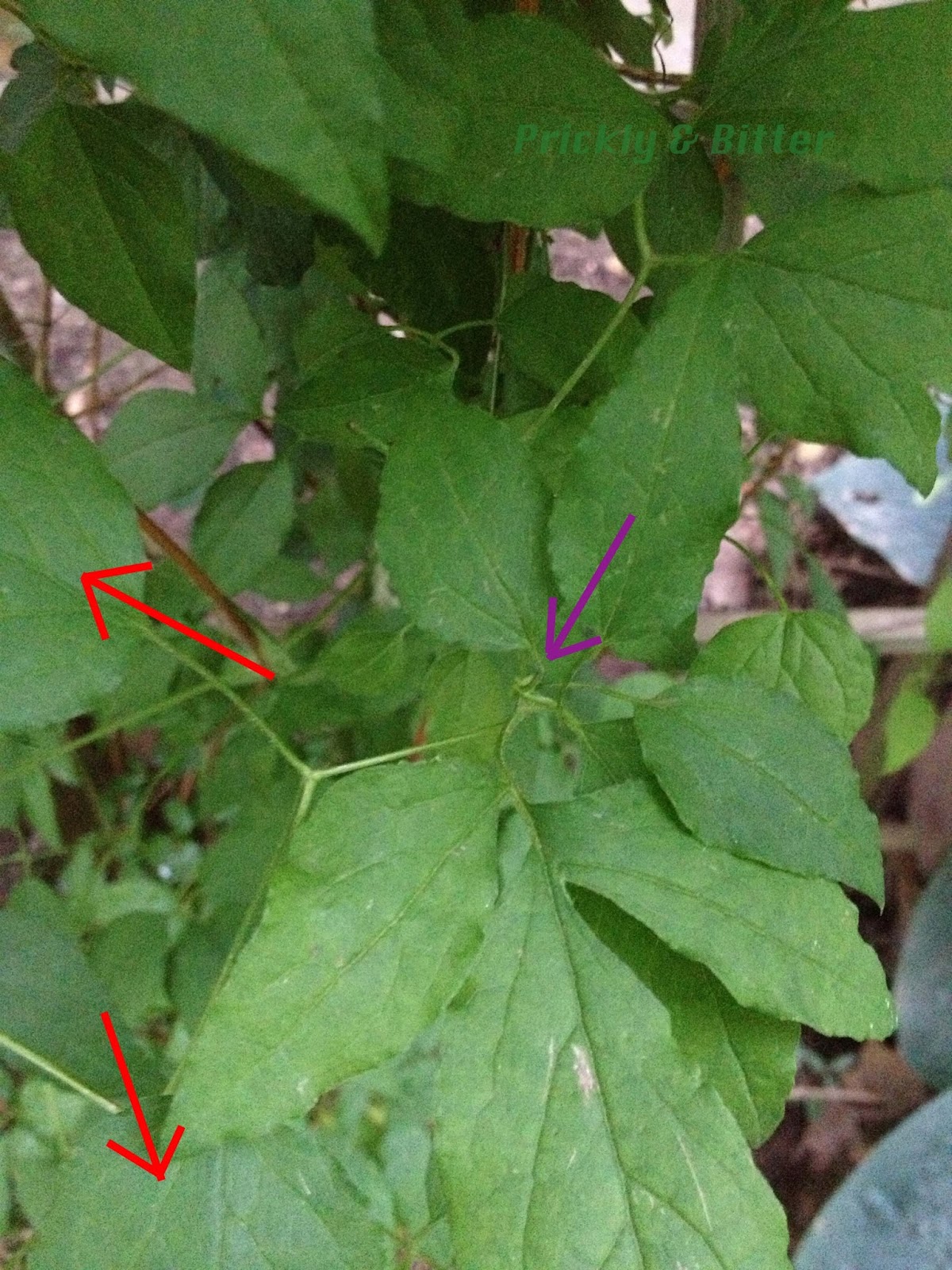
The second image shows the twice-compound leaves, which branch twice into three. The leaves are produced oppositely on the stem (the purple arrow points to where the petiole, or the "leaf stalk", attaches to the stem and you can see that there's another leaf growing off the stem in the same place in the opposite direction), and each petiole divides into three at a single point (you can see the path the petiole takes in yellow). From there, the petiole divides into three again, and at the end of this division there are three leaflets (red arrows). Sometimes leaves can do some strange things and not obey the rules. Instead of producing a leaflet at the end of the petiole, sometimes the leaf turns into a modified structure for climbing: a tendril.

In general, there's a lot of misconceptions about "specialized" plant organs used to attach plants to houses or climb up support structures. Peas are well-known for their tendril producing abilities, and clematis vines should be, too. Clematis vines produce very little growth from their old stems; they much prefer just to send up new shoots from their rhizomes just under the surface of the soil. If you consider just how much this plant has grown in a single growing season, obviously the height of the vine would produce too much weight for the plant to handle on a skinny non-woody stem. To help hold it upright, tendrils are produced to wrap around support structures. These tendrils originate from the leaf, and if you cut straight through a tendril and make a very thin cross-section and look at it under the microscope you'd notice that a tendril has the structure of a rolled-up leaflet. Pretty neat! These tendrils have another secret ability: they respond to touch. Have you ever wondered why a tendril coils? It's not because one side is produced "smaller" than the other and so it spirals to compensate for the lack of space. It's actually the plant that senses a suitable object is touching the tendril and has been for long enough to provide support, and the tendril will start bending towards that object as it grows. If you're REALLY patient (and I mean you would give a saint a bad name with your level of patience) and have a lot of time on your hands, take a tendril that's grasping at something to curl against, and hold your finger against it for maybe 30-60 minutes. Try to move as little as possible, but a little movement is OK. After your hour is up, you can walk away and return to your clematis the next day. What happened to the tendril? I bet it will have super-coiled around itself and made a mass of curly tendrily mess. There was a signal that the plant received when your finger was against the tendril that said "SUPPORT!!! COIL QUICKLY!!!" and it responded--just too late to be useful. You've now manipulated a plant into reacting to your touch. Pretty cool! See, manipulating plants for your own amusement can be fun...

The flowers of this plant are also incredibly unusual. There are flowers that produce four petals, five petals, or six petals (the majority seem to produce five). If you think that all of the flowers just had six petals and some lost a few before I took pictures of them, I also managed to find one of each version that was just getting ready to open, so I can definitely exclude that as an explanation. Why does this happen? As far as I know there's no explanation. None. Completely stumped. Our clematis grows in the shade, so I thought perhaps it was just confused and suffering from a lack of sun (these plants definitely prefer full sun or at minimum partial sun to be most happy) but I just looked up pictures of the plant on Google Images and there are people growing theirs in full sun and noting the same phenomenon. Find an explanation for why this happens? Let me know! I've always been interested in learning about why this happens.

Other than their obvious ornamental value, some clematis species (there are over 300 of them) have been used in North America as medicinal plants for centuries. It was used to treat nervous diseases and migraine headaches, but don't get excited about the medicinal properties of the plant in your back yard. Most clematis species are highly toxic, and the sap that's exuded from cut stems is highly allergenic, is phototoxic (meaning it will cause extreme rash and burning when the sap on your skin is exposed to intense sunlight), and can cause internal bleeding if ingested. This plant is best used as an ornamental species and not a backyard medicine. It's also probably best to use gloves when pruning this plant; some people are more sensitive to the toxins in the sap than others, but always better to be safe than sorry. The phototoxic effect can last for years, despite washing the sap off your skin.

Thursday, July 11, 2013

The tree with the yellow wood


Species name: Cladrastis kentuckea

Common name: American yellowood

Location: Western U Campus, London, Ontario

First of all, I've decided after doing a whole series of blogs about Sandra's garden that I'm going to start being more specific with where I took pictures of the plants I'm featuring in my blog. Featuring GPS coordinates would be silly (especially of rare plants, plus you would all also know where I live since I feature plants in my back yard a lot) and impractical since I don't own a proper GPS unit, but "Ontario" is a bit too vague. So this is the first blog to feature a more detailed location description. Blog evolution!

The yellowwood tree is a spectacular tree to have growing in your garden: it grows quickly but not very tall (the tallest yellowwood in the world is only 27 m tall), has a broad reach with its branches to provide a large patch of shade, and has incredibly attractive flowers during the spring. Unfortunately, it has a few downsides, too. The tree trunk tends to branch repeatedly close to the ground to get a "multi-trunk" type of tree so sometimes pruning is required to get enough space under it to park a lounge chair. Also, when the flowers start to drop it literally looks like it has snowed under the tree. This isn't necessarily a bad thing; it's a lot of organic material going back into the soil to support the soil microbes living in symbioses with the tree's roots. A lot of gardeners think it makes their lawn look messy, and so this tree is sometimes avoided. This is a shame since the seed pods, once they start to develop, are a great oily food source for animals during the fall and into the winter. Since these seeds are a preferred food source, very few of them make it into the ground to produce seedlings. Good if you don't want your lawn to look like a yellowwood nursery, bad if you're a yellowwood tree trying to reproduce. This same phenomenon can't be noted throughout the tree's range, nor is that seen further south; it actually has the potential to become an invasive weedy tree further south than its native range so be careful where you plant one. It is native to the United States as the name suggests, to a relatively small area bordered by North Carolina, Oklahoma, Missouri, Indiana and Alabama. Due to habitat loss it is becoming increasingly more rare throughout its native range, so if you live in that area and have the opportunity to plant a yellowwood, do it!

Aside from their obvious aesthetic value due to their flowers, yellowwood trees have traditionally been very valuable species in the woodworking industry. Because of the multi-trunking phenomenon they can't be used to produce many 2x4s, but they have been highly prized amongst furniture makers for their yellow heartwood to use for inlays and sometimes veneers. Wood turners have also valued yellowwood for its ease of carving yet very dense wood. Some of the most famous guns in American history also have their gunstocks made from yellowwood, although many other species of tree were favoured for this purpose.