



Species name: Clematis x jacksonii
Common name: clematis, traveller's joy
Location: My house (London, Ontario)
Clematis plants are some of the most interesting plants to me because of their quirkiness and eccentricities. They don't follow the "aesthetic rules" that most flowering plants do, and that's definitely one of the things that makes them so cool. This species, a hybrid between two Asian species then hybridized again with a common garden species popular in the late 1700s in gardens in Europe (the history of this garden hybrid is unknown, but likely from Asian ancestors, too). Due to the fact that this plant is a hybrid it technically carries no weight according to the IUCN Red List of endangered and threatened species, but I can vouch for the fact that this plant is not likely to spread, nor is it likely to reproduce and escape from the garden. We moved into our house in March of 2006, and I've never witnessed this plant producing seeds (which are actually quite spectacular; they're like dandelions with a bad hair day). Not good if you're the plant, but great if you're the gardener that doesn't want to clean up after the plant!
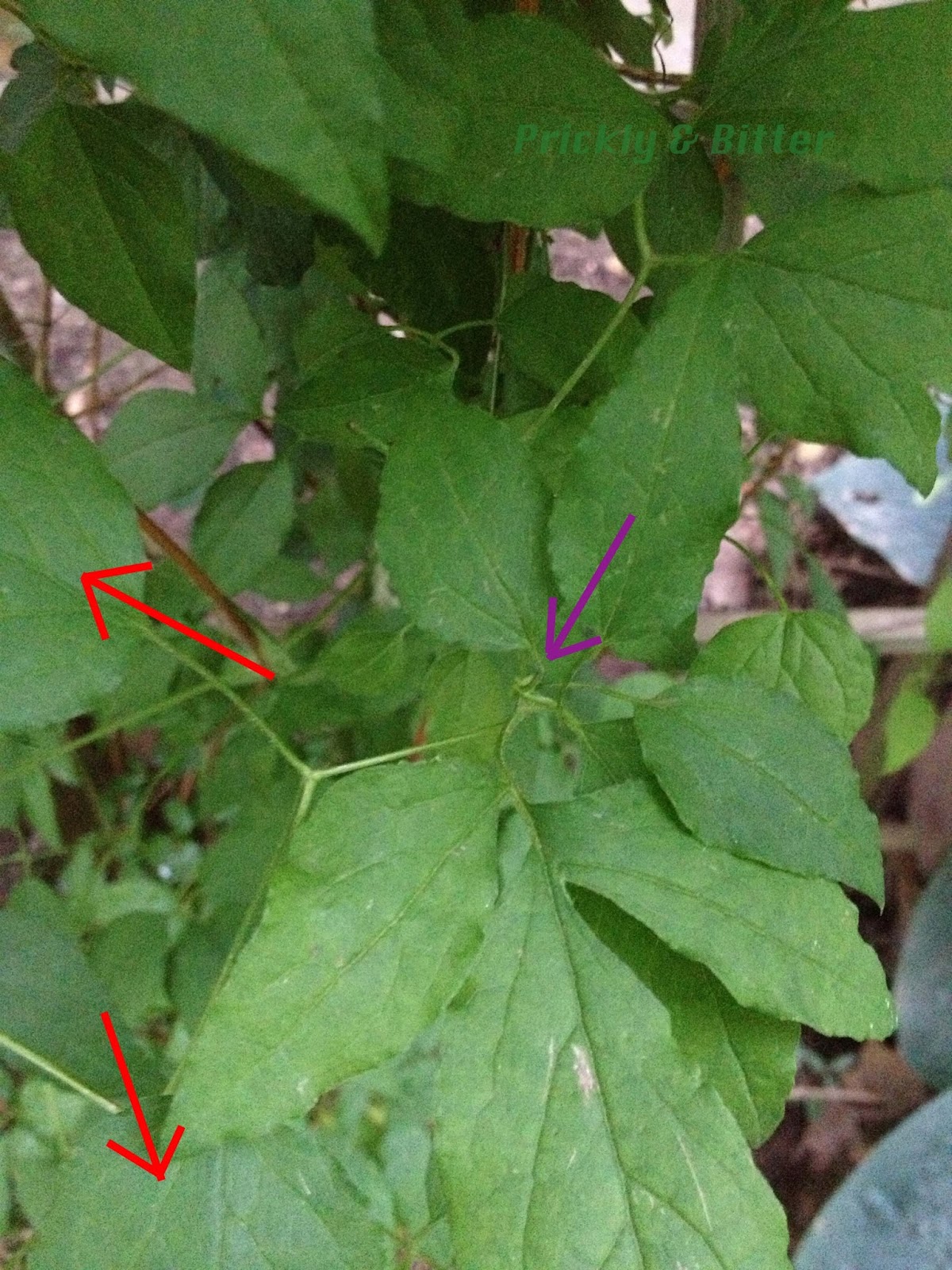
The second image shows the twice-compound leaves, which branch twice into three. The leaves are produced oppositely on the stem (the purple arrow points to where the petiole, or the "leaf stalk", attaches to the stem and you can see that there's another leaf growing off the stem in the same place in the opposite direction), and each petiole divides into three at a single point (you can see the path the petiole takes in yellow). From there, the petiole divides into three again, and at the end of this division there are three leaflets (red arrows). Sometimes leaves can do some strange things and not obey the rules. Instead of producing a leaflet at the end of the petiole, sometimes the leaf turns into a modified structure for climbing: a tendril.
In general, there's a lot of misconceptions about "specialized" plant organs used to attach plants to houses or climb up support structures. Peas are well-known for their tendril producing abilities, and clematis vines should be, too. Clematis vines produce very little growth from their old stems; they much prefer just to send up new shoots from their rhizomes just under the surface of the soil. If you consider just how much this plant has grown in a single growing season, obviously the height of the vine would produce too much weight for the plant to handle on a skinny non-woody stem. To help hold it upright, tendrils are produced to wrap around support structures. These tendrils originate from the leaf, and if you cut straight through a tendril and make a very thin cross-section and look at it under the microscope you'd notice that a tendril has the structure of a rolled-up leaflet. Pretty neat! These tendrils have another secret ability: they respond to touch. Have you ever wondered why a tendril coils? It's not because one side is produced "smaller" than the other and so it spirals to compensate for the lack of space. It's actually the plant that senses a suitable object is touching the tendril and has been for long enough to provide support, and the tendril will start bending towards that object as it grows. If you're REALLY patient (and I mean you would give a saint a bad name with your level of patience) and have a lot of time on your hands, take a tendril that's grasping at something to curl against, and hold your finger against it for maybe 30-60 minutes. Try to move as little as possible, but a little movement is OK. After your hour is up, you can walk away and return to your clematis the next day. What happened to the tendril? I bet it will have super-coiled around itself and made a mass of curly tendrily mess. There was a signal that the plant received when your finger was against the tendril that said "SUPPORT!!! COIL QUICKLY!!!" and it responded--just too late to be useful. You've now manipulated a plant into reacting to your touch. Pretty cool! See, manipulating plants for your own amusement can be fun...
The flowers of this plant are also incredibly unusual. There are flowers that produce four petals, five petals, or six petals (the majority seem to produce five). If you think that all of the flowers just had six petals and some lost a few before I took pictures of them, I also managed to find one of each version that was just getting ready to open, so I can definitely exclude that as an explanation. Why does this happen? As far as I know there's no explanation. None. Completely stumped. Our clematis grows in the shade, so I thought perhaps it was just confused and suffering from a lack of sun (these plants definitely prefer full sun or at minimum partial sun to be most happy) but I just looked up pictures of the plant on Google Images and there are people growing theirs in full sun and noting the same phenomenon. Find an explanation for why this happens? Let me know! I've always been interested in learning about why this happens.
Other than their obvious ornamental value, some clematis species (there are over 300 of them) have been used in North America as medicinal plants for centuries. It was used to treat nervous diseases and migraine headaches, but don't get excited about the medicinal properties of the plant in your back yard. Most clematis species are highly toxic, and the sap that's exuded from cut stems is highly allergenic, is phototoxic (meaning it will cause extreme rash and burning when the sap on your skin is exposed to intense sunlight), and can cause internal bleeding if ingested. This plant is best used as an ornamental species and not a backyard medicine. It's also probably best to use gloves when pruning this plant; some people are more sensitive to the toxins in the sap than others, but always better to be safe than sorry. The phototoxic effect can last for years, despite washing the sap off your skin.


