Sunday, August 12, 2012
The shrubby cinquefoil that's not a cinquefoil
Species name: Dasiphora fruticosa (formerly Potentilla fruticosa)
Common name: Shrubby cinquefoil
Location: Ontario
This plant is native to the Northern Hemisphere, but not to this area of Canada. The plant likely originated in northern Europe and Asia, and was introduced very early to North America. It has no potential to become invasive, and I would argue it has been incorporated in almost every way into our native flora of Ontario. It prefers growing in cool climates in subarctic or mountainous areas, and can tolerate dry conditions and saline soils. There has been a relatively intense effort to create new cultivars of this plant due to its attractiveness as an ornamental plant since it requires such little effort for upkeep. It is also very popular in Japan as a bonsai plant.
This plant is a great example of how DNA sequencing can show a different picture than what morphology tells us. The true cinquefoils, in the genus Potentilla, have compound leaves like this plant does but they have teeth along the edges while these leaflets are smooth. As far as morphology goes, that's probably not a significant enough difference to warrant putting a plant in its own genus, and so it was classified with the rest of the small, shrubby plants with yellow flowers and 5 petals that look a bit like buttercups (but you should now know why they're in the rose family!), and compound leaves with 5 to 7 leaflets. So far, DNA sequencing tells us that this is the only member of its genus, but that's probably only due to low sequencing effort; meaning that if more plants in the genus Potentilla and more plants in general that look like this one were sequenced, we would find that more species belong in this genus.
One negative aspect of this plant is that it acts as a prime food source and habitat for those pesky beetles that seem to become more and more numerous every summer in North America. Where there are more palatable food sources (like butterfly bushes, which are also numerous in North America) the bugs will prefer to eat those first, and just use the cinquefoil as a nighttime habitat. If you're into catching bugs by hand as a means of insect control instead of spraying, the hours right before sunset would be a good time to go out with an old pop bottle with a bit of vodka at the bottom to pick all of these guys off. The vodka ensures that they stay dead even when oxygen deprived (which these insects can actually tolerate for extended periods, which makes their control just that much more difficult).
Friday, August 10, 2012
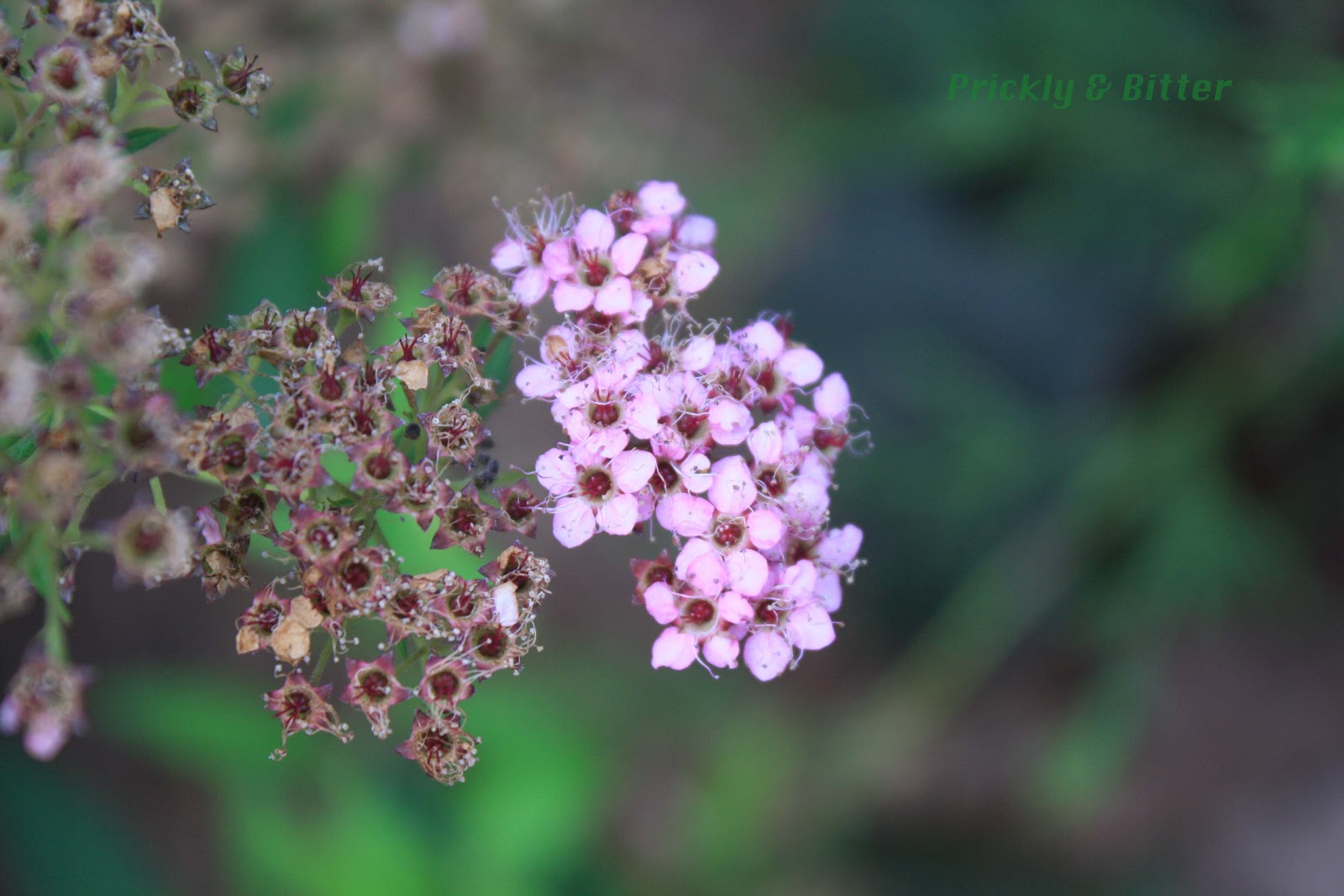
Spiraea: one of the top potential invasive species
Species name: Spiraea japonica
Common name: Japanese spiraea
Location: Ontario
This species or ornamental plant is native to Japan (as the name suggests; but also China and Korea) but has been naturalized in North America and parts of Europe. This plant is normally kept under control in gardens, but has the potential to become invasive if left unchecked. It prefers riparian or boggy habitats, so the first place you'll notice this plant popping up if becoming invasive in an area is along roadside ditches. It's unfortunate that this is yet another species of potentially invasive plants that prefers moist habitats since our bogs, swamps and marshlands are already under such large threats by invasives already.
Since I profiled how to identify a plant as being a member of the mint family, Spiraea is a good example of how to identify a plant in the rose family. Members of the rose family have typical 5-petaled flowers, and the petals are roundish at the edges and narrow towards the interior of the flower to make a star-shape in the middle when the flower is fully open. The female parts of the flowers are very difficult to see, but the male parts are numerous (more often than not, more than 12 stamens). Spiraea in general is not a good example of this, but the leaves of the rose family also more often than not have something called a stipule at the bottom, which is like a "mini leaf" at the base of the leaf's petiole where it attaches to the stem. There are other families of plants that have stipules, but only this family has the characteristic 5-petaled flower (usually pink or white, but not always) with many male parts and stipules.
The arrow in red points to the stipule at the base of the petiole of a compound leaf in the rose family (from Wikipedia)
The roots of Spiraea plants have been used for hundreds of years in Traditional Chinese Medicine as an anti-inflammatory tea. Recently, a couple of researchers from China looked at whether or not root extract from Spiraea has biologically active chemicals, and they found five new alkaloids in the roots that do show anti-inflammatory effects in mice. The kinds of effects this could have on humans and the diseases it could be useful to help treat are numerous and scientific investigations are ongoing.
Thursday, August 9, 2012
The Scottish bluebell, but not the British or American bluebell
Species name: Campanula x hybrida
Common name: Bellflower, bluebell (although not truly a bluebell at all!)
Location: Ontario
You'll notice this plant has no species status diagram! Since I have no idea what species went into making this hybrid (I have some guesses, but I'm not positive on any of them), I can't say for sure where in the world the genetic base of this hybrid is from, so I'm not going to tarnish its reputation. Many ornamental species of bellflower are from North America, and many of them are from Europe and western Asia. A few are even from temperate Africa. There are a couple species in the genus Campanula that are invasives in North America (some declared invasive more recently than others), while others are critically endangered. I'm sure that a more thorough genetic exploration of this group will reveal that it's actually not one genus at all but many, since the morphological variation in the group is quite drastic. If you're really observant, you'll notice that the bellflowers and the moss phlox are competing for space in this particular location in the garden!
One of the most impressive features of this plant is the morphological variation that occurs on the same plant. While this is not unique by any means in the plant world, this is one of the most common garden plants that displays drastic morphological variation of plant features all on the same individual. The leaves at the base of the stem, sometimes arranged in a basal rosette but more often extending vertically up the stem are broad, sometimes heart shaped and sometimes arrow-head shaped, with a wavy margin (but sometimes smooth). As you get further up the stem, the leaves become more grass-like: long and very, very thin. Once the individual plant is in flower, the large leaves at the base of the plant wither and die, leaving only the small needle-like leaves along the stem. I'm not entirely sure why a plant would do this; it seems counterintuitive since the largest leaves at the bottom would be best able to make fuel for seed production.
While working on an identification for this plant, I stumbled on a fascinating website of flower photography. A man named Brian Johnston has taken a series of photos of many different species of plants in flower, and documented their flowering cycle from the first appearance of a flower bud all the way through to seed set. If you're interested in browsing through the photos, please click HERE and then click on "Flowers" at the top of the page in the grey toolbar (2 links to the right of the yellow "Share" link) and then choose your flower. The photos are absolutely stunning!
Wednesday, August 8, 2012
Let's play a game: ID this plant!
UPDATE: The general consensus reached for the ID of this plant is Thymus pulegioides. This ID still doesn't feel right to me, but since I'm not a plant expert and the two that both came up with this ID are, I'm going to defer on their expertise and say that's what it is. At least, something close. The common name of this plant is broad-leaved thyme and sometimes lemon thyme (although, that common name is applied to just about any plant that looks like thyme that smells even remotely lemony, which is 5 or 6 different species). Thanks for playing, everyone! And thanks for Sophie and Matthew for the help via Twitter.
Species name: Lamiaceae sp.
Common name: plant in the mint family
Location: Ontario
I've been toying with the identification of this plant for a few days now, and I just can't seem to get it right. So instead of me identifying it, I'm opening the floor. Know what this plant is? Drop me a line in the comments section!
Instead of talking all about one particular species, I figured I'd talk about at least what I know for sure to be true: this plant is most definitely in the mint family, or the Lamiaceae. There are two major distinguishing features for this family. The first are the flowers: the petals are fused at the base into a tube-like structure, and at the end are modified into a large top petal and an even larger bottom petal. Sometimes, as in this example, the bottom petal retains morphological characters that would lead you to believe it came from the fusion of three petals (which it did) in the form of lobes on the petal edge. The second major feature that leads me to the general identification of this being a plant that's a member of the Lamiaceae is pointed out by the arrow in the bottom photo, the square stem. If a plant is in the mint family, it has a square stem. For some species, you have to use your imagination a bit more than others for how this rough round shape is actually a square, but more often than not the stem is a clear square shape in cross-section.
The leaves of this plant are smooth on both the top and bottom surface, and the leaves are incredibly small and lack teeth, all unusual characters for the mint family. One of the reasons why members of this plant family are so aromatic when the leaves are crushed is because of the tiny hairs on either the upper or lower surface of the leaves (or sometimes both) called trichomes that have a tiny oil droplet at the tip. This oil droplet is meant to deter herbivores, since in large amounts they taste downright nasty, and in fact most are carcinogenic. You don't have to worry about getting cancer from basil or oregano, though! Since humans are so large, you would literally have to eat a pound of basil a day for the chemicals in the essential oils to have any negative effect. The very reason why we started to use herbs and spices in food is to exploit these essential oils, which even in small amounts have very potent antimicrobial effects, and to kill food-borne bacteria before consuming food prior to refrigeration.
Friday, August 3, 2012
Stone-cold stonecrops
Species name: Hylotelephium cauticola
Common name: showy stonecrop
Location: Ontario
Let me start off by saying that this was a pain in the tush to identify, having really nothing to go on. Sure, it looks a bit like a jade plant (in a related genus, Sedum), and sure, it looks a bit like hens and chickens (in related genera, Sempervium and Jovibarba) but it doesn't really fit any species in any genus that I looked at. An hour and a half later, I decided to look on the Dave's Garden website at all of the different cultivars in these genera and lo-and-behold! What amazing things human beings can do to plants once we start selectively breeding! This plant in its "natural" state is actually quite large, not the puny little plant that is dwarfed by the downspout in our garden. The flowers are also naturally a much lighter colour pink, almost white. This species of stonecrop (the common name "showy stonecrop" is actually quite misleading since it is applied routinely to about 5 different species in different genera) is native to Japan, with various cultivars being created and naturalized to North America. This plant does very well in dry, rocky conditions where most other plants would not grow, and is especially popular (with many of its relatives) as plants for rock gardens. It reproduces very easily from stem and leaf cuttings, including accidental breakage. There have been reports of pieces of this plant and related species taking root in a new spot in a garden after having being whipper-snippered off the original plant and having laid in the sun drying out for weeks.
Hylotelephium and the genus it used to be classified in, Sedum (DNA evidence suggests these are separate groups despite being incredibly similar visually), are both considered (along with many other plants) succulents. A succulent plant is a plant that has very fleshy leaves that are used to store water. If you have a jade plant at home, you'll probably have noticed that a day or two after watering the leaves look very plump and a bright green, and as time goes on the leaves get thinner and a much darker green (eventually becoming brown if you leave it long enough without water). This is the plant storing water in the leaf tissues, and gradually using that water for growth and basic baseline energy production as the earth dries. For this reason, it's actually detrimental to the plant if they're watered too often, and will very easily succumb to "drowning".
Other than the obvious ornamental value, this plant has no other medicinal or economic value.
Thursday, August 2, 2012
The kidney stone hydrangea
Species name: Hydrangea arborescens
Common name: Smooth hydrangea, wild hydrangea
Location: Ontario
This species of hydrangea is native to eastern North America, but just slightly further south from where I am. The native range stretches from New York to Florida, but the plant was spread many, many generations ago by early settlers to North America because of its showy flowers in the late spring and early summer. The flowers, for the most part, are sterile; only a few in a bunch have stamens and stigmas. This seems to be a trade-off of showy flower production: the more flowers the plant produces that are able to be fertilized, the more the plant has to invest in resources for seed production. Here's the part where it's a trade-off; more resources into seed production means less resources into growth and general maintenance. That being said, almost all of the flowers that are sexual flowers do produce seed, so this plant is incredibly effective at reproducing that way. My over-the-back-fence neighbour has this plant growing in their back yard, so I couldn't get as close to the flowers as I wanted to show the difference between fertile and sterile flowers.
Historically this plant was used medicinally, but today this use has all but been forgotten except in historical texts. Ancient Native North Americans used this plant to treat problems with the kidneys and bladder, most likely kidney or bladder stones. They then taught this practice to early settlers of North America, who likely brought the practice back to Europe. How exactly this plant helped kidney or bladder stones to my knowledge is unknown; it could merely be the placebo effect where drinking a warm liquid seems to ease the intense pain of trying to pass a stone. Perhaps there is actually some molecule in the plant extract that helps break down stones; to my knowledge no one has truly done a clinical trial to observe the effects of hydrangea extract, nor has anyone done a full chemical analysis to determine what exactly it is in the extract that might be useful to the body. There was one medical doctor in the 1850s that noted anecdotally that up to 120 calculi (very, very small deposits on the inside of the kidney or bladder that can build and dislodge to become kidney/bladder stones) were passed by a single person taking hydrangea root honey, but you have to wonder considering the technology of 1850!
Wednesday, August 1, 2012
Are you telling me that dog vomit is alive?!
Species name: Fuligo septica
Common name: dog vomit slime mold
Location: Ontario
You might be wondering why I'm including pictures of dog vomit on some wood chips and trying to pass it off as a living organism, and you'd be partially correct. The common name of this organism is the "dog vomit" slime mold because of its obvious disgusting appearance, but that's where the similarities end. Slime molds are neither fungus nor plant nor animal; they're fungus-like organisms, which is why I'm including it in my blog (most mycology texts include a chapter about fungus-like organisms, since many of them cause devastating plant and animal diseases). There are a few phases of the life cycle that are missing since I didn't manage to catch them with my camera. Maybe I'll update the photos if it fruits again.
A slime mold has a few characteristic life stages that distinguish it as part animal, part fungus. First, the "vegetative" or feeding part of the life cycle of a slime mold is an amoebiod stage. Anyone old enough to remember the Barbapops knows what an amoeba is! It's a single-celled animal that obtains nutrition by engulfing particles of what can be considered "food" that it comes across in its environment. These amoeba can also take on any shape since they don't have a cell wall, and so they can fit between small spaces quite easily. Once these amoebiod cells "find" each other, they can gel together into a mass called a plasmodium, and then instead of acting like individual cells they act as one individual organism. Once resources start to deplete in an area, the plasmodium (in the case of this species, that's the stage that's missing; it's bright yellow) turns into a structure called an aethalium. In the case of this species, the aethalium is spongy and a cream colour, as depicted in the top two pictures. This is structure is equivalent to the mushroom that forms in true fungi; the aethalium will eventually produce structures called sporangia that produce spores for the slime mold to blow away in the wind to a new environment with more food. The sporangial stage is depicted in the third photo; in the case of this species the sporangia are a dark purple-brown. The spores germinate into new amoeba and the cycle continues.
In general, slime molds pale in comparison as wood decayers with fungi. Fungi are just so much more efficient that if a slime mold doesn't come along first then the nutrients it can use to sustain life are already gone. For this reason, we call them primary colonizers. So what use does this species have? Well, ecologically not much in the grand scheme of things. Most gardeners who have seen this before find it one of the ugliest living things that could appear in their garden, and immediately ask how to get rid of it. Well, it would be a challenge. It would involve getting rid of all of the woodchips, mulch, grass, plants that are starting to decay, etc. It would involve a massive overhaul of your garden, and would be much more trouble than it's worth. So what should you do instead? How about just enjoy it while it lasts? Slime molds are fleeting organisms that are gorgeous under the microscope, and are absolutely fascinating to watch them go through their life cycle. Beauty is all about perspective! And it's not hurting anything, so might as well let it do what it does.
Tuesday, July 31, 2012
Do Lamb's ears hold the key to multi-drug resistance?
Species name: Stachys byzantina
Common name: Lamb's ears
Location: Ontario
This plant is one of the few that we use as ornamental plants in northern North America that is native to the area around Armenia, Turkey and Iran. The climate there is so different from what it is here that most plants native to that area would never survive the winter. This is one of the exceptions; if the above-ground portions of the plant cannot survive the winter, the roots can regenerate shoots and regrow the next growing season. This does mean that as our climate warms, the range of this plant will expand much further north, and becoming much more likely to be invasive to certain areas.
The medicinal potential of this plant is huge, especially considering where infections are headed lately. It seems like there isn't a month that goes by that a major hospital in Canada or the United States (or in any other country, for that matter) doesn't have an outbreak of a drug-resistant bacterial species. This is becoming more and more dangerous, since more species are becoming multi-drug resistant. One such species of bacteria that has been in the news recently is drug-resistant Staphylococcus aureus. Historically, drug-resistant Staph infections could be treated with very strong antibiotics but now even those are no longer effective. For this reason, more drugs that are effective against this bacterial species need to be discovered, and it also needs to be an ongoing process (since bacteria can produce a new generation so quickly, drug resistance also evolves incredibly quickly). Lamb's ears extract contain a number of chemicals that, when in synergy, demonstrate the ability to kill multi-drug resistant Staphylococcus aureus. It's still in the early stages of drug development, but probably over my lifetime the drug will be released for select use only for multi-drug resistant Staph.
Monday, July 30, 2012
Black-eyed Susans rarely actually take a beating
Species name: Rudbeckia hirta
Common name: black-eyed Susan, yellow ox-eyed daisy
Location: Ontario
Black-eyed Susans are spectacular flowering plants native to southeastern Canada all the way south to Florida and Texas in the United States. There are four sub-species designating populations of plants in various locations, since the species range has become non-continuous due to land use change. It's an incredibly successful competitor and thrives in disturbed areas, so is often the first plant to colonize a recently abandoned field. Despite being able to out-compete almost all early successional field species, it does poorly in shade and so once shrubs and trees start to colonize the area it will quickly die out (or only remain in small patches). Anyone who has ever planted this plant in their garden knows about its ability to quickly colonize an area; keeping a patch of Black-eyed Susans under control feels like a losing battle (partially because, by definition, backyard gardens are disturbed areas which means this plant does exceptionally well).
Medicinally, this plant was used in almost the same way as the purple coneflower, Echinacea. The Ojibwa people used a paste-like liquid made from ground roots mixed with water as a treatment for snake bites, and made a tea-like infusion from the leaves and roots as a treatment for worms in children. The Menominee and Potawatomi people used the natural diuretic properties of this plant to flush toxins from the body. Because this diuretic effect is real, caution should be used when using this plant as an herbal medicine; over-use can result in severe dehydration which requires hospitalization. If this is not caught in time, permanent kidney damage or even death can occur.
Sunday, July 29, 2012
Ribbon grass is an invasive native plant
Species name: Phalaris arundinacea
Common name: reed canarygrass, ribbon grass
Location: Ontario
This is one example of a plant where, in hind sight, I wish I had made a species status diagram that included "invasive" as a category with "native". This species of grass, native so Ontario and the surrounding area, is incredibly invasive and downright impossible to eradicate once established (at least, without the use of harsh chemicals). It produces chemicals in the roots that prevent competitors from establishing in the same area, while at the same time being incredibly successful at reproducing both sexually by seed and asexually by thick underground rhizomes. Anyone who has ever tried pulling this plant out of the ground knows about the thick rhizomes! The natural form of this plant is solid green, but horticulturalists have bred this plant to be variegated, which has allowed this plant to become an attractive garden plant, especially for moist garden areas. Despite thriving in boggy areas it is also incredibly drought-tolerant once established, and has also been suggested as a good phytoremediator since it can sequester contaminants from the soil.
The reed canarygrass has also been suggested as a possible candidate for burning as biofuel, since it is so fast-growing. It has recently been used in trials of contaminated soil rehabilitation mimicking the Chernobyl or Fukushima nuclear disasters, to experiment with different plants that can be used to clear contaminants out of the soil. This plant, along with the common sunflower and a few other garden plants, have actually shown great promise. One of the neat things about plants is that they can be genetically manipulated to store radioactive waste in specific parts of its plant body while not in others. This means that, theoretically, you could get a sunflower plant to store radioactivity in its leaves that you could harvest and dispose of safely, while you could also harvest the seeds to be used for food, grain, or for oil production. Since the radioactive waste wouldn't ever make it to the seed, the seed would be perfectly safe for human consumption. I'm not sure how many of us would knowingly eat "Fukushima sunflower seeds" at a baseball game, but it's a neat idea. Still many, many years away from being a viable ecological treatment since so much safety testing must be done. By the time it was approved, I'm sure there would be other ways of remediating the soil that would be favoured instead.
This plant contains incredibly high concentrations of the chemical gramine, which causes brain damage and death in sheep who consume it. This effect isn't always translated to humans, but still probably a good idea to make sure this plant is always out of reach of children and beloved pets. Levels of hordenine have also been reported (a chemical present in high concentrations in germinating barley seeds, but denatured at the high temperatures used in malt production, for those of you who make beer in a home-brew), which act as a central nervous system stimulant by increasing heart rate and blood pressure. This effect is most strongly noted in horses, and the effect appears to subside after 30 minutes (although, it's hard to ask a horse how they're feeling and understand the resulting "speech"). Again, probably a good reason to keep this plant away from small children and pets.
Saturday, July 28, 2012
Is the population of pickerelweed in a pickle?
Species name: Pontederia cordata
Common name: pickerelweed
Location: Ontario
This species of aquatic plant is native from southeastern Canada (Ontario, Quebec, New Brunswick, Nova Scotia) all the way south to southern Argentina in South America. There have been arguments by plant taxonomists in the past about whether the South American populations should be considered the same species as the North American populations, and so many Latin synonyms have been given to this plant in the past. DNA sequencing has shown that this plant is the same species throughout its entire range, but with small divergent sub-populations. These sub-populations may one day become their own species with enough time to genetically diverge from the parent population, but this has not occurred yet (since all sub-populations can still breed with their parent population). Due to land use change throughout much of the native North/South American range of this species, the chances of these sub-populations having enough time to genetically diverge from the parent population to produce distinct species is pretty slim. In fact, back yard garden ponds are some of the richest sources of this plant, with it escaping back into boggy and swampy areas if left unattended (it is a very vigorous seed producer!). Again unfortunately, it is not a very good competitor with invasive species (which we have many, many invasive species in North American wetlands) so it rarely establishes a new population for long.
Since this species of plant can grow submerged in water like rice can, it, like rice, requires some sort of mechanism in its tissues to be able to transport gas from where it is absorbed in the leaves to where it is needed for growth in the roots. To do this, the plant forms a special type of tissue called "aerenchyma," which looks a bit like empty honeycomb. The large, empty cells are used to store oxygen and carbon dioxide so the plant doesn't suffocate under water. A neat adaptation! The flowers also have a special adaptation to attract bees that you can see in the third picture, that yellow dot on the top petal. Once the flowers are pollinated by bees, the plant undergoes a process called "geotaxis," which refers to the entire inflorescence stalk bending to submerge the developing seeds under water (peanut plants also do this with their developing seeds; this is why peanut shells always have a bit of dirt left on the outside!). The seeds then finish maturing and are released into the muck at the bottom of the pond. This is also a pretty incredible adaptation; without a prolonged exposure to water, the seeds cannot germinate.
With the exception of ornamental value, there is no other major use of this plant by humans.
Friday, July 27, 2012
No matter how you pronounce it: the zebra that's a grass
Species name: Miscanthus sinensis
Common name: zebra grass
Location: Ontario
I mentioned in a previous blog post about the tufted hair-grass, Deschampsia cespitosa, that there was essentially only a couple other very easily identifiable grasses without the use of a microscope, and this is one of them! Zebra grass is a grass species native to Asia that has the potential to become incredibly invasive in North America. Thankfully, there are many modern cultivars that do not produce viable seed, so this possibility has been reduced. The plant can still reproduce asexually through the use of rhizomes, but this mostly helps to "fill out" a patch, as opposed to spreading underground to a new location. That being said, I have seen some zebra grass in roadside ditches around southwestern Ontario (with the striped foliage, it's hard to miss!), so some has still very clearly (and very successfully) escaped. With a little background knowledge about this plant before you landscape with it, the chances of zebra grass escaping and becoming an invasive species is slim. This is definitely one plant where gardener responsibility is key: if you remove the plant from your back yard make sure you dispose of it properly, and make sure you plant a hybrid cultivar.
Other than ornamental value, it currently has no other uses. It is, however, being examined as a possible candidate for bioenergy (either through fermentation of the leaves to produce ethanol or burning the plants to produce combustion energy) due to the fact that it is extremely fast-growing during the growing season. It would rival sugarcane as an energy source (sugarcane currently accounts for up to 80% of Brazil's energy production annually in some areas, up to 50% of the energy produced for large cities. The Olympics in 2016 will run exclusively on sugarcane!) for temperate areas where it thrives. It also is not as destructive on an ecosystem like corn (so an attractive alternative for corn-based ethanol) and has much higher levels of genetic variation than typical crops so you don't have to worry as much about pathogens wiping out the entire crop in a growing season.
A word of caution about this grass: while it might not seem that way at first, the edges of the grass have saw-like projections which can seriously harm human skin if grabbed the wrong way. I was weeding in the garden and found this out the hard way. If you've got this grass easily accessible to a small child, make sure you put a fence around it until the child is no longer tempted to grab at the attractive leaves. If not, you might end up being the single reason why Band-Aid is still in business!
Thursday, July 26, 2012
When is a Beebalm a Bergamot?
Species name: Monarda media
Common name: purple bergamot
Location: Ontario
This species of plant is a common garden plant (especially in areas of gardens that are planted to attract pollinators and hummingbirds) but now relatively uncommon in the wild. The USDA lists the plant as "apparently secure" since it doesn't have much data on the population status of the plant, but whenever someone goes out looking for it they find it. In order for it to be listed as "secure" the population numbers have to be reasonably estimated and shown that based on current numbers and current threats, the population is at no risk of depletion due to regeneration rate. The next step up from this is obviously "secure, invasive" which means it not only regenerates itself faster than natural death/predation, but it is also a better competitor than the plants in its surrounding area. Purple bergamot is native to Ontario, and it is often mistaken for one of two of its close relatives: Monarda didyma (beebalm) or Monarda fistulosa (wild bergamot). Beebalm is traditionally a much more vivid red when it flowers than purple bergamot (which, to me at least, isn't truly purple--more like a "slightly more purple than red" pink), and wild bergamot has pale purple flowers. That being said, the flower colour of any one of these species can vary based on environmental conditions before flowering, so an overlapping range of colour possibilities between these three species can be expected, only furthering the confusion for which species is which.
All three of these species are very important in Native American medicine, especially for the Blackfoot, Ojibwa, Winnebago and Menominee people. They recognized the strong antiseptic properties of this plant very early on in human history, and have been using it as an antibacterial salve for many, many generations. Gingivitis and toothache caused by cavities were also treated using this plant; instead of grinding the leaves and using them as a paste, the herbal medicine was consumed as a tea. In fact, when you buy mouthwash you're using this same ancient herbal remedy: the modern source of the antibacterial chemical Thymol is still beebalm. These three plants have also been used to treat flatulence, headache, nausea, vomiting, and diarrhea. What can't this plant do?! It was also used by Native North Americans and Europeans to season wild game; the flavour of the plant is almost a mixture between mint and oregano.
A word of caution: the plant has reported stimulant properties, so making sure small children don't consume this plant is probably a good idea. I haven't specifically heard of any ill-effects of animals eating the plant, but I think the scent is deterrent enough for most animals. These are one of the few plants in our garden that is not consumed when still young by the combination of rabbits, skunks, raccoons, squirrels, chipmunks and groundhogs.
Subscribe to:
Posts (Atom)