Sunday, November 11, 2012

Today We Remember


Species name: Papaver rhoeas

Common name: corn poppy, Flanders poppy

Location: picture 1 from 416-florist (click HERE), picture 2 from Wikipedia (click HERE), picture 3 from The Canadian War Museum (click HERE), picture 4 from the City of Toronto website (click HERE)

Today across much of the world is Remembrance Day, or Armistice Day, where we pause to remember the men and women who have sacrificed their lives for their country. The day was officially dedicated in 1919, and it was actually on November 7th, not November 11th. The date of remembrance was changed to reflect the signing of the Armistice by Germany at the end of World War I, which was somewhere between 5:12 and 5:20 am on November 11th 1918 (often referred to the "eleventh hour"). The war officially ended with the Treaty of Versailles on June 28th 1919.

The symbol of the poppy as the official flower of remembrance actually occurred as an "accident," as in it was not specifically chosen by anyone to represent war or remember lost soldiers. The corn poppy thrives in highly disturbed regions in Europe (where it grows like a weed), so it was one of the first plants to colonize battlegrounds. Poppies often bloom all at the same time, so entire fields will be bathed in brilliant red all at the same time. This image was made especially poignant by a Canadian physician for the army during World War I, Lieutenant Colonel John McCrae. He was present for a burial ceremony for one of his friends that died in the Second Battle of Ypres on May 2nd 1915. He wrote the poem "In Flanders Fields" from the back of an ambulance while thinking about how remarkable it was that the corn poppy was one of the first plants to grow over the graves of the dead. He thought they symbolically represented the blood shed by those soldiers fighting for freedom, and so penned one of the most famous pieces of poetry ever written. While the poppies in Flanders Field are long gone (they are not a persistent species by nature, but also that area is a pristinely maintained area commemorating the dead of World War I), they symbolically remain the flower of remembrance. John McCrae died of meningitis in Boulogne, France, on January 28th 1918. He would never return to Canada.

Today we pause to remember the men and women that have lost their lives fighting to protect their country, and to help others protect theirs. We thank them for making the ultimate sacrifice, as we know that without their actions the world would be very different form how it is today.

Lest we forget.


In Flanders fields the poppies blow
Between the crosses row on row,
That mark our place; and in the sky
The larks, still bravely singing, fly
Scarce heard amid the guns below.
We are the dead. Short days ago
We lived, felt dawn, saw sunset glow,
Loved, and were loved, and now we lie
In Flanders fields.
Take up our quarrel with the foe:
To you from failing hands, we throw
The torch; be yours to hold it high.
If ye break faith with us who die
We shall not sleep, though poppies grow
In Flanders fields.
Colorado Blue Spruce


Species name: Picea pungens var. hoopsii

Common name: Hoopsii spruce, Hoopsii Colorado Blue spruce

Location: Ontario

I had wanted to post back-to-back blogs to contrast the difference between spruces and firs, since many people when they're first starting out at plant identification (me included) have a hard time telling them apart. I didn't get a chance to post a blog yesterday and I had a different blog planned for today, so I guess I'll just have to post two blogs today :)

The Colorado spruce, as I'm sure you can guess, is native to the alpine regions of Colorado in the United States. It has been transported all around the world by humans, favoured for its blueish tint to the needles at the tips of the branches. As the branch grows and the needles age, they lose their waxy frosting that gives them the blue tint, and turn green. The Colorado spruce is very intolerant to shade, and so the needles on the inside of the tree are shed as they become too shaded by branches above them. While the Colorado spruce is a popular Christmas tree, all spruces lose their needles when the tree dries out, so they can be very messy by the time it's time to compost the tree. The needles compared to fir trees, which don't lose their needles when dry, are also much sharper and not as nice to handle, and can be quite dangerous to small children with sensitive skin and to animals (compare the photos of the needles above to the needles in my blog post about the white fir HERE). Spruces also don't smell as wonderful as fir trees do; the typical "Christmas smell" that I think of when I think of Christmas is cinnamon, apples, the smell of fir trees, and a roasting turkey. Yum!

This variety of spruce tree is actually quite misleading when it comes to the "typical" form of spruces. It actually looks absolutely nothing like a typical Colorado spruce, and actually much more like a black spruce (which you can read all about HERE). Black spruces, except when young, have this type of characteristic shape; very dense branch growth towards the top of the tree that point almost straight outwards but with very short branches, then the longer branches towards the bottom of the tree are much longer, droop downwards, and are much more sparse compared to the top of the tree. The Colorado spruce, on the other hand, should be shaped almost like a pyramid with very dense branches throughout the length of the tree, and branches pointing nearly straight outwards. The Hoopsii spruce, a variety of the Colorado spruce, was selected by humans to have that drooping, very narrow growth habit.

As for the uses of the Colorado spruce, it is rarely used in the lumber or paper and pulp industry unless it is found growing in a stand of trees intended for pulping. It grows incredibly slowly and adds very little girth with each growing season, so is not very useful for lumber. The Navajo use the bark from the Colorado spruce as a medicinal item; it is steeped like a tea with other herbs to treat various medical conditions. The Colorado spruce is also the state tree of Utah and (of course) Colorado.

Friday, November 9, 2012

The Colorado Christmas Tree


Species name: Abies concolor

Common name: white fir, Colorado fir

Location: Ontario

As you can probably imagine from the common name, this tree is native to western North America in alpine regions in and around Colorado. While this tree survives well in eastern North America as an ornamental tree, it doesn't make seeds willingly (while cones can be quite prolific, depending on the environmental conditions). In its native range, it hybridizes readily with the grand fir.

Throughout much of North America, this tree is a very popular ornamental tree due to the coloration of the needles. It's not nearly as big of a contrast from regular green trees as the blue spruce is, but it is still quite the contrast nonetheless. There are huge stands of white fir trees of all roughly the same age, which may look strange to visitors to Canada and the United States. If you drive past the stand often, you'll notice the trees never get very large before the entire stand is cut down. This might make you think they're being used for some sort of commercial or industrial purpose and you'd be correct: Christmas trees! The white fir (sometimes sold as the concolor fir) is the single most popular tree to use as a Christmas tree due to the softness of the needles, the colour of the needles, and the fact that the needles stay firmly attached to the tree even after they start drying out (this cannot be said for all fir trees, and certainly can't be said for spruce trees). It also has a great smell when the tree starts to dry out!

Other than commercial value of the white fir as Christmas trees, it has very few other commercial uses. It is sometimes used as a pulp and paper tree, but only when its growing where it isn't wanted in a stand of other trees; the lumber is very soft and very knotty. The tree also is not self-pruning like many other coniferous trees, and retains its lower branches when mature (even though they have long since lost their needles). This is of great concern for "lumber farms," and National and Provincial Park staff; the bottom branches of the tree act as a sort of fire ladder, spreading forest fires very quickly through stands of trees.

This species of conifer tree is important in forests for reasons other than just fire hazards and as the odd pulp source; they are also the host for fir mistletoe, a parasitic plant that grows off of the carbon sources produced by the host plant. It doesn't produce any of its own food, and doesn't ever produce roots that root the shrub to the ground. Instead it completely relies on the fir tree for shelter, food, protection, and water. The mistletoe likely doesn't ever weaken the tree to the point where it will kill it, but when a tree is weakened for any reason it is more likely to be invaded by insect pests or infectious fungi. Mistletoe can indirectly lead to stand-wide forest death.

Wednesday, November 7, 2012

Fountain blood grass


Species name: Pennisetum setaceum

Common name: fountain grass

Location: Ontario

This species of grass is native to Africa, where it survives very hot and very dry temperatures on a regular basis. Despite this, fountain grass can also tolerate very wet conditions, making it an ideal plant for areas where there is a prolonged dry season but also a wet season as well. It can tolerate very cold temperatures (but the leaves should be cut back to the ground level or a few inches above the ground in order to tolerate the winter), and so is a popular plant in Canada and much of the United States. The grass in its natural or wild type form is green, but many varieties and cultivars have been created with different amounts of red; the plant commonly known as "blood grass" is another variety of this species. The major downside to this plant, and the reason why I would never recommend it to be planted in Canada and especially the southern United States is that it is an invasive species when left unchecked, and can completely dominate dry grasslands if given the chance. In Canada, the plant doesn't flower well, and when it does flower (as the plants in the pictures above are doing) it doesn't produce many viable seeds. This is a completely different story than in Georgia and Florida, where it thrives and outcompetes native grass species. If you could tolerate the razor-sharp edges of the blades of the leaves, it would make a fantastic lawn grass! Mowing it constantly would ensure that no seeds are produced.

Other than the ornamental value this plant has, it has no economic value. It was once suggested as a possible biomass crop, but it only grows to 3 or 4 feet at most in a season which is significantly less than other suggested biomass crops. Since it also can be invasive (and can increase the risk of forest fires in an area because of the low, dense, dry vegetation), it has been abandoned as an economically viable biomass species in favour of efforts being concentrated with other grasses like Miscanthus (which you can read all about HERE and HERE).

Monday, November 5, 2012

Game Time: ID this plant!


Species name: Asteraceae (Callistephus chinensis? Bellis perennis? Campuloclinium macrocephalum?)

Common name: A pretty purple pom pom aster

Location: Ontario

To be honest, I have no clue what this plant is. I've managed to narrow it down to the sunflower family or the Asteraceae, but that's all I've got. I found two species that might be close to the ID of this plant, but I'm doubtful that either are the correct species name. I've got my best three guesses below; if you have a better suggestion, please leave it in the comments below! Unfortunately, I have no way of going back to get photos of other features of this plant; it seems it was planted in the late fall as a "Welcome to Campus!" symbol (the school's colours are purple and white) for Autumn Convocation and have since been ripped out.

C. chinensis is otherwise known as the China aster, and is native to (you guessed it) China. It is a popular ornamental plant in North America, but the leaves seem to be quite different than the plant that I photographed. They have more obviously toothed or lobed leaves, and they aren't as hairy and thick as the leaves on the plant I found on campus. Other than the ornamental value of this plant, it has no other uses. It also, to my knowledge, is not invasive in North America (but it might be in other locations).

B. perennis is also known as the English daisy, and the wildtype of this plant (what we call a species that has not been cultivated and is growing freely on its own accord) is very different than the cultivated varieties. The natural version of this plant (native to Europe but naturalized through much of North America) looks very much like your typical daisy, with white ray florets and yellow disc florets. There are sponaneous mutations in the wild that cause either a change in ray floret colour, a change in disc floret colour, what is referred to as "petal doubling" or the conversion of (in the case of this species) disc florets into ray florets, or all three. There are quite a few cultivars that have pink to purple ray florets and disc florets, fringed ray florets, and petal doubling. Again, the leaves don't quite seem to fit the description of the species, so I doubt this is the correct identification of the plant. If it was, this plant would be used in homeopathic medicine as a wound healer due to its astringent properties (usually a tincture is made from the rhizomes; this makes me wonder if it's the plant's action or the action of the alcohol with which it is mixed that makes the treatment effective).

C. macrocephalum, also known as the pompom weed, is the last potential plant that I think is a close fit to the photos that I took and what I remember of the plant. This species is native to South America, but has been introduced to much of the rest of the world. In South Africa, it is one of the most destructive plants that has ever been introduced there; it is an incredibly vigorous competitor and threatens to completely decimate natural grasslands by outcompeting native species. The plant has the ability to turn grasslands completely pinkish-purple during the summer months (remember that summer there is from December to March!), much like our previous problem with purple loosestrife in North America. I haven't ever seen the leaves of this plant (there don't seem to be many photos of the whole plant on the internet; just the very conspicuous flowers), so I don't know if they would be a good fit.

Sunday, November 4, 2012

The best tree for climbing


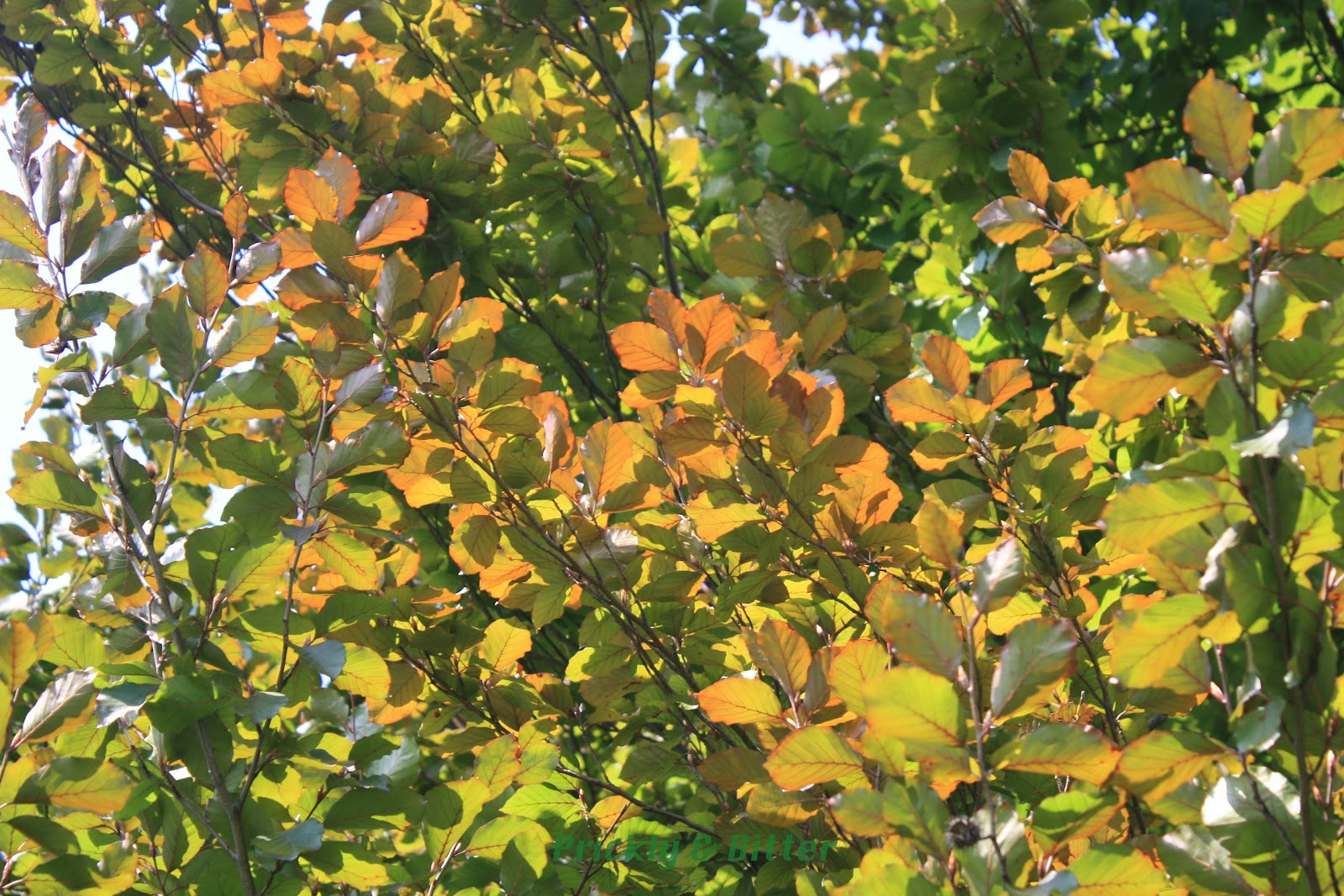
Species name: Fagus sylvatica

Common name: European beech

Location: Ontario

The European beech is an incredibly popular landscaping tree in North America, even more popular than our native American beech (which you can read all about HERE). This isn't because the European species is more hardy or a better competitor than the American species; in fact, the American beech is a better competitor for resources in North America than the European species is. The only difference is that the European species has been in cultivation for longer, and so has many more cultivars showing unique characteristics compared to the American species. There are drooping cultivars, purple cultivars, upside down cultivars, dwarf cultivars, some with twisted branches, and some cultivars with golden leaves. The cultivar pictured has been selected to be short and stout; branching occurs very densely so very large branches are very close to the ground, and the tree takes on a "globe" shape. If we put more effort into cultivating the American beech in its native range, perhaps we might have more demand for our native species.

The European beech is popular not just for its ornamental value, but also for its uses as a tree for wood. Handles for tools like mallets and old screwdrivers (when the handles were wood, not metal or plastic) were often made out of beechwood, as were tool benches. The wood is incredibly durable when kept indoors; outdoors it will rot quickly if not protected by its own bark. This was one method of using the wood for outdoor applications that would last longer than it normally would; coating beechwood with a substance extracted from the bark called "beech tar" makes it incredibly durable to the elements. When you see railway ties that are coated in a black tar, those aren't the typical hemlock railway ties. Those are made out of European beech. Still popular across Europe, but largely replaced by other types of wood in North America.

Beech fruits, the "nut," are edible. Care should be taken if you choose to partake in eating the fruits; they do contain small amounts of a toxic chemical called trimethylamine. An easy way to decrease your intake of this chemical (other than avoiding eating them) is to roast the nuts before you eat them; not only does it increase the flavour of the nut, but it also reduces the amount of triethylamine by breaking some of the chemical bonds which causes the chemical to break down.

Saturday, November 3, 2012

The mighty white oak


Species name: Quercus alba (hybridized with...?)

Common name: white oak

Location: Ontario

I took this photograph of a white oak on campus, and I doubt it's a "pure" white oak. The swamp oak (which you can read about HERE) and the white oak are not only very closely related species, but they also readily hybridize. For anyone to sell a "pure" white oak, I would like to know how they did it. Collecting acorns in the wild and growing up trees in a nursery (then repeatedly harvesting nursery acorns and replanting to grow up your stock) will almost always result in hybridized white oaks. And if the tree nursery also grows swamp white oaks, they've compounded their problem. In fact, oak pollen is so light and can travel so far on wind currents that you don't even have to know where a swamp oak or a white oak are to get them to hybridize. Like the issue with the Freeman maple (which you can read about HERE), once these two species hybridize they often get intermediate features, or a "blending phenotype." Oak pollen is actually one of the leading causes of seasonal allergies in the spring. Anyone living near an oak tree can attest to this; my dark grey car often takes on a yellow tinge because of our big red oak growing in the front yard.

The white oak, no matter its genetic background, has been used for centuries as one of the most prized woods in the world. Because of the structure of the cells in the wood, it is completely watertight when used for making furniture or other items. These same cellular structures make it rot-resistant, which is why it is so popular in the use of barrel construction; the liquid won't leak out of the barrel, and if it does start to become saturated with the liquid inside it won't rot and release the contents. Not cracking and breaking apart is probably preferred during the alcohol aging process! It's not just wine that's stored in oak barrels, but also rum and whiskey. Since some rums are aged for 20 years or more (an Appleton Estates rum to be released this year is a 75 year aged rum, all done in oak barrels), putting them in a barrel that's likely to rot or leak is probably not preferred! The watertight and rot-resistant characteristics also make oak a popular wood historically for shipbuilding and agricultural construction (both equipment and barns).

On the inside of homes, oak is a popular wood for visible finishings. Sometimes cabinets are made out of a different kind of (cheaper) wood, then the front facings are oak. Oak flooring is also incredibly popular, and often it's even stained to resemble other, more expensive woods (like cherry, walnut or mahogany). In fact, most mahogany flooring sold today in Canada is just white oak wood stained a reddish colour, since international trade treaties have been signed preventing the import of South American tropically-grown mahogany wood into Canada. Since the term "mahogany" doesn't actually apply to any one species of tree (unlike wood from black walnut, white oak, sugar maple, white pine, etc.), that eliminates many options for sourcing mahogany! While I'm sure mahogany is incredibly popular to use for fine furniture and household finishings, South American rain forests are being eliminated at an alarming rate for both the international wood trade, and conversion to the North American style of farming (higher productivity for a few years, but then a drastic decline in productivity due to the low level of nutrients in the soil). By preventing the import of these trees, we are doing our part in attempting to conserve the tropical forests in South America.

There are some notable famous white oaks across the United States. The first isn't one tree, but actually an entire grove of white oak trees. The USS Constitution is made entirely of white oak, and whenever parts of it need to be replaced they come from a grove of trees called Constitution Grove near Bloomington, Indiana. The states of Connecticut, Maryland and Illinois have all made the white oak their state trees, with one specific oak representing the honorary tree of the state. The Charter Oak in Connecticut is even featured on the back of their state quarter (which I, of course, proudly own since it features a botanical design). The honorary state tree of Maryland, the Wye Oak, was one of the oldest living trees in the United States until it was destroyed in a storm in 2002. In Illinois, they couldn't decide which tree they liked better to serve as their honorary white oak so they picked two; the first is on the front lawn of the governor's house, and the second is in a school yard. The new largest living white oak is the Linden Oak, also located in Maryland.

Friday, November 2, 2012

The Birch with the chronic bad bark days.


Species name: Betula nigra

Common name: river birch, black birch

Location: Ontario

The river birch is a species of tree native to eastern North America, but the native range doesn't quite squeak up into Canada (the northernmost point in its native range is about Ohio), but it has been naturalized here and is now quite common. The bark is incredibly distinctive; to me it looks almost like a birch with a bad bark day. The tree is called the river birch for a reason; it is often found on river banks where the soil is often flooded, but not completely submerged in water (but it can withstand seasonal flooding, as long as the water retreats and the soil dries during the summer).

When young, these trees have many lower branches and look relatively "bushy". After a few years, the trees can self-prune away the lower branches to start to look more like a tree. Because of this pruning and previous branch growth, adult tree wood is very knotty (branches are what make knots in wood). In general, knotty wood is not favoured for anything other than pulp, particleboard, or firewood since the wood grain in the knot is going at a different angle than the wood grain in the rest of the plank of wood. This means that as the wood expands and contracts (with temperature, moisture, drying after initial cutting, etc.), the wood will bend and warp due to the knots. For this reason, black birch is very rarely used as a lumber tree.

Believe it or not, maple trees are not the only trees where Native North American people used to get an edible syrup. The black birch can be tapped during the spring exactly like a sugar maple can, the resulting sap boiled to reduce the liquid, and used as "birch syrup." It has a very different flavour than maple syrup, but no less good. Sugar is sugar, after all! It's the impurities that make the taste.

Wednesday, October 31, 2012

The best boat ever made in nature


Species name: Cucurbita maxima

Common name: giant pumpkin

Location: photo 1 from Veggie Gardening Tips (click HERE), photo 2 from McShanes Nurseries (click HERE), and photos 3 to 6 from The Daily Mail (click HERE)

The giant pumpkin is actually a completely different species of squash than the regular pumpkin. When young (or more "natural" plants that have not been bred specifically for their oversized fruit), they are a completely different colour than regular pumpkins (almost red) and a very different shape. They are often sold in the grocery store as an edible squash variety, and called many names depending on their general appearance: banana squash, buttercup squash, Jarrahdale pumpkin, Kabocha squash, Lakota squash, Arikara squash, and the Hubbard squash. The giant pumpkin species originated about 4,000 years ago in southern North America (southern Texas and northern Mexico, but also perhaps as far south as Nicaragua) but was transported quite early in human exploration to Europe where species like it were already familiar to them. Cucurbita as a genus also has a second area of domestication around Burma, and since that was one of the stops on the great spice route, it was one of the groups of species that had been used by Europeans for centuries.

Believe it or not, the seeds of the giant pumpkin are reported to have medicinal qualities. Fry the seeds in oil then grind into a powder, mix with sugar, then suspend that in castor oil (this sounds incredibly dangerous...I wouldn't EVER recommend that someone ingest castor oil, for any reason!). Drink it, and if you've got intestinal worms they will be no more. I think by the time you've resorted to drinking castor oil you're in pretty bad shape and would resort to any treatment, but to me this sounds like a disaster waiting to happen. There have been no scientific studies to suggest that this home remedy is remotely successful in the treatment of any human disease.

Since today is Halloween, I couldn't possibly pass up one of the most awesome uses of giant pumpkins that have nothing to do with carving them into jack-o-lanterns. Giant pumpkin regattas. Yes, you read that right. There are locations that actually grow giant pumpkins to turn into really awkward kayaks, then have races in them while the "pilots" are dressed in ridiculous costumes. There seem to be points awarded for creativity in decorating your "boat," too, since some of them seem to have some rather unusual additions that wouldn't contribute to the aerodynamics of their vessel. Don't believe me? That's why I have pictures.


Happy Halloween!

Tuesday, October 30, 2012

The Canadian beer-tree


Species name: Ptelea trifoliata

Common name: hoptree, wafer-ash

Location: Ontario

The common hoptree or wafer-ash (named after the wafer-like fruit that persist on the tree until the following spring) is a rare species in Ontario, but the native range of the species doesn't extend far into Canada. Species become less and less common towards the limits of their range (whether the northern edge or the southern edge) since those habitats are less ideal than towards the centre of their range. There is the potential for this species to become more common as the climate changes, but there doesn't seem to be anywhere for this species to expand northward.

This species belongs to the Rue family, or the citrus family. It is the northernmost species of this family on any continent. When the young twigs or leaves are bruised or ground, they smell distinctly like lemons or oranges. Fantastic! The fruits look similar to the hop fruits normally used to flavour beer, and when used for that purpose the fruit of this species give a similar flavour (and hence the common name). The trees themselves rarely actually look like "trees," as in the first image above. The branching occurs very close to the base of the tree, giving it more of a bush-like appearance. For this reason, it's not a popular ornamental tree species, but would fit very nicely in a location meant for a shrub (but they can grow to be 8 meters tall under the right conditions!). They are not ideal for providing shade, since the branches don't fill out well towards the top of the plant. They're very..."sticky."

Sunday, October 28, 2012

The maple with gold paper bark


Species name: Acer griseum

Common name: paperbark maple

Location: Ontario

This species of tree is native to China, and is used there extensively as an ornamental plant. It has recently taken hold of landscapers' attention in North America (recently as in approximately 60 years ago), and is becoming more and more common here. While being non-native it is incredibly tolerant of cold, harsh Canadian winters and survives well; it reproduces on its own incredibly poorly here and so there is very little chance of it becoming invasive.

The bark of the paperbark maple is very similar to the bark of a birch tree; the outer layers of the bark, instead of being heavily suberized (waterproofed) and hardened onto the tree's surface as scales, are instead gradually sloughed off in almost transparent layers that are only a few cells thick. This gives the tree almost a shimmery appearance under the right light conditions, one of the reasons why this plant is so favoured for its ornamental value. The leaves are also quite spectacular, at least as far as maple leaves go. The leaves are so heavily lobed that the lobes with the main veins actually turn into leaflets like you would see in the Manitoba maple. The main difference between the leaflets of the Manitoba maple and the paperbark maple is that the Manitoba maple shows a huge amount of phenotypic plasticity: the ability for a structure to show very different morphology based on growing condition. The newest leaves only have three leaflets (which sometimes fuse together under unusual circumstances to make one full simple leaf) to as many as nine leaflets in the older leaves. The paperbark maple only has three leaflets per leaf, no matter how old the leaf is.

The leaves of the paperbark maple deserve just as much mention as the bark, since they're quite pretty no matter the season. In the spring when they first start to grow out of the buds they're almost white and furry, then towards the late spring and during the summer the tops of the leaves are a dark green while the undersides are almost a pure white. In the fall, the leaves turn my favourite colour: pink. They almost end up the colour of pink strawberry candy before falling off the tree. It might be a non-native species, but it's certainly one of my favourites!