Showing posts with label bulb. Show all posts
Friday, June 21, 2013
Sandra's Garden: What's eating Gilbert Grape?
Species name: Muscari armeniacum
Common name: grape hyacinth
Location: Sandra's Garden
Grape hyacinths are wonderful little plants, if you're willing to put a wee bit of effort into keeping them tamed. Sometimes called bluebells (although not true bluebells), these plants are native to Europe from Greece to Turkey. They are planted usually from bulbs (although some cultivars do reproduce well from seed) and have a high likelihood to become invasive if you're not careful. Fortunately, they are not good competitors unless they are in full sun, so they, for now, are not invasive in natural areas. The easiest way to control their growth and prevent them from escaping your garden is simply by clipping off the flower heads once the flowers are spent and the fruit starts developing. There is usually a significant delay between the flowers dying and the fruit opening, so even if you miss the last flowers falling off by a couple of days you've still got some time to get your clippers out.
Sandra has two different cultivars of grape hyacinths planted, which are quite striking beside each other in the garden. The first one is the "regular" grape hyacinth with the typical blueish purple bell-shaped flowers with the white border that is slightly frilly. This would be the regular grape hyacinth that you would expect to see in the wild throughout its native range. These are also the kind that produce many, many seeds and almost all of them are fertile (so not only do they spread underground via their bulbs and bulbet production, but also spreading aerially via their seeds). The second one is the doubled grape hyacinth, a cultivar selected to have double the flowers on the stalk. Whenever a doubled cultivar is created, it almost always removes the plant's natural ability to reproduce via seed production. This is great in the case of the grape hyacinth because it provides the same splash of colour at the same time as a regular grape hyacinth but you don't have to worry about it becoming invasive. Best of both worlds!
Strangely enough, despite this being a popular garden plant, I can't seem to find any information on the toxicity of this species. Since it does grow from a bulb a good rule of thumb is not to eat it (onions and their close relatives like chives, garlic and leeks are the only bulbs that are reliably edible no matter what cultivar), and it's also probably a good idea to wear gloves since the sap that comes out of the bulbs when cut may be irritating to the skin. One great reason to plant doubled grape hyacinths in your garden if you live near a natural area is because of deer. Deer absolutely HATE grape hyacinths, and will avoid other plants that are near them. If you have some prized flower bushes or a young tree that you want to protect from deer grazing, planting a border of these plants around them would work very well. Then when the deer are no longer interested (or when your tree is large enough to tolerate having some of its branches stripped of leaves and bark), dig them up and transplant them to a new area that needs protecting!
Friday, March 8, 2013
Don't squish this spider!
BLOG UPDATE: Good news! I have now gone through all of my pictures from my vacation (can you believe that I took 600 pictures in a single day twice?!), and organized them into "plant pictures," "lizard pictures," and "other" pictures. Since I have so many of them, I might even find a way to squeak a lizard picture or two into a blog post somewhere down the line...
Thanks for bearing with me during my weeks of sporadic activity! Back to regular blog posts we go.
Species name: Hymenocallis speciosa
Common name: spider lily
Location: Dominican Republic
The spider lily, which should be incredibly reminiscent of my last blog post about the potted bulb of the "amaryllis" (which you can read all about HERE), is native to Dominican Republic and other islands in the West Indies. It has been spread all over the world in tropical and sub-tropical areas where it is very popular as an ornamental garden plant (it doesn't do nearly as well in a pot as the traditional amaryllis). While not the same genus, the "amaryllis" and the spider lily are very closely related, and have many characters that are similar between them.
One notable difference is how the flower itself looks. In the spider lily, the tepals are fused into a bottom structure called a staminate cup. Here, all of the stamens (and hence the name of the cup) emerge from the centre of the flower and produce huge amounts of pollen. The bottom of the cup is also where the nectaries are formed, and if you catch the flowers as soon as they open they reportedly have a very strong vanilla-like scent (I can't speak for that since all I smelled most of the trip where these flowers were growing was sunscreen and BBQ!). The seed pods are also quite different than in Hippeastrum; instead of being located on stalks coming off of the inflorescence stalk, they are sessile (or directly attached by their base to the stalk of the inflorescence). Other than those two differences, the leaves look nearly identical, the bulbs are completely indistinguishable from Hippeastrum, and the flower buds before they open look nearly identical.
The growth form of this bulb and where it thrives is also very different from the traditional houseplant amaryllis, and can be used as another easy way to distinguish the two genera. Hippeastrum does very poorly when submerged for any amount of time, and that's one of the reasons why it is recommended when you have an amaryllis in a pot that you water it from the bottom to prevent drowning the bulb. Hymenocallis, on the other hand, can grow in swampy areas where the bulbs are completely submerged in water for months at a time. They do require a dry period to store enough nutrients to support flowers the next year, but this doesn't have to be a significant amount of the year. Also, it does very well growing in pure sand, which is incredibly unusual for a plant since sand contains very few nutrients (the soil is so porous everything just flows right through). Since these plants are such popular ornamental species in the areas where they are native, their status as a common species is secure.
Sunday, March 3, 2013
A hippopotamus of a bulb
Species name: Hippeastrum sp.
Common name: "amaryllis"
Location: Ontario
Since I'm still not done going through all of my plant pictures from the Dominican, I figured I would profile a plant from my house! Every year, my grandma gives an amaryllis bulb to every family and there's a friendly competition to see who can get the first flower, the tallest flower stalk, the shortest flower stalk, a bulb that doesn't grow (this always seems to go to my uncle Steve, who couldn't get a weed to grow even if he tried), and the most number of flowers. There are no prizes other than the right to brag to everyone that you know that you're better and/or worse at growing a bulb than the rest of your family. Apparently this is fun...
The plant that has the common name of "amaryllis" actually isn't an Amaryllis at all. The common ornamental species of Hippeastrum (there are approximately 90 species in the genus) are native to tropical and subtropical regions in the Americas, from about Mexico and the Caribbean south to the northern half of Argentina. The appearance of the flowers of this genus can be wildly different, but they all have three things in common: the plants are called "bulbous perennials" (they flower every year from a bulb and live for many years), the flower stalk is the first green part to emerge from the bulb, and all of the flowers have 6 tepals (3 petals and 3 sepals which are indistinguishable from each other once the flower is mature). The true Amaryllis, however, is native to South Africa and is starting to become more and more common throughout the world as ornamental species. The two genera are morphologically similar, but they can be easily distinguished if two species are side-by-side. They were both thought to originally belong to the genus Lilium, which contains all of the "true" 6-tepaled lilies, but DNA sequencing has shown that this is definitely not the case (it was no longer believed to be the case, even before their genes were sequenced; all lilies are highly toxic and have very different growth morphologies than either the amarillii or "amarillii"). There are significantly more issues with the taxonomy of these two genera, but I'm not going to get into that; if you want to read about the issues, you can read the "taxonomy" section of the Wikipedia article of Hippeastrum HERE.
One of the aspects of the indoor amaryllis that makes it such an ideal houseplant is the ease of growing it: put the bulb into some soil (it can be significantly less soil than you think should be able to support how big the plant will actually get), put it in a window, and water it once a week. Seriously! That's it. Some bulbs take longer than others to flower the first time because of the amount of nutrients it managed to acquire the season before; if it doesn't flower right away, give it some time and perhaps put it into a sunnier, less drafty window. The roots will become well-established and will funnel nutrients to the bulb, allowing the flower stalk to start to emerge. It is green when it first starts growing, producing sugars for the rest of the plant to use as fuel for growth. Not long after the flower stalk emerges from the bulb the leaves will start to grow, and within a few weeks you should have something that's starting to look very much like a traditional amaryllis. The varieties and cultivars used for their ornamental value and packed in boxes in November and December are usually grown for their enormous flowers and very long flower stalk; this is typically not how the plants would look in nature (and the last image should give you a hint why if you're observant). The height of the flower stalk and the weight of the flowers is far too much for the plant to handle on its own, and you're going to need to resort to staking up your plant unless you want soil all over the floor! Once the flower stalk is done flowering, you might be lucky enough to get seeds produced, which you can plant in new pots and get new plants growing from seed. Be warned, however, that the offspring will likely look nothing like their parents; genetic recombination that occurs during fertilization means that genes will be shuffled and some that produce the ideal flower and plant morphology of the bulb you bought in the box will be lost.
Once the flower stalk dies, clip it off at the base and allow the leaves to continue to grow and produce sugars that are stored in the bulb (this is where it's important to ignore all information about how to properly grow an amaryllis that's on the box). The leaves will gradually yellow and start to decay; that would be a good time to pull them off the bulb (they should detach very easily at the bulb). Eventually, you'll be left with just a bulb in a pot. Water the bulb very sparingly (as in, not at all or once a month at most) until December rolls around again, and then water it whenever you remember, but no more than once every couple of weeks. Once it's ready, it will start to grow a new flower stalk. Water once a week, and voila! A new flower. Don't get discouraged if it doesn't flower again the second year; some varieties can only afford to flower every other year because of the number of resources it requires to produce the flowers.
Thursday, October 11, 2012
The vampire-hating chives
Species name: Allium tuberosum
Common name: garlic chives
Location: Ontario
There is a "free herb garden" on campus right beside the building that my office and lab are in, mixed in with some non-edible ornamental plants and some giant slabs of different kinds of rocks that were donated by various "rock companies" (most of them are affiliated somehow with the concrete business, but not all; some are granite supply companies). That is, the herb garden is free for the picking as long as you can identify plants; none of them are labelled. It means that if you really, really like sage and can identify it, you've got a perennial sage plant to pick from that's now about 3 feet tall and 3 feet across. Great for "backyard cooks"! The downside of this idea, however, is that many non-native herbs are invasive in North America. Garlic chives are one great example of this. They are native to the Mediterranean region (North Africa and Southern Europe), and are flavour-wise a hybrid between garlic and chives. The plant looks like a chive plant but with white flowers (chives have bright purple flowers), but the leaves taste much more pungent than the chive leaves; the flavour is much more like garlic. I personally have never cooked with them so I can't attest to whether the flavour remains after cooking, but I have tried a leaf raw and oh, my. I'm not about to repeat that purpose any time soon. It was great for clearing the nasal passages, and the room once I opened my mouth to speak! This species is used very commonly in Chinese, Korean and Indian cuisine, and in one traditional dish from Nepal called "dunduko sag."
Should you decide to use this plant as an ornamental and edible species, make sure you keep it under control. We do have quite a few native Allium species in Canada and the United States, and non-natives are much better competitors for resources (they have the same problem in Europe with the North American species, don't worry. It's not a one-way street!). Another danger with this plant is that it's a good example of why you must learn to identify plants properly if you want to be a forager. There are plenty of edible wild species of plants in North America that would make a great addition to any table, raw or cooked. Wild garlic, Allium canadense, which is very morphologically similar to this species, is not one of them. All parts of the plant are incredibly toxic and should never be eaten (cooked or raw; the toxins do not neutralize with heat)! The best way to tell these two species apart is to look at the flowers; in wild garlic the flowers are purple and have purple "bulbets" in the inflorescence between the small flower stalks, and in garlic chives the flowers are white with no bulbets. Wild foraging for food can be incredibly rewarding, but as my supervisor says "you can eat everything once!" Make sure you're confident of the identification of the species of plant (or fungus!) before consumption.
Tuesday, August 21, 2012
The plant that's the Red Hot Poker in my side for the week
Species name: Kniphofia uvaria
Common name: Torch lily, Red Hot Poker Plant
Location: Ontario
I'm not going to lie on this one, I had a devil of a time coming up with a name for this plant. You'd think with something so unique-looking that it would be an easy ID, but such is not the case for me! I figured I'd give an explanation for how I identify new plants (new to me, at least) without the use of a microscope and technical identification keys. I'm sure I'm not the only amateur botanist that doesn't have access regularly to these tools!
First, there's nothing in my Peterson Field Guide of wildflowers that looks anything like this, so at least I could figure out that it's non-native, and non-invasive. Usually when a plant is non-native but has invasive tendencies, the plant makes it into their book. Second, this plant looks like it would have tropical origins to me; it just has "that feeling" to me. That doesn't make sense, however, since I live in Ontario and this plant has been in the same place two years in a row. There's the possibility it's been planted in the same spot for two straight years, but that seems like way too much effort than it's worth, so now we're down to it having to be at least somewhat temperate. Third, "red/orange bell-shaped flowers in a spike" returns so many hits on Google images it's mind-boggling so I needed to come up with something that returned fewer results and results that were more relevant to the plant I'm trying to identify.
When I was searching for a proper identification, I clued in that narrowing down how it grows is a helpful first step. Even without going back outside to dig one up, I know this plant grows from a bulb; it just has "that feel." If you look at the first picture and use your imagination, it looks like a small, thin-leaved Amaryllis with different flowers, and anyone who's ever planted an Amaryllis around Christmas knows they grow from bulbs. So there's a first clue. The first possibility that this generates according to Google image is a genus called Lachenalia, a group of about 120 species that grow from bulbs. The most common of these is Lachenalia bulbifera, but that's incredibly rarely grown as an outdoor plant in northern North America (if ever) and all of the rest of the species are either endemic to Namibia (and likely not grown far from there) or critically endangered. Like Occam's Razor dictates, the chance of this being one of the Lachenalia species I couldn't find a picture for is incredibly unlikely. This is Canada, not a tropical desert. So onto option two! The second option for a group of plants that this might fit into is the genus Velthemia, which is only composed of two species that are easily distinguished. Unfortunately, both species in this genus have much wider leaves that are much more leathery and have a wavy margin (compared to these almost grass-like leaves of this plant) so there's no way it could be a Velthemia. Again, there's a possibility that it could be a previously unrecognized species, but "when you hear hoofbeats, assume horses not zebras if living in North America." So off to find a horse! The last option that I stumbled across is the genus Kniphofia, a group of about 70 species of plants native to Africa. We have our "EUREKA!!!" moment!
As far as I can tell, Kniphofia as a genus has only become popular as an ornamental plant in northern North America recently. If this has anything to do with our (generally) warmer winters and drier summers I can't say. It had been introduced to Australia and New Zealand where it escaped and is now considered an environmental weed so we should all exert caution when choosing this plant as an ornamental in warmer locales. This particular species of K. uvaria is native to South Africa. The common name of this plant comes from the fact that when the inflorescence is young, the flowers within each inflorescence vary in colour from yellow to red based on how recently they've opened so giving a general look of fire. Interestingly enough, despite the flowers opening and being fertilized at different times the seeds all seem to develop and are released at the same time from the plant.
Thursday, April 19, 2012
Tulipmania!


Common name: tulip
Location: Nova Scotia
I took these photos when my friend Tanya and I were in Nova Scotia for a conference in May one year. The tulips there were in full bloom (they were a little past their prime in Ontario, but it's cooler in NS so it was a nice colourful surprise), along with the rest of the late spring wildflowers and cultivated flowers.
Tulips have a long-standing tradition of being one of the most popular ornamental flowers to humans worldwide. The Dutch were the ones that got the ball rolling during the Ottoman Empire (weren't you disappointed, too, to learn that this wasn't named after the invention of the footstool?) in the mid-1500s. Officially, the first documented case of planting tulip bulbs in Europe was in 1559 in Germany, with the bulbs arriving in the Netherlands in 1593 (the bulbs being planted at Leiden University). On the books, 1594 is the first tulip flower year for Holland, and these first flowers were the ones that led into Tulipmania and the commerical tulip flower trade.
Tulips do grow from bulbs and take many years of growth to build up the storage tissue in the bulb before they are prepared to flower. If you were to grow a tulip plant from seed, depending on the variety it would take between five and eight years to wait for a flower to appear. That's a lot of waiting, and an amount of time most people are not prepared to invest into an ornamental garden. So how is it that we put bulbs in the ground and they flower in the spring? Well, someone else has done the waiting for us. In fact, Holland is still the biggest grower and exporter of tulip bulbs worldwide (they've had a lot of practice!), and they dig up the bulbs that have formed every year and sort those by size. The bulbs big enough to flower the next spring are sent for export and sale, while the ones too small to produce a flower are set aside to be planted again. By the time you buy a bulb in the store, it has been deemed by the experts to be ready for flowering. If you do plant bulbs and not all of them flower, don't despair! Give them another year and I'm sure you'll be happy with your efforts. If you've been paying attention, you should be able to point out based on the third picture that tulips are monocots (click here for a refresher course in monocots vs. dicots, look at the third paragraph), since they have flower parts in multiples of three: three petals, three sepals (since they look so similar, we call them tepals like in Easter lilies), six stamens and three lobes on the stigma.
Tulipmania is often regarded as the first economic bubble in human history: tulip prices in 1637 skyrocketed to almost 10 times the annual salary of a skilled tradesman (that would be like you walking into a garden store with the keys to a ferrari, leaving the ferrari and taking a marigold plant home with you), then suddenly crashed. For those people that "cashed in" on the tulip market and sold everything, they also lost everything. To get fancy patterns on tulip tepals, the bulb must be infected with a virus called the Tulip Breaking Virus, or TBV. This is what causes the streaks of colour running vertically along each tepal. Since the virus must be in the bulb to cause the colour pattern, this pattern can only be seen in the mother plant and not in the seeds that plant produces. For this reason, "broken" tulips are relatively rare, and at the time of Tulipmania they were incredibly valuable. The most rare variety, called Semper Augustus, was not only a broken tulip but also a black tulip. To see a black flower is incredibly rare in nature, and for it to also have white streaks running through the tepals made them especially sought-after; so much so that there's a documented case of someone offering 34 acres of land for one Semper Augustus bulb.
The bubonic plague is also tightly tied to the story of Tulipmania: in 1637 the tulip trade came to a grinding halt since no buyers of tulip bulbs showed up to February tulip auction. The speculation for why this is the case is that the plague was rampant during this time, and there was widespread fear over catching it in populated places. Since tulip auctions always drew large crowds, the crowd just decided this time to stay home. By May of that year, the price of tulips was back down to baseline levels, and have remained relatively stable even today.
Monday, April 16, 2012
Hyacinth: a plant of the gods


Common name: Hyacinth
Location: Ontario
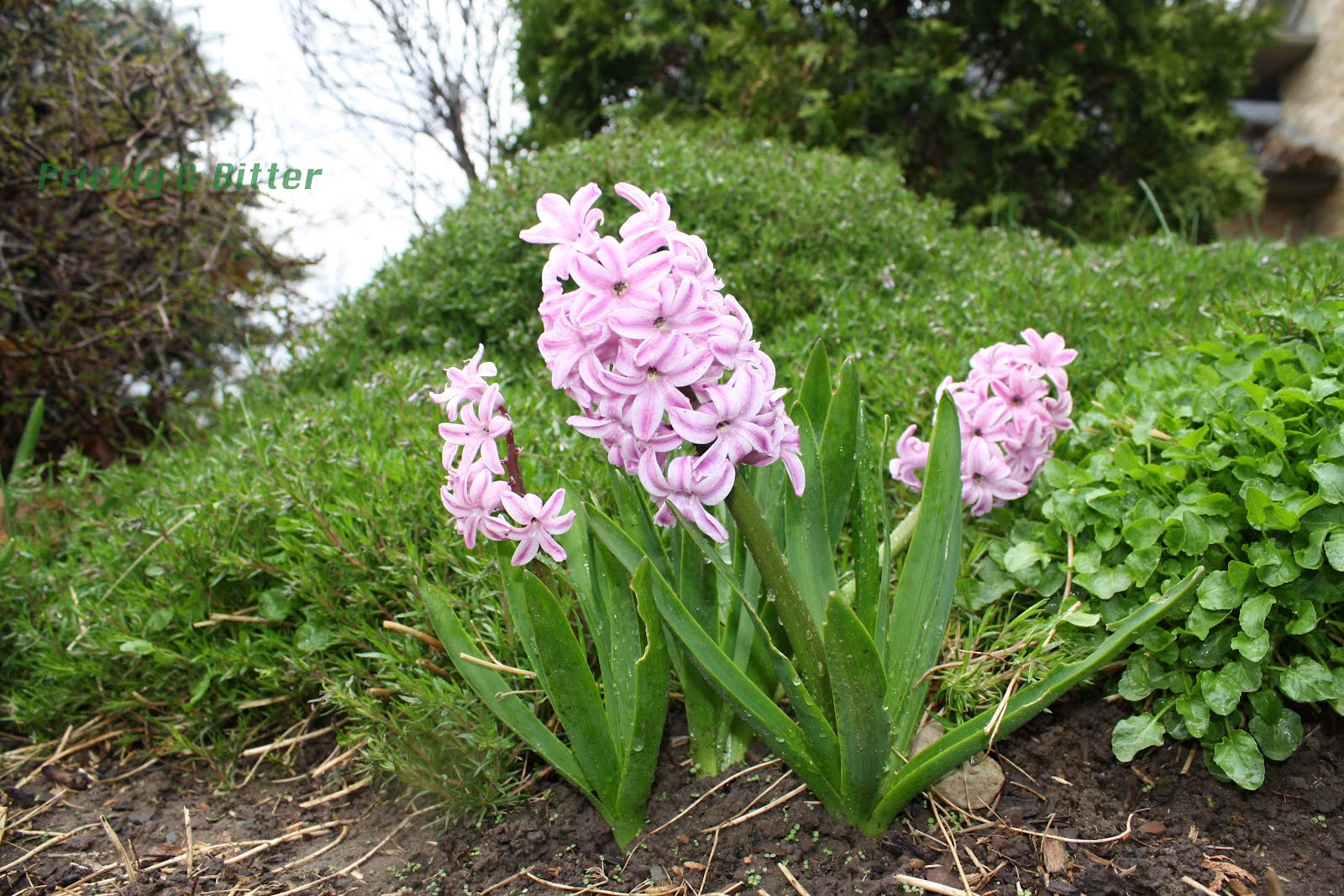
Hyacinths are native to Turkey, Israel, Iran and Turkmenistan (the epithet of the species name, "orientalis," is a bit misleading in this case). It has been a popular plant for gardening for a very long time, and has been in North America for 200-300 years. As with most "bulb" plants (I'll explain the quotation marks further down), the Dutch were famous for breeding hyacinths, and had up to 2,000 cultivars by the 18th century.
Contrary to popular belief, hyacinths actually aren't bulbs. They are underground storage organs very similar to bulbs, called corms, but where the plant stores their starch is very different. If you picture an onion, that is a bulb. The leaves have been modified to be very fleshy and to store starch. In a corm, like a hyacinth or the edible plant taro, it's instead a swollen underground stem that has been modified to store starch (which is why when you cut a hyacinth "bulb" in half, it doesn't have layers like an onion). I have heard of an old wives tale where if you cut a storage organ in half and it has layers you can eat it, and if it doesn't you can't. This is 100% false, and "rules" such as these should never be followed when deciding what wild or cultivated plants can or cannot be eaten. Tulips come from bulbs, and you would be very disappointed if you ever tried eating a tulip bulb. While taro is edible (and quite delicious, actually), hyacinth bulbs most definitely are not. They are toxic and contain high levels of oxalic acid, an acid that will cause blistering for sensitive skin. Wearing gloves when gardening is always a safe precaution, but especially if you are planting large amounts of these corms and you have sensitive skin.
The hyacinth flower is heavily rooted in Greek mythology. The story goes that Apollo and Zephyr were jealous of the youthful beauty of Hyakinthos, and competed for his attention. Zephyr was angered by the fact that Hyakinthos seemed to like Apollo more, and blew Apollo's discuss stone off-course and it hit Hyacinth and killed him. Instead of allowing Hades to claim Hyakinthos' body, Apollo poured his blood on the Earth and turned it into a flower. An interesting story of how plants are tightly intertwined with mythology (from all countries; the Persian New Year also uses hyacinths in their table settings). The hyacinth is also associated with rebirth in many cultures, and so is often planted at grave sites.
Subscribe to:
Posts (Atom)