Showing posts with label leaves. Show all posts
Wednesday, January 22, 2014
The creeping vine from Virginia
Species name: Parthenocissus quinquefolia
Common name: Virginia creeper
Location: Western University campus
As promised in my last blog, this post is about the "other" common vine with blackish-blue berries common, and native, to this area: Virginia creeper. Many people are actually surprised to learn that this species is native, as we don't often associate native species as being potentially invasive species. Anyone who has ever grown Virginia creeper in their garden under ideal conditions knows it will absolutely explode in growth and smother out anything in its path; a rather unfortunate characteristic since I like to encourage gardening with native species! Fortunately, Virginia creeper isn't as vigorous as grower as periwinkle or kudzu, so when you go to bed one night and wake up the next morning your house won't be covered in it (that has never actually happened, but at times it sure feels like both of those plants could grow that fast). The Virginia creeper vine is native to eastern North America, and its native range extends from Quebec and Ontario south to Texas and Alabama. There's a bit of an argument about whether or not its native range is also extending into northeastern Mexico (a few botanists believe it to be either introduced or a different species, depending on who you ask).
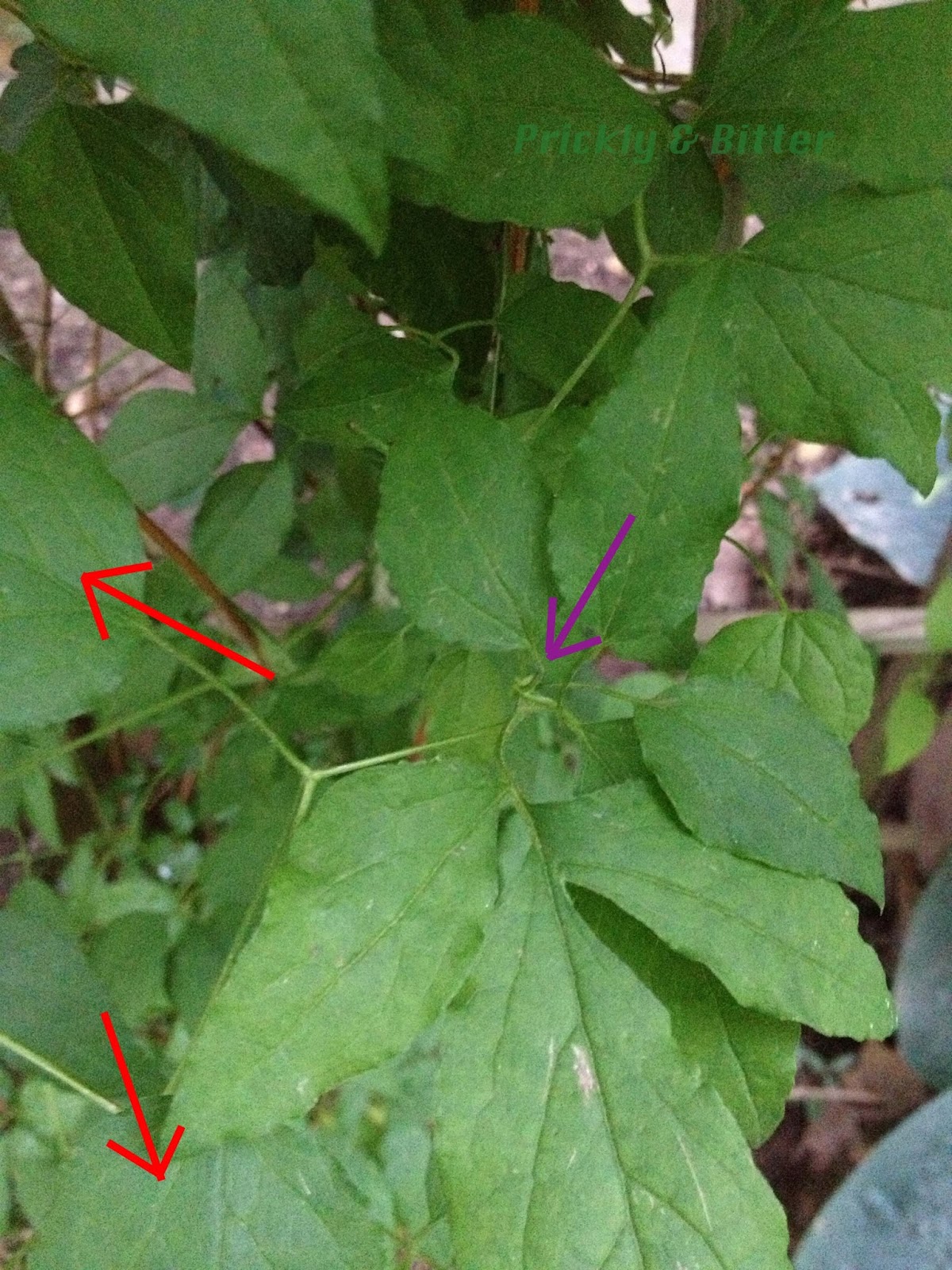
Virginia creeper is one of the banes of my existence because it doesn't follow the rules set out by its Latin name. The species epithet "quinquefolia" refers to its five leaflets, all originating from the same point on the petiole which is referred to as a palmately compound leaf. Unfortunately, no one told the Virginia creeper that it had five leaflets originating from a common point on the petiole. When young, sometimes the leaves only produce three leaflets (called a trifolate leaf). This is all fine and dandy, except what other plant might you know about that produces three leaflets from a common point, with the same general leaflet shape as Virginia creeper, and can also grow as a smothering vine along tree trunks? That's right, poison ivy. If you don't want to get mistaken for poison ivy, don't go looking like poison ivy! Geez. There have been a few times I've been out in forests where I could have SWORN that what my supervisor was grabbing onto to push out of the way was poison ivy, but turns out he knew it was only an abnormal Virginia creeper vine. Better to be safe than sorry I think, so I steer clear. Based on the skin sensitivity I display towards other stinging or itchy things (plant or animal-based), I would probably blow up like a balloon if I got the two confused. Keep trifolate leaves away from me and I'm a happy camper :)
All of that being said, Virginia creeper can be a nasty plant in its own right. The whole plant contains oxalic acid, which can be a very potent skin irritant to some people (and those with sensitive skin to other plant-based toxins, especially rhubarb juice, are most likely to be affected). The berries also contain very high levels of oxalic acid and so should not be eaten. Rarely will they cause any type of major problem other than intense intestinal discomfort, but if children confuse them for grapes and eat a lot of them there could be severe consequences. The oxalic acid crystals are sharp enough to perforate mucous membranes, and so severe internal bleeding can result after ingesting significant amounts. As with many toxic plants, a hot-water infusion made from the fruits (most of the time, but sometimes also the leaves) of this plant were used by Native North Americans as a treatment for heart conditions, diarrhea, prostate disease (or other diseases or disorders that might cause difficulty or painful urination), and joint swelling due to (most often) rheumatoid arthritis. No clinical trials have ever been set up to determine if the plant can be effective against any of these conditions, but the possibility is there.
Aside from its traditional medicinal use, this plant is becoming more and more popular as a garden ornamental species. It is very successful in full sun, and does a great job of climbing up buildings to act as insulation from the sun (and so is especially successful on south-facing walls). Fortunately for homeowners using this plant in landscaping, it (like Boston Ivy but unlike English Ivy) produces sticky knobs to attach itself to a substrate (like your brick wall on your house). English Ivy, that nasty little vine, produces penetrating roots that worm their way right into the mortar between the bricks in order to anchor itself. This means that Virginia creeper is a much less destructive plant to grow on the side of your house. There's always a catch to all things that sound to good to be true, isn't there?! The catch for this plant is that removing adhesive knobs can still be quite a labour-intensive process because pulling the live plant from the wall will still rip out small pieces of brick and mortar along with the adhesive knobs. If, however, you cut the plant at the base (either at ground-level for complete removal or just a branch here and there for trimming purposes) and let the plant wither and die on the house, it can be removed once brown with no damage at all (the adhesive knobs have to be alive to be adhesive!). It's like magic! The only downside is that Virginia creeper vines do lose their leaves in the fall (but not before turning a BRILLIANT shade of red first), so you don't get the same kind of winter insulation as you do with English ivy. But for the cost of having to re-brick the side of your house...I think the substitution is worth it!
Labels:
common,
English ivy,
leaves,
medicinal plants,
native species,
palmate,
Parthenocissus quinquefolia,
potentially invasive,
riverbank grape,
tendrils,
toxic plants,
trifolate,
Virginia creeper,
Western U
Sunday, November 10, 2013
The North American planetree
Species name: Platanus x acerifolia
Common name: London planetree
Location: Western University campus
As promised, this blog is about our version ("our" referring to the North American meaning of the term) of the planetree. Ironically enough, it's called the London planetree not after London, Ontario, but after London, England. A half-British, half-American name for a European species. Just when you thought common names couldn't get any more perplexing... :)
The planetree is a hybrid, which makes its native range essentially a moot point. But for the purpose of a species status diagram, it's a non-native species since the hybrid is rumoured to have been first discovered in Spain in the 1700s, but was first officially described by a Scot in 1789 as a variety of the Oriental sycamore, or Platanus orientalis. It was elevated to the status of species in 1805 by Willdenow (Platanus acerifolia), but it is now widely believed to be a hybrid of the American sycamore and the Oriental sycamore (sometimes called the Chinese sycamore or even the Oriental plane). It looks like an exact intermediary of the two species: has leaves with lobes not nearly as shallow as the American sycamore but more shallow than the Chinese sycamore, fruits in pairs instead of singly like the American sycamore (the Chinese sycamore usually has 3-6 fruits in a group), and light green inner bark unlike the white bark of the American sycamore and the much darker green bark of the Chinese sycamore. I love it when hybrids are a 50/50 blend of the parent species! It makes life so easy.
So why would you want to plant a hybrid species, when the American sycamore is a native species and looks pretty darn similar? Well, for one, the planetree is much more tolerant of urban conditions like pollution and root compaction, as well as being much more drought-tolerant and so doesn't require the riparian habitat that the American sycamore does. It also doesn't get nearly as large, which is often beneficial in cities (you don't exactly want a 5 meter in circumference tree growing between a sidewalk and a road). It is also much, much less susceptible to a fungal disease called anthracnose, which is quite common in American sycamores. So far it sounds like a pretty good compromise! Unfortunately, all good things must come to an end. The planetree actually has a really nasty side to it in the spring: it is highly allergenic. The new growth of the tree produces tiny hairs on the surface of the leaves, the leaf buds, the branches, and the fruits. As the tree sheds these hairs while it matures, they blow off in the air and (usually) end up up your nose. Here, they attach to just about anything they can get ahold of, and trigger a severe immune response (this isn't just your typical pollen-allergy runny nose). Some people have even reported a skin response that looks like a second-degree burn as a result of coming into contact with many of these hairs (say, for example, grabbing onto a young branch in the spring) and the resulting rash is a hyper-immune response. This effect tends to decrease as the tree ages, but if you plant a young tree, be warned. Now that I know this, you won't catch me coming anywhere near one of these trees in the spring. I have really sensitive skin, and with my luck I'd be the one that ends up with giant pustules all over my hands and arms! The leaves are also difficult to deal with in urban settings as the leaves produced on mature branches are very thick and leathery. If left to rest where they fall, they can take years to start to decompose (unlike a few months like most leaves, which is why they make great compost starters and mulch). This means they are problematic to deal with in the fall clean-up to prepare streets for winter.
Planetrees are sometimes planted for lumber and logging purposes because of the very attractive wood (it's a light yellow wood with red flecks). In the lumber industry it's often referred to as Lacewood, and is used in wood trim or decorative panels in fine furniture.
Sunday, October 27, 2013
Not named for its resemblance to a fish or a musical instrument: the basswood
Species name: Tilia americana
Common name: American basswood, American linden
Location: Western University campus
The American basswood (from now on I'll just call it the basswood, since I'm in one of the Americas) is a great native species that's tolerant of many environmental conditions naturally thrown at it in North America (from Ontario and Quebec all the way south to Nebraska and Tennessee, but some pocket populations even exist in Mexico!). It is highly drought-tolerant, is shade-tolerant, salt-tolerant, and even flood-tolerant. Unfortunately, this tree has largely been replaced in ornamental plantings by the littleleaf linden (or, if you'd like, the European basswood), Tilia cordata, because of the rather unruly growth of the basswood (you can read all about the littleleaf linden HERE).
What do I mean by unruly growth? Well, if you look at the first image that's not exactly the type of "specimen tree" you'd normally see on boulevards. Once this tree reaches a certain height, it's nearly impossible to stop it from starting its bushy growth. It naturally clones from the base of the tree, and suckers form at the base. If you catch them early they're easily removed with a pair of small hedge clippers. But because of their vigorous growth they can get very large very quickly. They can grow so fast, in fact, that it's sometimes difficult to determine which was the original stem and which are the suckers! There are a few varieties of the basswood that don't sucker, but early settlers in North America figured this tree was incredibly similar to the "lime tree" they grew back home, so they just brought their linden trees to North America. Now, you can find large linden trees planted along roadsides as ornamental trees.
If you look at the second and fourth photos, you can see a rather unique characteristic of the basswood that the littleleaf linden doesn't show, and that's that not all leaves are created equal. Since I didn't think to include an object for reference of scale (only realizing after the fact that this was a poor decision), I included scale bars for reference to measure the widths of the leaves. The second image above is of a canopy leaf, as evidenced by the fruit that can be seen growing (they do not grow on sucker shoots until they reach the canopy). The scale bar on that leaf corresponds to about 10 centimetres, or about 4 inches. That's a pretty average size for a leaf in the canopy, but the ones at the very top are slightly smaller (some in shaded areas near the trunk of the tree an also be slightly larger). The fourth picture is a leaf growing on a sucker, and the scale bar on that leaf is about 35 centimetres, or almost 14 inches. That's an absolutely enormous difference, and one that can be consistently seen in all basswood trees (so you don't have to worry that I chose a mutant tree!). So why the huge difference in leaf sizes? This phenomenon can actually be seen in many plants, but to a smaller extent: leaves changing sizes or shapes to be better competitors for light. The small leaves at the very top of the tree don't have to be very big to get lots of sunlight, because nothing is blocking them. In fact, many leaves at the tops of tree canopies are angled so only the edges are exposed directly to this sun which prevents them from getting sunburnt :) (this phenomenon is called "scorch" in plants and is common in plants grown outside of their native range) As you travel further down the trunk towards the ground, there is less and less sun that reaches the lower leaves. They must grow bigger, and are usually darker in colour, to be able to absorb more sunlight to make sugars. For something without a brain, basswoods are pretty smart!
Surprisingly enough, both the leaves and the fruits of this tree are edible to humans, although not all that pleasant. I can't say I've ever tried them, and I also can't say I'll be tempted to do so in the near future. That being said, if you get lost in a maple-beech hardwood forest and are looking for food, finding a basswood would be a nice source of vegetal munchies to sustain you for a few hours. The basswood has also been used as a medicinal plant for many centuries, having effects very similar to the littleleaf linden (which is arguably more potent). The leaves can be steeped in a tea and consumed as a treatment for cough, cold, flu, and indigestion (none of which have been demonstrated to be effective treatments according to modern scientific studies); the flowers can also be steeped for the same purposes but also as a diuretic to promote urine production, as a sedative, and as an antispasmodic to quell intestinal cramps; and even the wood is used (once burned to charcoal) as a treatment for lower leg ulcers, cellulitis, edema, or infection (again, none of these treatments have shown any promise in modern clinical trials). As an aside, rubbing burnt wood into an open wound in order to treat infection is probably not a smart idea. Wood is festering with microbes whether burnt or unburnt (it's amazing the types of bacteria and fungi that can grow on charcoal!), and in order to sterilize it you have to use it while it's hot; rubbing burning wood into an open wound will probably do more harm than good, and I'm sure you can imagine why!
Friday, October 18, 2013
The unfortunate case of the butternut tree
Species name: Juglans cinerea
Common name: butternut, white walnut
Location: UWO campus
The butternut is a rather unfortunate tree, and a great example of how "world connectedness" is sometimes a bad thing. The butternut is native to the Carolinian forest, but is now completely absent from North and South Carolina in the United States, and almost completely absent from Ontario in Canada (the two extremes in the natural range of this species). Towards the middle of the range of this species in Ohio, numbers are dwindling quickly. Why is the population of butternut decreasing, you ask? Well, the saying "when in doubt blame it on a fungus" certainly applies here. In fact, when in doubt blame it on two fungi is even more appropriate.
Before we go blaming things on fungi, let's talk a bit about the butternut tree itself. It looks incredibly similar to the black walnut (which you can read all about HERE), but differs in two major ways. The first way that a butternut differs from a black walnut is in the shape of the leaves. Both butternuts and black walnuts have numerous leaflets in their compound leaf (and this number often depends on maturity of the leaf which determines the length of the petiole or the "leaf branch", rather than genetics determining number of leaflets in a compound leaf), but the butternut leaf ends in a terminal leaflet where the black walnut leaf ends in a terminal pair of leaflets. Unfortunately, the wind can shear off the terminal leaflet (pictured in the second image near the pink arrow) so the leaves end up looking identical. So when using leaves to identify species, make sure you look at more than just one! The second way to tell them apart can be seen in the third image above, but admittedly this is a terrible picture of the fruit (the pink arrow points to the fruit in the third image). On this entire tree there was only one single fruit produced this year, so I didn't have much to work with for angles to photograph. But in a nut shell (pun intended), the fruit (or nut) of the black walnut is spherical, but the fruit (or nut) of a butternut is shaped like a football. This can even be distinguished by looking at the shell casings on the ground, so take a poke around the base of the tree if you're trying to identify a butternut or black walnut. Like the black walnut, the meat on the inside of the nut is completely edible, and apparently tastes wonderful when roasted slightly in the oven or pan-fried a bit (I haven't ever had the pleasure of eating a butternut, so I don't speak from experience on this one; see below for why I DON'T recommend eating butternuts).
I guess there's no time like the presence to talk about an evil fungus. The steady decline of butternuts isn't just due to habitat loss (and there is quite a bit of that happening in the Carolinian deciduous forest in Eastern North America!). It's actually because of a disease called Butternut Canker, which is caused by a fungus. :( I know, sad face. But, of course, that's a boring story so I wouldn't just tell you about a single fungus. Recent evidence shows that it's not just one fungus that's responsible for the butternut canker disease, it's actually two. The first one comes in and attacks the tree, causing a localized disease that, theoretically, the tree should be able to overcome. Unfortunately, this causes open wounds in the bark of the tree, exposing the underlying wood and the juicy vascular tissue. This vascular tissue is critical for the survival of the tree, and is the only living part out of all of the wood in the trunk in the tree. Because it is located just under the bark, this is one of the reasons why cracking bark is a critical step in so many fungal infections (sometimes even insect infections or bacterial infections) of trees. Once this vascular tissue has been exposed, the second fungus comes in and completely kills the tree. It will start off being one or two limbs of the tree near the crown (a fancy word for the top), and once the branch loses all of its leaves it won't grow them back the next year. Even pruning these dead branches won't save the tree; once limb death starts it's only a matter of time before the rest of the tree is killed. Because it's a combination of two different fungi that cause the death of the tree, it is exceedingly difficult to come up with a solution to prevent infection. The first fungus that attacks the tree (it has a ridiculously long name: Sirococcus clavigignenti-juglandacearum) is carried by potentially hundreds of different vectors, from the wind to other plant species to insects, and nearly all of these are impossible to prevent from coming in contact with the tree. You might think that lone trees would be most susceptible to this disease, but actually that's not the case. The canopy of the forest traps a lot of pathogens in the circulating air within the forest, so it actually increases the incidence of butternut canker. Lone trees often survive much longer without the disease. This fungus, an invasive fungus introduced from Asia, has managed to infect nearly 90% of all butternut trees left in existence. It won't be long before this species goes extinct, as there is no way of preventing the disease. It's an incredibly unfortunate set of circumstances for butternut trees, and for the Carolinian forest in general. We're about to lose one of the most majestic trees in the deciduous forest of eastern North America. Because this species is so critically endangered, do the world a favour: if you happen to find an intact butternut fruit, don't eat it! Instead, hold it in your hands, do a little "rain and good health to butternuts" dance, and lovingly plant it in the ground. Cover it with some chicken wire (I recommend making a box, and burying it at least 4 inches into the ground over where you planted the seed), and hope for the best. These are one of the preferred food sources for deer and squirrels, so not many seeds manage to escape being eaten (especially considering how few are left). I'm not going to suggest you take a seed home and try to grow it in a pot; that would be illegal in Canada according to our Species At Risk Act (SARA). Even if you plant the seedling back exactly where you found the nut, it would still be against Canadian endangered species laws, and much the same regulations exist in the United States. You might ask who enforces these laws and how common these people are in butternut territory...
Instead of ending on a sour note, let's end on a happy note! There is currently an effort underway in both Canada and the United States to try to protect the butternut in some way from disease. The method developed currently will not save the trees that are dying, but will instead protect the new generation of butternut trees. When butternuts are hybridized with the Asian walnut, the tree has almost complete resistance to the butternut canker. This is great, but unfortunately it dilutes the genetic pool of butternuts with Asian walnut genes. To try to combat this (since hybrids don't actually have any status according to any endangered species act anywhere in the world), hybridizing this hybrid with a different butternut tree causes the tree to have characteristics that are nearly identical to the butternut, but still have the disease resistance of the Asian walnut. This process is known as "back-crossing," and is commonly done with agricultural plant species to introduce disease resistance. This still doesn't make a "true butternut," but the resulting tree is nearly identical to a genetically pure butternut. There might come a day when we have forests containing this "butternut" (technically called a "Butter-Buart" which to me just sounds strange) in abundance once again. I wonder if anyone has tested the edibility of the butternuts of this backcrossed hybrid to determine tastiness... :)
Wednesday, October 9, 2013
The sedge masquerading as nutsedge
Yesterday I did a Sherwood Fox Arboretum tour with a group on campus (the Senior Alumni). We walked around a tiny corner of the campus, talked about a bunch of trees (but certainly not all!) that we saw on the way, they asked questions (I tried my best to answer most of them!), we laughed at my silly jokes, and then we all went on our merry way. If you're here reading my blog because I told you about it yesterday, welcome! I'm glad you found it. To the rest of the almost 21,000 of you that have discovered my blog: you're awesome! Thanks for helping make my "little project" turn into a rather large project read worldwide. I appreciate your eyeballs glancing over my blog every so often :)
Species name: Cyperus sp. (probably Cyperus strigosus)
Common name: false nutsedge
Location: Western University campus
Sedges are neat and wonderful plants, but most of them get completely overlooked by the average person. They are relatives of grasses (in that they're in the same order of plants, which I guess would make them cousins in a way), along with rushes, but have one notable characteristic that distinguishes them from the grass family. More on that later. A lot of people, even a lot of professional botanists and a lot of amateur botanists, completely ignore sedges (any kind of grass, really) when coming up with plants to identify because they're just so gosh darn hard to ID without a microscope. There are so many species of grasses and grass relatives that it is incredibly easy to misidentify them. There are only a few subtle characteristics that can be used to identify different species of grasses and sedges, most of which require the use of either a dissecting or compound microscope. Characteristics like the shape and size of the flower (in this species you can see the flowers in the bottom picture; they are about 1 mm long and are yellow, with the white stamens sticking out to disperse pollen), and the shape and size of the pollen grains (not pictured since that requires a microscope to see, and that would have required me collecting the plant which I don't normally do). Since I have neither of these to work with, the best that I can do is a "best guess" based on habitat (a place that regularly gets wet, and can be quite swampy at times), country location (North America), and colour of the flowers based on the time of year (many turn brown as the seeds mature, and seed maturation is in the spring for some species, the summer for others, and the fall for yet others). I know I definitely have the genus correct, this is most certainly a Cyperus. I'm also pretty certain about the species name (C. strigosus) because of the presence of wispy leaves at the bottom of the stem (many sedges only have leaves under the flowers, not also at the base of the stem), and the general shape of the inflorescences or the flower heads.
If I am correct about my identification, this species of sedge is native to North America, from Canada all the way south to parts of northern Mexico. It prefers disturbed areas, as this species is only good at competing for resources with other plants when there is low diversity and a large amount of available light. This is the same as many species of sedge; in established meadows it is rare to see a lot of sedges (although, at the periphery they might lead you to believe they might be common, since edge habitats are disturbed areas by definition). In areas of bare soil (like newly tilled agricultural fields or even backyard gardens), it is common for this plant to invade and spread rapidly. It can become invasive in some areas that are under constant states of disturbance, and is also considered an agricultural pest.
So what makes sedges, as a group, interesting? They look a whole lot like grass, and with one exception have no major economic value. The fascinating part about these plants is their stem structure: it's triangular. If you make a cross-section of the plant, it is incredibly obvious that the stem is triangular (mint stems are, as a general rule, square but some species have "rounded square" stems so you have to use your imagination a bit to see the square; this is not the case with sedges. They all have distinctly triangular stems). You can even tell that the stems are triangular in the middle picture by looking at the leaves emerging from just under the inflorescences: the largest leaves all radiate outwards from each edge of the triangle, and the smaller leaves under them radiate outwards from the three corners of the triangle stem. If you think about it, maintaining a triangle during growth would be incredibly difficult. The more you push the sides of a triangle outwards to "make room" for stuff on the inside, the more it becomes a circle. You'd think that after the stem was finished growing, it should be completely cylindrical and only have three ridges or bumps where the triangle's corners used to be. That's not actually what happens, since fully-mature sedges still have triangular stems. Plants aren't as simple as we think they are!
I mentioned somewhere up there that there's only one economically important sedge. Even at that, the economic importance of this species is significantly less than what it once was. I'll give you bonus points if you can figure out what it is (these points can be added to other hypothetical points you get in other places. You know, like bonus points you get for doing the dishes or walking the dog without having to be asked. Those kinds of points).
Sunday, September 22, 2013
You put your left flower in, you take your left flower out...
Species name: Physostegia virginiana
Common name: obedient plant
Location: Western University campus
I didn't realize until after I had taken and water-marked these photos that I had already blogged about this plant once. If you'd like to go back and read the first version, you can do so HERE. If you'd like to read a "better than the last" version, keep reading! :)
The obedient plant is one cool plant. Endless hours of entertainment if you're lost in a prairie (more on that later). The native range of this tiny plant is quite impressive, ranging from the northernmost edge of the temperate forest in Canada all the way south to parts of the (very small bit that's remaining) tropical forests of Mexico. If grown in Canada it illustrates the reason why I should have made the species status diagrams with a "common, native, invasive species" combination because it spreads very quickly and can dominate a landscape in just a few years. Where there is snow during the winter the plant will die off, but because of the extensive underground network of rhizomes it will pop back up in the spring and produce more of the beautiful flowers. If you're thinking of planting this species in your garden, then go ahead and do so if you live in my area. It's a native species, and it's never a bad idea to plant a native species! You might want to reconsider, however, if you have an intense aversion to weeding (it will spread, trust me) or if your yard backs onto an Environmentally Significant Area. For those locations, even the slightest change in dominant species (such as providing a source for a seed bank of a weedy, although native, species) could spell disaster for the area. Always make sure you keep in mind what is around you before making major changes to the landscaping in your yard.
This species is one of the best examples of a member of the mint family, or the Lamiaceae. The stems of this family are almost always square, while nearly all other plant stems (the notable exception are the sedges) are round in cross-section. You can see the ridges of the square stems of this plant clearly in the third picture, above. The leaves are also characteristic of the mint family: they are simple leaves with teeth (some members of the mint family have leaves with smooth edges) that emerge from the stem directly across from each other. The next node up (or down) on the stem will also have opposite leaves but they will be at right angles to the previous level of leaves. You can also see what I mean by this in the third photo. The flowers are also very characteristic of the mint family, although different varieties of this plant have been modified in different ways (sometimes quite drastically) to be different than the so-called "wild type." A wild type plant is a plant that would be found growing in the wild without having experienced any intervention by horticulturalists (or, in the case of edible plants, farmers). The group of plants above are pretty characteristic of the wild type of this species: purple-pink flowers, the flower petals are joined at the bottom and form a structure that looks like two lips at the edge of the flower, darker purple or purple-pink splotches on the bottom lip, and the sexual parts (most noticeable being the stigmas) being attached to the top lip of the flower. This "two lip" morphology isn't done just by chance by the plant; it's actually a flower shape that has co-eveolved with the choice pollinator of this species: bees. Something that you may or may not be aware about bees is that they can't see colours like we see colours. Everything green looks a very dark blue to them, so picking out flowers from a sea of blue-black is difficult, especially when you can't see them. Bess are special, though, because they can see a wavelength of light that we can't see: ultraviolet light. This means that anything that's purple, or even purple-pink, will glow when a bee looks at it. The flowers themselves aren't quite purple, so merely act as lightly glowing beacons in the sea of blue-black plant material. This is enough to entice the bees over, but the dark purple patches on the lower lips of the flower is what really brings the bees over. The bees see the structure of the flower, and use the lower lip of the flower like a landing pad (those darker splotches would be like the landing lights that pilots use to land planes on runways at night). The bee would wiggle around, trying to get its head as deep into the flower tube as possible to access all of the yummy nectar. This would cause the bee's back to rub up against the stigmas of the flower (located on the top lip, which you can see in the fourth and fifth pictures above), which would dust pollen all over the bee's back. Once the nectar is gone, the bee would fly to the next flower, do the same thing, and transfer all of the pollen from its back onto the stigmas of the next flower, ensuring successful cross-pollination. Sneaky little flower! But also quite a smart little flower.
So why is this plant called the "obedient" plant? Well...it stays where you put it. Huh? The flowers actually have the ability to swivel around the flower stalk, and when the flowers swivel into a new position they stay that way. Check it out below:
In the top photo all of the flowers are pointing towards the ground, which is actually pretty common in this species once the flower heads flop over (often they grow too quickly for their own stems to support them if conditions are ideal). In the bottom photo I took two of the flowers by the base and swivelled them around to point straight up. They'll stay that way for up to a minute, then flop back to their original position. If you give the flowers a break, you can move them back and forth multiple times before the plant will just give up on those flowers and dissolve them off the flower stalk. Only the best are allowed to set seed!
Labels:
common,
false dragonhead,
flowers,
Lamiaceae,
leaves,
mint family,
native species,
obedient plant,
Physostegia virginiana,
pollination,
potentially invasive,
rhizome,
Western U,
wildflower
Tuesday, September 17, 2013
Snowdrops sometimes turn into trees?
Species name: Halesia carolina (=? Halesia parviflora)
Common name: snowdrop tree, little silverbells
Location: Western University campus
To say that this plant has "a bit" of confusion surrounding the proper Latin name would be an understatement. There isn't just a bit of confusion, there's a whole lot of confusion. Linnaeus (the grandfather of modern taxonomy) was the one that first described this species, and even he admitted later that based on his "vague" description of the species he might not recognize it if face-to-face with it again. I guess that doesn't say much; some of the first biologists interested in assigning proper names to every living thing on earth often gave two, three, sometimes even four separate names to the same organism after forgetting they had already described it and with no Google Images to make the task easier, I don't blame them!
When the original description of a species is somewhat vague and someone else comes along later describing that species and assigning a new name, sometimes this new name becomes the official name. This happened for a while with this species, when Andre Michaux came along and not only provided a much more eloquent description of the species which contained more information, but also deposited a "voucher specimen" (or a portion of dried plant material kept in a dried and pressed plant library called a herbarium) that was much more informative than Linnaeus' specimen. In order for a specimen to be deemed "valuable" or "informative" to a herbarium and to future researchers, you need to be able to see a few key characteristics: either intact flowers or fruit but preferably both, both the front and the back of the leaves, an intact branch or portion of the branch showing the leaf arrangement on the branch, and any other important characteristics of the plant that could be used to distinguish species. If you just press a leaf or two and call it a new species, all green glossy leaves start to look the same after a while! The fact that Michaux's specimen contained both the fruit (of the previous year, which don't dislodge from the branch until the end of the flowering period the next spring) and the flowers as well as some leaves means it was much more valuable than half a fruit and four leaves. BUT. Life as a taxonomist isn't always that easy, especially if you're trying to "one-up" Linnaeus. Most taxonomists today concede that Linnaeus' description and specimen are "good enough" and so his name takes precedence (also because it is older). Regardless of the proper Latin name for this species, the status of the species and the native range doesn't change. The native range has now become highly fragmented due to the urban expansion of large cities; the snowdrop tree used to occupy a large range from Mississippi all the way southeast to Florida and northeast to North Carolina in the United States, but now only occupies a few small pockets in this area where intact forests remain. It is now widely planted around the world as a small ornamental tree, but this doesn't help the regeneration of the natural population. Given more deforestation (due to continued urban expansion or natural disasters like Hurricane Katrina), this tree species will almost certainly be at risk of extinction.
So what's so special about this tree? Well...it's pretty. And that's about all I've got. It's not a particularly outstanding tree for ornamental value, although it does have pretty white flowers (that don't usually have a very strong scent) in the early spring before the leaves emerge, then the unusual four-sided fruits that contain the seeds in the late summer through to the next spring. It's not a particularly good food source for any native Canadian animals since they don't recognize the fruits as being edible (that is, if they're edible at all; a single website states the fruits are edible and taste like cucumbers when still green but I don't recommend you experiment). The tree is incredibly slow-growing and rarely is taller than 10 meters in height. The tree often starts branching very close to the ground, giving it a bushy appearance, meaning the wood is also less than desirable for lumber purposes. The wood can often take on a very "knotty" appearance when grown in the presence of cicadas; they tap into the tree for the sap during the late summer (they use the tree's sap an energy source to make that buzzing sound). The tree goes a bit crazy trying to repair the "tap wounds" from the cicadas, and you end up with giant bulbs of woody tissue protruding off the main trunk and large main branches. Here in Canada the same thing happens, but often as a result of damage by other insects (which is strange, because we also have cicadas. Maybe they don't know they should be drinking snowdrop tree sap in Canada?). These protrusions make the tree look especially creepy at night because of the strange shadows the limbs cast.
Apparently this tree not only has an incredibly showy display in the spring with the flowers (which I'm ashamed to say I've never noticed despite this tree being right outside the building I work in), it also has a spectacular fall colour display. The leaves turn almost a neon yellow, which makes it stand out from all other yellow-turning trees before losing its leaves to overwinter. If I manage to catch the tree before it goes from "green to dead" (as I suspect many trees will this year with our first frost that we had last night...), I'll post an update with the fall colour and (if I remember this long down the road) another update in the spring when the tree is full of flowers.
The common name of this tree, for once, is actually something I can get behind. If you're familiar with early-flowering wildflowers, you will probably know and love snowdrops, sometimes called silver bells. If you've ever looked at them closely, they look an awful lot like the flowers on this tree except smaller and a clear difference between the petals and the sepals (sepals stick straight outwards, and the petals point down towards the ground). If you've never seen this tree before but have seen snowdrops, it will look a bit like you've picked a bunch of snowdrops and crazy-glued them to the branches of the tree to give it some colour. "Snowdrop tree" is indeed exactly what it looks like!
Sunday, September 1, 2013
Green tea: won't cause you to lose weight or prevent cancer, but tastes good!
Species name: Camelia sinensis
Common name: tea plant, tea tree (see below for why you should never call this plant a tea tree), tea shrub
Location: teaching lab at Western
For the last "Plants as a Human Resource plant profile," I figured I would do one of my favourite plants in the world, and one that I exploit multiple times per day: the tea plant. The tea plant (often referred to by it's Latin genus, "Camelia") is native to China, as are all plants with the species epithet "sinensis" (it means "from China"). There are two major varieties of tea plants: one that was domesticated in India and the Middle East called Assam tea (C. sinensis var. assammica), and the other that was domesticated in China and known as Chinese tea (C. sinensis var. sinensis). There are two other recognized varieties but these are only used locally for tea, not shipped to international markets. If the tea you buy is just referred to as "tea," you can be almost guaranteed that it refers to Chinese tea, as Assam tea is almost always specified on the label. It does have a slightly different taste, and when the leaves are cured it brings out the difference in flavour. It would be appropriate to note here why I say above that the term "tea tree" should probably not be used to refer to this plant, despite the fact that it can reach "tree height." When you call something a tea tree, most people think of an essential oil that is referred to as tea tree oil, used in cosmetics and in fragrances (sometimes now used medicinally in herbal medicine, too). This is NOT the same species, and this extract is from the leaves of the tea tree plant, or Melaleuca alternifolia. Please don't drink tea tree oil...your digestive system will hate you for it.
One thing that catches many people off-guard is that ALL types of tea (black, white, green, yellow, oolong, and pu'erh) come from this plant. The way that the leaves are treated after picking is what determines what type of tea the leaves will become. There are also differences in when the leaves are picked, and how many are used in the making of different types of tea.
Black tea: leaves are picked and then allowed to fully oxidize. The leaves are fully oxidized when they turn black and start to roll inwards. The leaves may then be dried and packaged (being cut before or after drying, or left whole), or they may be flavoured before drying. Earl Grey tea has bergamot flavouring added before drying (bergamot oil is extracted from the skin of the bergamot orange), English breakfast tea is made up of plain black tea leaves, Irish breakfast is a blend of Chinese and Assam tea leaves, and Masala chai is a blend of black tea leaves and other spices (and often sugar).
Green tea: the newest leaves are picked, rolled, and immediately dried with minimal oxidization. This allows for a much milder taste, and a taste that blends well with other flavours for tea blends (like dried fruit pieces or other mild flavourings like flower petals). The quality of the leaves, the amount of time they are given to develop on the plant, and the environmental conditions the plant was subjected to during growth all play major roles in the flavour of the tea. Lower-quality teas have a much more bitter after-taste to them than higher-quality teas, and if you compare a good quality green tea to a poorer quality green tea in a taste test you'll be able to tell the difference right away. Because of the lack of oxidization of the leaves, this leaves all of the chemicals intact that many claim have health effects (more on that later).
Matcha tea: this is just a specific cultivar of tea plant where the leaves are dried without oxidization and then ground into a powder. This powder is whisked into warm water until a frothy-like consistency is reached, and then consumed. Many proponents of green tea having positive health effects say that matcha has a much larger effect on health because the leaves themselves are also consumed (unlike drinking traditional green tea).
White tea: this is a special type of green tea, where the leaves are allowed to wither on the plant before they are picked and dried. This prevents the oxidization process, but the leaves are "bleached" on the plant so they are nearly white in colour. This is emphasized by the fact that the leaves are very young and still have a dense covering of white hairs, which make the leaves look even lighter in colour. The term "white tea" does not refer to the colour of the beverage, just like "green tea" doesn't refer to a beverage that is green. If you get a cup of white tea that looks like water...you've just been served water. If you get a cup of green tea that is green (and it's not matcha, which is bright green in colour), you've been served a cup of bad quality green tea and green food colouring.
Yellow tea: this is a relatively uncommon type of tea, where the leaves are allowed essentially to rot slightly while being dried very slowly. This gives the leaves a yellow-ish appearance, and gives a very different flavour to the tea. I have yet to try yellow tea (or see it for sale in many places) myself. Sometimes the term "yellow tea" is used to refer to tea that is either green tea or white tea that is served in the Imperial court (just to make things more complicated).
Oolong tea: this type of tea is almost an intermediate between white tea and black tea. The leaves on the tea plant are allowed to wither during extreme sun exposure during the hottest months of the year, then picked and fermented (not fully fermented like black tea, but fermented enough to give a smoky and full-bodied flavour). The amount of fermentation depends on the quality of the leaves picked, and in some areas in China only one specific cultivar is used to make oolong teas. The withering of the leaves causes them to curl and twist, so watching oolong absorb water during steeping is often a sight to be seen. What looks like tiny little fragments of tea leaves actually unfurl into complete leaves. It's like magic!
Pu'erh tea: this is a type of tea produced exclusively in Yunnan Province in China, and it is made by fermenting and oxidizing the leaves of the tea plant after drying. This gives the leaves a very unique flavour which is difficult to describe, but also allows for customized fermentation and oxidation prior to shipping. The leaves are, more often than not, packaged in "cakes" to be sold and wrapped in decorative foil. This actually allows for the continuous oxidation and fermentation of the leaves during shipping and storage, which is referred to as "aging" the tea. Sometimes tea cakes are shipped immediately and may be aged by the purchaser or used right away (the flavour, and colour of the steeped tea, differs drastically depending on amount of time left to age). Other times tea cakes are allowed to age at the factory, then shipped. These are usually consumed immediately, and are very expensive to buy. The cakes are packaged with "tickets," that are always stamped with a four-digit number. The first two of these numbers represent the year in which the recipe for that specific type of pu'erh cake was developed, the third number refers to the grade of the leaves used (the smaller the better), and the last digit refers to the specific factory in which it was made. To use the leaves, they are often just chipped off the cake until the desired amount is separated, but sometimes the entire cake may be steamed to loosen all of the leaves (and then they would be stored in an airtight container after re-drying). Often a pu'erh knife is used to loosen shavings of leaves from the outer surface; you never take a "slice" of a pu'erh cake because the amount of fermentation and oxidation from the outside to the inside of the cake differs drastically. Sometimes pu'erh tea can taste "fishy" if it is fermented or oxidized too quickly, which is often a sign of poor quality. Choose your pu'erh wisely!
Onto the health effects of tea. For the most part, black tea might be a tasty beverage but it is almost entirely lacking in the polyphenols that tea is known for. If you want to drink tea to be healthy, put the Earl Grey and English breakfast back on the shelf and find yourself a good-quality green tea. There are four diseases or disorders that tea has been shown to have proven positive effects, as demonstrated in large-scale clinical trials. The first is in calming the symptoms of asthma. When green tea is consumed on a regular basis it can act as a bronchodilator, which would increase the air flow to the lungs. This does NOT mean that if you're having an asthma attack you crack out the green tea and make yourself a cup. "Green tea therapy" for asthma is used in conjunction with emergency inhalers and also the everyday inhalers; the idea is that asthma attacks will occur less often, be less severe, and everyday inhalers could be at lower doses and be used less frequently. The next three diseases all have to do with dilating the vascular system; regular consumption of green tea has been shown to help decrease the severity of angina, peripheral vascular disease, and coronary heart disease by increasing the diameter of the blood vessels, allowing for better blood circulation. This definitely won't cure any of the above diseases or prevent you from getting them, but if you are at high risk of developing any of them then it may help prolong the onset (or decrease the severity of the symptoms). That being said, the number one and number two risk factors for all three of those disease are no longer related to inheritance from your parents; they're now obesity and smoking. So do yourself a favour and quit smoking and get out and exercise!
There are a lot of other claims out there about the health benefits of drinking green tea, but so far none of them, I'll repeat that in big letters, NONE OF THEM, have been demonstrated to be true in large-scale clinical trials. People will tell you drinking green tea regularly will decrease your cholesterol and prevent the onset of cancer, neither of which have been demonstrated. Extracts from the tea leaves from the plant (the key here is from FRESH leaves. Are these chemicals still there in quantities that are useful to the body after drying and then steeping in boiling water? Unlikely) have been shown to have anti-cancer properties and the ability to reduce cholesterol but these effects have never been demonstrated in humans. There's also the strong suggestion that drinking green tea will contribute to weight loss, which I find incredibly hard to believe. Any kind of caffeine intake will "contribute" to weight loss if you don't take in more calories than you burn, because caffeine is a stimulant. Will drinking green tea specifically cause you to lose weight? No. Exercise and burning more calories than you consume causes you to lose weight. If you want to lose it, you need to put in the effort. Don't fool yourself into thinking you can drink some tea or take a pill made of green tea extracts and the pounds will melt off.
So are there any benefits to drinking green tea, other than the four mentioned above? Well, the jury's still out. There's evidence that the consumption of green tea SHOULD be beneficial, but nothing has been proven yet. That being said, there's absolutely no evidence that green tea is harmful to you, and if you're concerned about pesticide use there are now an over abundance of companies that produce organic green tea. Just don't go overboard; remember that tea does contain caffeine (although much less than coffee), and if you're drinking it to be healthy you can't be adding milk (or worse, cream!) or sugar. Learn to love the purity of the leaves :)
Friday, August 30, 2013
There's Rosemary, that's for Remembrance
Species name: Rosmarinus officinalis
Common name: rosemary
Location: teaching lab at Western
Rosemary is an incredibly unusual plant in the mint family (the Lamiaceae) because of its almost cactus-like lifestyle. The Latin name of this plant actually comes from its unusual ability to acquire nutrients in a hostile environment: "ros" for dew, and "marinus" for ocean. Not only is this plant incredibly salt-tolerant (with much of its native range in marine spray habitat), but it can acquire almost all nutrients it needs to sustain life from the air, where droplets of dew condense on the hairs and waxy coating of the leaves, where they are absorbed and used by the plant to make energy. In fact, rosemary is so drought-tolerant it can go without being watered for months. This makes me seriously wonder how I managed to kill my rosemary plant in a single month; something tells me I over-watered and should only have been misting it. It was one of those strange rosemary Christmas trees, so it might have also been root-bound. Yep, let's blame it on being root-bound. Then it's not my fault. :) Rosemary is native to the Mediterranean, where it still commonly grows in the wild. It is also a popular ornamental species, and some rosemary plants are hundreds of years old.
Rosemary is one of the most popular herbs to use in cooking, especially in meat dishes because it has such a distinctive flavour. In fact, what most people don't know about rosemary is that the flavour is best brought out of the herb when you "spank" it (for a refresher on why you might want to spank an herb, refer to my blog post about mint HERE) and then burn it. Yep, that's right. Burn it. One of the best ways to use rosemary is on barbecued meats where you poke some sprigs of rosemary into the meat and just let them singe and burn until the meat is cooked to desired done-ness. Take the burnt pieces out of the meat with some tongs before serving (or just eat it. Burnt rosemary won't kill you), and voila! Smoky rosemary-infused meat. Yum, yum. Rosemary also pairs really well with mustards, because the acidity in the mustard also brings out the flavour in the rosemary leaves. Interestingly enough, mustard is native to almost the same geographic region that rosemary occupies. There might be something to this mustard-rosemary pairing...
As the Latin name suggests, rosemary has been used for centuries (some people have argued for many millennia, but the evidence for rosemary use only dates back to about 3,000 years ago. Yeah, "only.") as a medicinal plant, mainly to improve memory. It wasn't just used to improve "brain memory," either, but also to improve muscle memory. After someone suffered a stroke in the Middle Ages, a salve of rosemary leaves ground into wine was applied to the site of muscle paralysis as it was believed that doing so would help the body "remember" how to move the paralyzed muscles. It probably didn't work very often, but at least you would smell good :) That type of concoction was also consumed orally to treat gout (it was most famously used in this manner to treat the Queen of Hungary Elisabeth of Poland in the 1300s). Don Quixote also used rosemary leaves in his miraculous balm of Fierabras, which was reported to heal anyone that drank it. This very likely had at least SOME effect on the body, as the secondary compounds of rosemary are highly antimicrobial. Back in the 1100s and 1200s, before the discovery of penicillin, any kind of wound that got an infection would almost certainly lead to death. By either drinking this highly antibacterial (and antifungal) beverage or applying it directly to the wound, it would help protect it from infection. For some wounds it would have been irrelevant as they would be severe enough to kill you anyway. But for other more minor wounds, it might have made the difference between life and death. It's always nice to know when some of the folklore of popular tales is actually biologically possible!
Because of its historical medicinal use in improving memory, rosemary sprigs also play a leading role in wedding and funeral traditions around the world. In funeral bouquets that are scattered on graves, rosemary serves as a sign of remembrance for the dead and a way of honouring their memory. Across much of Europe, rosemary is still incorporated into the wreathes in Remembrance Day ceremonies, and also in war commendation ceremonies (especially if these are to commemorate the brave acts of a soldier who died in battle). In wedding ceremonies, they represent remembrance of loved ones that passed before the time of the ceremony and also to remember the life the couple spent apart before they were united in marriage. This eventually caused the evolution of rosemary from an herb of remembrance into an herb of love, and now sprigs of rosemary are considered to mean love and good luck in marriage. The sprigs of rosemary in the bride's bouquet would be planted in the ground, and if they grew it would be a sign of good prosperity and good luck. If they didn't grow...well, I guess it sucks to be you. Hint: dip it in some rooting compound first and problem solved. See, there's always a way to coerce luck into working out in your favour. Just takes some work!
Tuesday, July 16, 2013
A joy for travellers to see
Species name: Clematis x jacksonii
Common name: clematis, traveller's joy
Location: My house (London, Ontario)
Clematis plants are some of the most interesting plants to me because of their quirkiness and eccentricities. They don't follow the "aesthetic rules" that most flowering plants do, and that's definitely one of the things that makes them so cool. This species, a hybrid between two Asian species then hybridized again with a common garden species popular in the late 1700s in gardens in Europe (the history of this garden hybrid is unknown, but likely from Asian ancestors, too). Due to the fact that this plant is a hybrid it technically carries no weight according to the IUCN Red List of endangered and threatened species, but I can vouch for the fact that this plant is not likely to spread, nor is it likely to reproduce and escape from the garden. We moved into our house in March of 2006, and I've never witnessed this plant producing seeds (which are actually quite spectacular; they're like dandelions with a bad hair day). Not good if you're the plant, but great if you're the gardener that doesn't want to clean up after the plant!
The second image shows the twice-compound leaves, which branch twice into three. The leaves are produced oppositely on the stem (the purple arrow points to where the petiole, or the "leaf stalk", attaches to the stem and you can see that there's another leaf growing off the stem in the same place in the opposite direction), and each petiole divides into three at a single point (you can see the path the petiole takes in yellow). From there, the petiole divides into three again, and at the end of this division there are three leaflets (red arrows). Sometimes leaves can do some strange things and not obey the rules. Instead of producing a leaflet at the end of the petiole, sometimes the leaf turns into a modified structure for climbing: a tendril.
In general, there's a lot of misconceptions about "specialized" plant organs used to attach plants to houses or climb up support structures. Peas are well-known for their tendril producing abilities, and clematis vines should be, too. Clematis vines produce very little growth from their old stems; they much prefer just to send up new shoots from their rhizomes just under the surface of the soil. If you consider just how much this plant has grown in a single growing season, obviously the height of the vine would produce too much weight for the plant to handle on a skinny non-woody stem. To help hold it upright, tendrils are produced to wrap around support structures. These tendrils originate from the leaf, and if you cut straight through a tendril and make a very thin cross-section and look at it under the microscope you'd notice that a tendril has the structure of a rolled-up leaflet. Pretty neat! These tendrils have another secret ability: they respond to touch. Have you ever wondered why a tendril coils? It's not because one side is produced "smaller" than the other and so it spirals to compensate for the lack of space. It's actually the plant that senses a suitable object is touching the tendril and has been for long enough to provide support, and the tendril will start bending towards that object as it grows. If you're REALLY patient (and I mean you would give a saint a bad name with your level of patience) and have a lot of time on your hands, take a tendril that's grasping at something to curl against, and hold your finger against it for maybe 30-60 minutes. Try to move as little as possible, but a little movement is OK. After your hour is up, you can walk away and return to your clematis the next day. What happened to the tendril? I bet it will have super-coiled around itself and made a mass of curly tendrily mess. There was a signal that the plant received when your finger was against the tendril that said "SUPPORT!!! COIL QUICKLY!!!" and it responded--just too late to be useful. You've now manipulated a plant into reacting to your touch. Pretty cool! See, manipulating plants for your own amusement can be fun...
The flowers of this plant are also incredibly unusual. There are flowers that produce four petals, five petals, or six petals (the majority seem to produce five). If you think that all of the flowers just had six petals and some lost a few before I took pictures of them, I also managed to find one of each version that was just getting ready to open, so I can definitely exclude that as an explanation. Why does this happen? As far as I know there's no explanation. None. Completely stumped. Our clematis grows in the shade, so I thought perhaps it was just confused and suffering from a lack of sun (these plants definitely prefer full sun or at minimum partial sun to be most happy) but I just looked up pictures of the plant on Google Images and there are people growing theirs in full sun and noting the same phenomenon. Find an explanation for why this happens? Let me know! I've always been interested in learning about why this happens.
Other than their obvious ornamental value, some clematis species (there are over 300 of them) have been used in North America as medicinal plants for centuries. It was used to treat nervous diseases and migraine headaches, but don't get excited about the medicinal properties of the plant in your back yard. Most clematis species are highly toxic, and the sap that's exuded from cut stems is highly allergenic, is phototoxic (meaning it will cause extreme rash and burning when the sap on your skin is exposed to intense sunlight), and can cause internal bleeding if ingested. This plant is best used as an ornamental species and not a backyard medicine. It's also probably best to use gloves when pruning this plant; some people are more sensitive to the toxins in the sap than others, but always better to be safe than sorry. The phototoxic effect can last for years, despite washing the sap off your skin.
Subscribe to:
Posts (Atom)