Showing posts with label oak tree. Show all posts
Sunday, October 20, 2013
One of the last big burly oaks on campus
Species name: Quercus macrocarpa
Common name: bur oak (sometimes burr oak or even burl oak), mossycup oak
Location: Western University campus
Burr oak trees (that's how I spell it since that's how I was taught to spell it, but Bur oak is just as common a spelling) are native to the Carolinian forest of eastern North America, and are still present throughout much of their native range. Unlike most oak species, the burr oak does best in open areas like savannahs (depending on the area, they can sometimes be the only oak species in a traditional Oak Savannah habitat) and actually does rather poorly in forested areas. It is very shade-intolerant but grows very quickly, and these two characteristics have made it one of the most popular boulevard trees (or landscaping tree). The burr oak is also incredibly long-lived, with some individuals reaching ages of 350 years or more! That's one old tree!
Like most oak species, the burr oak is known for its masting. Masting is when a tree over-produces fruit in an attempt to overwhelm seed predators so that some of their offspring (fruits are the structures produced by plants to carry and protect their seeds, which are their babies) make it to the next generation. Burr oak seeds are some of the most prized nuts in the eyes of wildlife (like squirrels, deer, and in some places even bears), and they will selectively eat burr oak acorns over any other type of acorn. There are a few reasons why this occurs: first, the acorns are the largest of any oak species ("macrocarpa" means "big fruit"). Second, the acorn wall, or that tough shell you have to crack through to get to the yummy meat of the nut, is quite thin compared to other oak species so it's much easier to eat. Third, there are fewer tannis in the acorns of the burr oak, which make it much more palatable than other oak species. They are rumoured to even be choice edibles to humans, although I've never tried one. As long as you roast it a bit I could see them being at the very least edible, but tasty? I don't know if I'd go that far. I would make a terrible forager! When tree seeds are the most eaten food item of an animal species that has co-evolved with the tree, they tend to use really odd yearly cycles to over-produce fruits. These masting years, depending on the species, are every 7, 9, or 11 years. Our red oak in the front yard had a masting year a couple years ago. It sounded like it was raining acorns every time the wind lightly blew through the tree! It was incredible. The squirrels didn't know what to do with themselves :) To put it into perspective just how many burr oak acorns are eaten by wildlife, there are reports of certain trees in Tennessee and Kentucky in "bear country" near the Great Smokey Mountains having a 0% reproductive rate in some years (non-masting years, that is). When you set up video cameras to check out what's going on with these trees reproducing less than their neighbours, you catch bears climbing the trees and eating every single acorn they encounter. They'll even rip off branches or shake the trunk of the tree to get the ones higher than they can climb (bears are heavy, you know!), and then scramble down the tree to eat what dropped. Something tells me you don't want to come between a burr oak and a bear...
Unfortunately, the burr oak that I took a picture of and its nearest equally old neighbour are on their way out as far as tree lifetimes go. The third picture above shows where a branch broke off many, many years ago and a massive hole has formed in its place. I have no idea if the hole is occupied, but it's large enough to be an ideal place for a Great Horned Owl to build a nest. And those birds are huge! It would also be a good nesting place for a raccoon family, or the equivalent of a Hollywood mansion for a family of squirrels. The fourth picture shows where on that same tree the bark is starting to come off the tree. Unlike in my previous blog post about the butternut (which you can read HERE), this is not a direct result of a fungal infection. There is now likely a fungus that has exploited the tree's old age and exposed wood, but that bark fell off because the tree is just getting old and nearing the end of its natural life. The last picture shows where more bark is coming off the tree near the base, and you can see that it, at one point, was heavily infested with insects. Again, that's likely not what caused the bark to come off in the first place, but once the old rotting wood was exposed the insects took advantage. The tree is also likely hollow, because the old inner wood of trees is often decayed by fungi before the tree is completely dead; this is called heart rot. This also doesn't directly kill the tree, but rather creates a standing hollow tube. Doesn't take much of a wind storm to knock the tree down once the structural integrity is compromised. I personally have no idea how old this tree is (I might be "old" according to my students, but I'm not THAT old!), but I'm guessing upwards of 250 years. It will be a shame to see this tree come down in a storm, and I'm sure it's not that many more years before it does.
Aside from being some of the oldest trees that can be found around southern Ontario and the eastern half of the United States, burr oaks can also be some of the largest. They grow to be very, very tall trees but also grow to an enormous girth. It's hard to tell from the above pictures, but the burr oak I was taking pictures of is one of the largest trees on campus. To put it into perspective, I took a picture of the width of the tree at "breast height" (about 4 feet off the ground; this is traditionally a way to determine if a tree is ready for logging) with the arboretum label for size:
Still doesn't really look like much, but that arboretum label measures 2.5 by 5 inches (or about 6 x 14 centimetres). So if you figure out what the diameter of the tree is (by my rough estimation, 63 inches or 160 centimetres), that's...enormous. That would make it about 196 inches in circumference (or almost 5 meters!). You would need three people joining hands to comfortably circle the tree. That's bigger than enormous! There are two trees of this size that are burr oaks, and a couple hackberries (look for this species to be covered in my next blog), all in the same general location. Standing here looking at the trees, I often wonder what these trees have "seen". They would have survived the entire outwards growth of the city I live in, and would have been here long before London, Ontario actually became a city. I wonder who planted them? Or was this an acorn that sprouted there? If it was, where was the tree it came from? It would be long gone by now. Did anyone care for this tree when it was a wee seedling? If so, who were they? What did they do? Did the Kingsmill family, the ones that owned the property that Western University is built on for many generations before Western purchased all of the land in 1919, ever use this tree for a rope swing? When there were bears living in southwestern Ontario, did bears used to climb this tree to get the acorns? So many questions and no one left to ask...
When I helped Jane Bowles with an arboretum tour back in June, she said that the four trees in this small patch of campus were "some of" the largest, oldest trees on campus. I never thought to ask her where the biggest or the oldest trees were. I guess I'll have to go exploring to find them myself now (and learn a bit about how to determine the age of a really big tree depending on the species). Until then, I'll just have to be content with the geezer trees I know :)
Thursday, February 7, 2013
(one of) The real jade plant(s)
Species name: Crassula ovata (formerly Crassula argentea)
Common name: jade plant
Location: UWO Greenhouse
This plant is a wonderful example of taxonomy and taxonomic rules. A few days ago I profiled the trumpet jade, which is a variety of the jade plant selected for its morphologically messed-up leaves (you can read all about it HERE). It is native to South Africa, and has (to my knowledge) never been evaluated for its species status. It is likely very secure (meaning there are many individuals left in the wild that readily reproduce), but since I've never been to South Africa I'm definitely not one to comment first-hand.
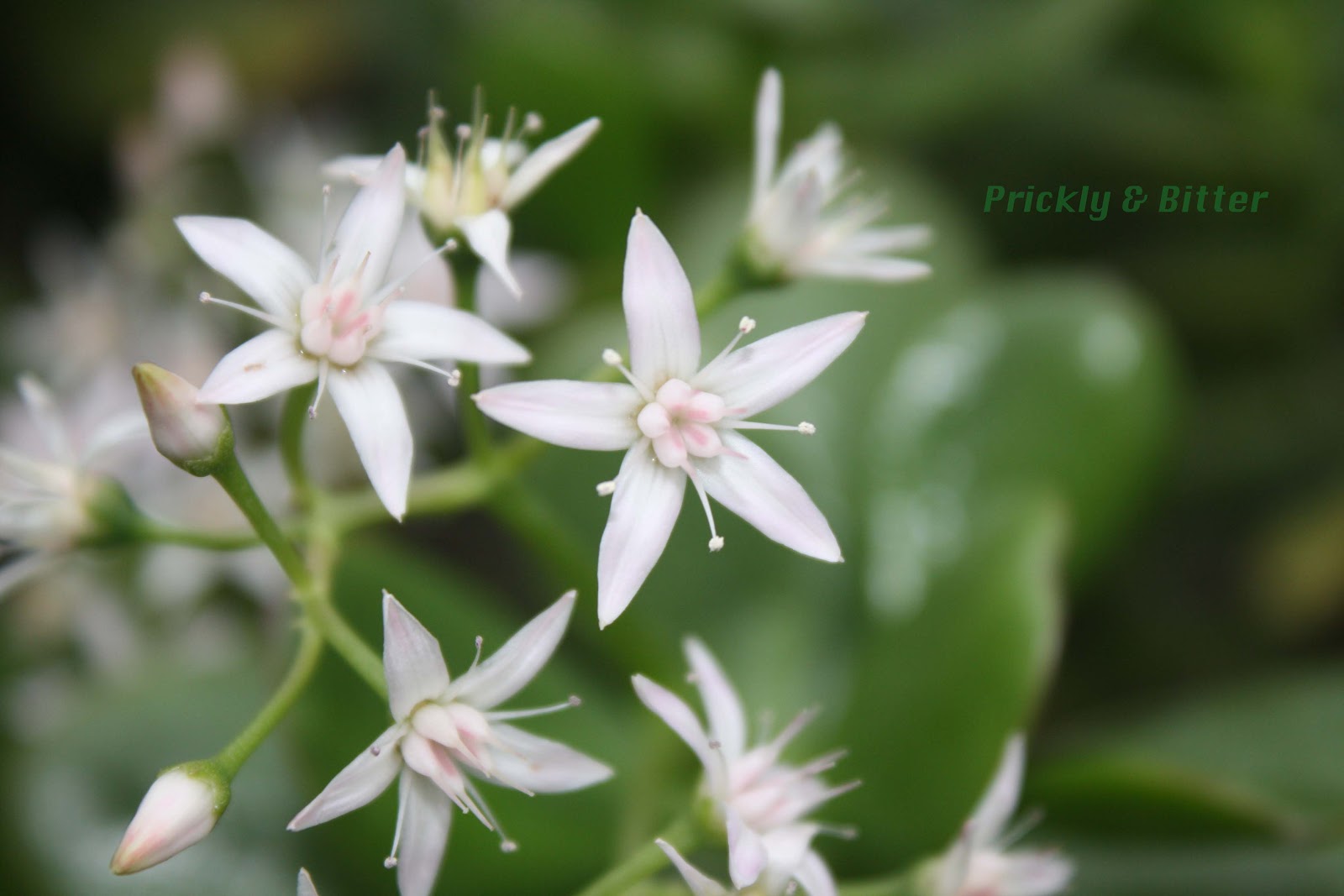
Historically, the jade plant was divided into two different species based on flowers; the pink-flowered plants were placed in Crassula ovata and the white-flowered plants belonged in Crassula argentea. There is also a correlation between colours of flowers and the general shape of the leaves; the leaves of the pink-flowered plants often have longer and more oval leaves, while the white-flowered plants have shorter, slightly rounder leaves. Unfortunately, this was just smoke and mirrors and a great example of how plants confuse botanists. The "rules" that were made up for how to tell C. ovata from C. argentea were 100% artificial, and it turns out they're both the same species. The colour of the flower is controlled by a single gene and there can be gene copies for white flowers or pink flowers. Depending on whether the plant has white genes or pink genes, the flowers can be more white, more pink, or somewhere in between. Leaf shape is probably more controlled by level of maturation and environmental conditions than anything else; leaves produced in very dry conditions and high amounts of sunlight will be smaller and more ovate than ones produced when lots of water is available and the temperature is cooler.
So once a species has two names, what do we do? In the naming of any kind of biological organism, there is a rule called the "Rule of Priority". Whatever name was validly published and applied to the organism first is the name that stays. There are some ways to make exceptions to this rule (especially in animals...zoologists are terrible with following rules of taxonomy!), but I won't get into that. If I don't get to bend the rules with my thesis when I'm naming species, no one else should :)
This jade plant has been masterfully cared for. How do I know this? Look at all the flowers! I've seen the odd flower or inflorescence group on a jade plant before, but nothing like this. One thing that you often have to be careful of when it comes to flowering plants (and some non-flowering plants that are gymnosperms) is that when they "moult" because their health is suffering, it's often mistaken for a sign of great health and prosperity. Some trees are known to do this: the tree somehow knows that it is infected with some kind of disease (insect, fungal, bacterial or viral), produces significantly more seeds than it would under normal conditions, then dies pretty quickly after the big seed flush. Oak trees also do this on an incredibly predictable cycle, which is off-set with population booms of squirrels. When the squirrel population is high, the oak trees need to produce an over-abundance of acorns just to keep up. They moult and over-produce acorns in an effort to overwhelm the squirrels and hopefully reproduce instead of being completely eaten. The results of this effort can sound like it's literally raining acorns. This effort seems to be incredibly successful, since most species of oak aren't at risk of becoming endangered due to squirrel predation any time soon. The moulting of oak trees depends on the species; red oaks are on a 4-5 year cycle and white oaks a 5-7 year cycle. Is this jade plant at risk of keeling over after this flush of flowers? I'm guessing not, but I'm really not sure. If it's mysteriously absent from the greenhouse in 8-12 months, then I think I know why! If it's still there, then its just a well-loved jade plant.
Monday, September 10, 2012
The pin oak
Species name: Quercus palustris
Common name: Pin oak
Location: Ontario
My friend Tanya demanded more native species in my blog, so here we go! Another native tree, just for Tanya. The pin oak is just barely native to Ontario; the native range extends only as far north as my hometown so I guess I should be considered lucky! The native range extends quite far south, as far as Georgia and all the way west to Oklahoma and Kansas. In Ontario this tree is relatively rare except where planted for ornamental value, and it's difficult to say what might happen with climate change. Species ranges are expected to move towards the poles (so in this case, north) but one also has to keep competitive ability in mind before you make those kinds of assumptions. The pin oak is an incredibly poor competitor, especially when it comes to shade and moisture. In the spring, during the seasonal flooding periods, the pin oak is incredibly tolerant of being partially submerged, and opts to set leaves later in the season once the ground is drier. During the growing season, however, the pin oak is very intolerant of standing moisture around the trunk, and any moisture at all towards the base of the tree often leads to severe decay. Unlike most other oaks, the pin oak doesn't have a large taproot that it uses for underground support; instead it has a very shallow root system that stretches over a large area. Once the bottom of the trunk is rotten, the tree no longer has a support system and it is prone to being blown over during any kind of severe weather. This tree is also very shade intolerant; even small shrubs can out-compete this tree for resources when young. It just doesn't seem to have the ability to push up out of the lower canopy, even though the potential height of this tree is 60 feet or more.
I guess this is the first blog post where I have to admit that my plant identification skills are sometimes aided just by the location that I'm in. My hawk-eyed blog readers will notice that there's a post coming out of the ground in front of the tree with an information plaque on the top. All of Western University's campus is an arboretum, which is basically an outdoor museum of living plants. It's not quite a botanical garden, since botanical gardens often have public greenhouses associated with them (we don't), but they also have ALL plants labelled to the species level. At Western, it's only the trees that have labels, not all plants. The label contains the common name, the species name, the family that the species is in, and soon will have information about whether or not the tree is native, and whether or not the tree is considered invasive. It's incredibly convenient being able to walk around campus and learn about plant identification; you can actually walk up to the trees and touch them, smell them, feel their bark, break open young twigs to see what colour they are, etc. It's also incredibly helpful to be able to see a tree through the seasons, which can also help with remembering names of trees.
But back to the pin oak!
The uses of pin oak are many aside from the ornamental value of this plant. The pin oak is actually one of the many reasons why we now have an entire field of work called "forensic botany"! Sometimes the pin oak is sold as lumber under the name "red oak," which as you know is a completely different species. If it stopped there, then I wouldn't really see a problem. But in reality the wood of the pin oak is much weaker compared to the red oak, has much less of a desirable colour and grain pattern, and has many, many more knots in the wood than a red oak would. Using this species in place of red oak could lead to disastrous consequences, depending on the intended purpose of the wood. The best use of pin oak wood is as firewood, or to make wooden pins for building construction (where the common name probably originates). It is also a medicinal plant, having been used historically in a tea used to treat intestinal and abdominal pain.
Friday, August 31, 2012
The English French Oak, or the French English Oak
Species name: Quercus robur
Common name: English oak, French oak
Location: Ontario
Luckily, given the common name, this plant is native to most of Europe and parts of North Africa. I'm glad I didn't have to come up with some kind of creative way to explain why it's named the way it is! Despite being a common natural species in European woodlands, it has never truly made its way into North America as a popular ornamental plant unlike the many others that have. North Americans will see this plant in the odd garden, but it never achieves great height here so is not planted as a shade tree; that's one of the qualities that makes for a popular non-native ornamental tree. Fast growth to provide shade quickly, and growing to be a large size to provide shade across a large area.
In Europe this species is commonly planted for lumber use, as it produces very hard heartwood with a desirable grain pattern. It is used most often in fine furniture, and is also sometimes used in hardwood flooring. As an ornamental there have been about 15 hybrids created for various desirable characteristics, from dwarf characteristics to a "creeping" stature similar to a weeping willow.
As a symbol, this tree is very important across much of Europe. In Britain, it is the national emblem and is often used by the royal family as an emblem (where it gets another of its common names, the Royal oak). The Royal Oak is the name of 547 different pubs across Britain (all owned by different people!), and has been the name of at least eight Royal Navy ships. There is a rather famous specimen of this tree (sometimes referred to as the Carroll Oak) growing at Birr Castle in Ireland that is 6.5 m in circumference, and is estimated to be over 400 years old! That's an old tree.
Wednesday, June 27, 2012
The oak of champions
Species name: Quercus rubra
Common name: Red oak, champion oak
Location: Ontario
The red oak, who's "official" common name is actually the Northern Red Oak, is native to North America, specifically the northeastern United States and southeastern Canada. It is a popular ornamental and lumber tree worldwide, and has been spread across Europe and Asia. It's also the state tree of New Jersey.
The pictures I selected to showcase the red oak aren't exactly your typical tree pictures. We had three oak trees growing in the front yard: one angled slightly over the neighbour's driveway (they never park there anyway), one angled slightly over our driveway (it's just a car!), and one angled slightly over the house (...it's just a house?). Since the one angled slightly over the house swayed more than just a little in the wind, it was decided that it would probably be best to cut it down. The top picture is what's left of "Curly" from our Three Stooges trees. Upon closer inspection (middle picture), the stump actually shows some pretty cool things about red oak trees! Even using a regular camera lens, you can actually see some of the cells that make up oak wood since they're so large. These cells are present in all trees, just larger in some than others, and are called vessels. Along with tracheids, they are the two types of cells that conduct water up the tree from the roots to the leaves. What most people don't know is that the only part of the tracheid and vessel system is still useful in a tree, and that's what's on the very outside of the tree. Trees actually grow by adding a new layer of wood to the outside of the tree, pushing the bark further outwards (which is why bark cracks and has ridges in it!). So that "old wive's tale" that you shouldn't carve your name into a tree because it might die? It's true! Injuring any part of the new growth of a tree leaves it open to infection even if there's still enough remaining wood for water transport.
Another neat thing that you can see from this tree stump is the ring pattern itself. Not all tree rings are created equal! In temperate areas, we always have trees with rings. Tree rings are created by the tree's generation of new tracheid cells. These tracheids are larger in the spring because there's lots of water and nutrients around, and smaller in the summer because of the lack of water. This makes a difference in density of the wood, creating what looks like stripes in the wood to our eyes but are actually just gradients of different sized cells. Red oaks are also what we call "ring porous," where all of the vessels are restricted to the spring wood, giving an even more distinct ringed appearance of the wood (which also gives a more pronounced grain when turned into furniture or flooring).
The last picture shows a phenomenon called "oak apple," which is the result of a parasitic wasp called the gall wasp laying eggs inside the plant tissue. This causes the plant to release wounding hormones at the site, which then causes tissue to be rebuilt. The gall wasp exploits this reaction by the larvae injecting these hormones continuously into the plant, causing the plant to make a bigger and bigger gall or apple. Once the larvae have matured, they bore a tunnel out of the gall, moult on the gall surface into the adult form, and fly away. In general, oak gall won't kill or otherwise harm the tree except in localized areas. If you're planning on growing a "show tree," the oak apples themselves are not very sightly. But if you do happen to have them, you should be thankful! Oak apples are one of the sources of a reddish-brown pigment used as ink ever since the Middle Ages, and they're actually the main source of ink for some of the oldest, most important texts of modern times. Now you know!
Tuesday, April 10, 2012
Look into the darkness...

Species name: Mycena inclanata
Common name: clustered bonnet
Location: Ontario
I took this photo in my back yard as the sun was setting (and hence the black halo around where there flash could reach) without much thought about composition or depth of field. It’s a pretty “artsy” photo as far as photography of fungi goes, as a technical image would also show the gill arrangement under the cap and gill colour.
One of the reasons why I find this particular species so fascinating is because of its predictability. Where you have decaying underground roots or stumps of oak trees, you find this species of mushroom fruiting all spring/summer/fall (but usually in cooler and wetter months). For the amateur mycologist, it’s one of the most easily identified “backyard mushroom” species. It’s unfortunate that it’s not recommended eating this species since it is so common and so easily identified. I doubt it would kill you (or your beloved pet), but it certainly wouldn’t be tasty like a morel or a chanterelle.
As with a lot of Mycena mushrooms (and fungi in general, actually), this species displays a phenomenon known as autolysis. This is the self-digestion of tissues due to enzyme activity. In fungi, it was thought to believe that this was one of the mechanisms of spore dispersal: a mushroom would autolyse its tissues into a drippy, goopy mess and the spores would be transported away from the mushroom (likely after mixing with rain water and flowing over or through the soil). This long-standing assumption was only recently found to be untrue, as about 95% of spores are released into air currents before autolysis occurs.
The more you know!
Subscribe to:
Posts (Atom)