Saturday, May 5, 2012

Eastern White Pine: Ontario's provincial tree


Species name: Pinus strobus

Common name: Eastern White Pine, White Pine, Wheymouth Pine

Location: Ontario

The Eastern White Pine is a native evergreen tree to Eastern Canada (Newfoundland to Manitoba), and has now been naturalized in the mountains of Poland and Czech Republic (naturalized meaning it is not native, but not out-competing native species). These trees are incredibly important in Canadian industry for timber and in the pulp and paper industry. They are the provincial tree of Ontario, and the state tree of Maine and Michigan. In the photo are the male or staminate cones, which are the cones that produce pollen. The pinecones that fall off the tree in the fall and are often used for decorative purposes are the female or carpellate cones which eventually produce the seeds. Staminate cones are the reason for many pollen allergies in the spring. These staminate cones are even the state flower of Maine!

Eastern White Pine trees were historically very susceptible to a fungus called the White Pine Blister Rust, which was introduced from either Asia or Europe during the 19th century. By the early 20th century the mortality of White Pines in some areas was as high as 80%. The Blister Rust is a fungus that requires an alternate host to complete its life cycle (in this case Ribes, or Gooseberry or Wild Currant). In the mid- to late-20th century, it was suggested by the US Department of Forest Pathology that if Ribes plants were removed from surrounding forest with White Pine, the disease can be controlled. This method was actually incredibly effective, and now mortality of "natural" pines (not ornamental pines, but those occurring naturally in forests) is about 3%. Now in New England in the US it is actually illegal in some locations to plant wild currant or wild gooseberry plants.

In the forestry industry, White Pines have historically been used to make masts for boats and some were even marked with a blue arrow as reserved for the British Royal Navy. This was a practice of great controversy in the US, leading eventually (at least contributing to) to the American Revolution. There are now more than just North American White Pines that are used as lumber to make masts of ships, should they be made of wood at all (most are now metal). Instead of growing trees for masts, we now grow pine plantations for Christmas trees and other lumber/pulp/paper purposes (building materials, furniture, carving, etc.). The sap of the White Pine is purified to make turpentine.

Surprisingly enough, White Pine trees are also used for food and as medicine by some native North American people. Pine needles themselves contain about five times the amount of Vitamin C as lemons (the typical Vitamin C benchmark), and make a great "Vitamin C tea." The cambium of the tree (the fast-reproduicing cells that produce the wood and inner bark of the tree) is commonly eaten by the Algonquin people. It is a good source of a chemical called resveratrol which has been touted as the "new cure" for just about everything that affects humans from diabetes to cancer. It has shown some promise as a chemical that will significantly reduce blood sugar as a potential treatment and/or cure for diabetes, but only in extremely high doses. The only human trial that has shown this was sponsored by a drug company, so any results that come from it have to be taken with a grain of salt. Other medicinal uses of this tree: as an anti-microbial agent used to treat gangrene by the Chippewa, and using the residue of slowly burning branches and roots as a treatment for dandruff.

Friday, May 4, 2012

The bitter bane of dogs


Species name: Amsonia tabernaemontana

Common name: Eastern bluestar, blue dogbane

Location: Ontario

Every year this plant flowers in the back yard, I think to myself "we should rip this out." It just keeps getting bigger and more unruly. It can't possibly be a native plant! Well, apparently it is. And a native plant that's not known to be especially vigorous even in its native range, let alone slightly north of its range. I guess it can stay!

The Eastern bluestar is native to the Northeastern United States, and likely into Canada, too (but like political boundaries, the range of this species appears to end at the border...). This plant was voted in 2008 as being one of the top 10 most sustainable plants by the Phipps Conservatory due to its non-invasive habit and its ability to resist insect predation and fungal/bacterial diseases. As evidence by its growth abilities when being ignored in my back yard, it doesn't need any kind of supplemental fertilization, and the plant actually looks better in low nutrient soil (in nutrient-rich soil the plant becomes very spindly and is unable to remain upright on its own). It is also incredibly drought-tolerant which is good for warm, dry Ontario summers.

When the stems of bluestar are broken, a milky sap is exuded. Those with sensitive skin should use gloves when handling portions of broken stems; the sap contains a bitter alkaloid that can cause skin rashes, blistering and burning. If you're going to pick these plants to use in a flower arrangement, you can decrease the chance of skin irritation by very briefly burning the ends of the stems to prevent the exuding of the sap. Keep in mind that this would also seal off the stem to the possibility of pulling water into the stem; flowers won't last long after this is done. The alkaloids in the plant also mean it should never be consumed, and caution should be exerted if planting this plant in a garden exposed to small children (their skin is more sensitive).

Thursday, May 3, 2012

Japanese quince: the best for bonsai


Species name: Chaenomeles japonica

Common name: Japanese quince

Location: Nova Scotia

You should be able to guess by the name that this plant is not only a non-native tree, but also that it is native to eastern Asia (Japan, China and Korea). The Japanese quince is somewhat related to the traditional quince in that it's in the same family, but other than that it's not closely related at all. The two can be used to make jams and jellies, but the Japanese quince is much less palatable on its own. It makes a fruit similar to an apple but is quite bitter and leaves you with an intense dry-mouth feeling. They do, however, contain more pectin than an apple and more vitamin C than a lemon and so are ideal for making jams. That being said, they are mostly grown in North America for their ornamental value as opposed to their nutritive value.

This specific species of Japanese quince (despite only one species of the genus Chaenomeles being the true Japanese quince, all three species in the genus are commonly referred to by the same common name; the way to tell them apart is by their size and the colour of their flowers) is ideal for the art of bonsai. This is a very arduous process of making a regular-sized plant very, very tiny through pruning and root growth restriction. The crown, or very top of the plant, is pruned as well as the tips of the roots to ensure that the plant remains a very small tree. Once the final product is achieved by the artist, it is typically planted in a pot with defined physical characteristics depending on the type of plant. I didn't realize that there was literally a rule book on traditional bonsai tree pruning and artistry! Once in the final display pot, the plant is continuously pruned to force the plant into a specific growth pattern (size and shape).

Other than ornamental purposes and the odd jam or jelly, this plant has no real commercial value. The Japanese quince is commonly attacked by the apple scab fungus but since the fruit are not typically consumed this is of little importance. In a cold environment this plant can suffer since it doesn't have much frost tolerance and the flowers are damaged easily.

Wednesday, May 2, 2012

There's pansies, that's for thoughts


Species name: Viola tricolor

Common name: Wild pansy, Heartsease, Johnny Jump Up

Location: Nova Scotia

This species of pansy is native to Europe, and is the genetic basis for all commonly planted garden pansies. The wide variation in colour (white, yellow, orange, golden, purple, blue, variegated, etc) in these garden plants is due to selective breeding over hundreds of generations, not due to genetic modification using modern technology. They're a great example of the effort that we as humans have put into moulding plants into our idea of beauty.

Pansies are perennial plants in the right environment (no frost), and annual in others. The wild varieties that haven't been selectively bred are much more cold-tolerant and can survive as perennials in much less hospitable environments. In Ontario, we get wild pansies popping up as forest ground cover near river banks and in forest lowlands despite our (often) very cold winters (except not this year!). Since their introduction to North America as a decorative and medicinal plant, the pansy population has exploded and has become an invasive plant.

Pansies are a great example of coevolution between bees and flowers requiring pollination. Their purple colour attracts bees (who see in the ultraviolet range) like a glowing beacon. The yellow portion in the interior of the plant would be a dark spot against the glowing background, directing the bees to the nectary of the flower. While the bees are feeding on the plant's nectar (which they will later turn into honey), the flower is depositing pollen behind the bee's head. The bee would then travel to another flower, depositing that pollen onto the female parts of the next flower and ensuring cross-pollination. A good rule of thumb to figure out what kinds of flowers are pollinated by what methods is to look at the colour of the flower and pay attention to the smell: bright red tube-like flowers (and some darker pink ones) are almost always pollinated by hummingbirds, butterflies and moths, purple flat flowers are almost always pollinated by bees, purple tube-like flowers are almost always pollinated by butterflies, dark red smelly flowers are almost always pollinated by flies, and white flowers are the "grab bag" of the plant world depending on their smell.

The wild pansy has been used for hundreds of years as a medicinal plant, hence its other common name: heartsease. Historically it has been widely used as a treatment for epilepsy and asthma, and more recently as a herbal treatment of cancer. Pansies contain chemicals called cyclotides in their tissues which have been shown to be cytotoxic (meaning they induce cell death in rapidly-dividing cells). Whether or not the plant contains potent enough cyclotides or whether or not these chemicals are biologically active is still under investigation. I doubt "eat wild pansies" will become a treatment of cancer any time soon. But medicine has to start somewhere! Another great example of why medical researchers need to have a solid understanding of botany in order to come up with new, cheap drugs for various medical conditions. The wild pansy has also been used as a treatment for skin diseases, bronchitis, whooping cough, rheumatism and cystis. Despite the plant's demonstrated anti-inflammatory abilities in rats, it hasn't ever been demonstrated as being effective against any of these health problems. The flowers are actually edible, and are now becoming more and more popular as a garnish on summer salads and as a wedding cake decoration.

Tuesday, May 1, 2012

Update: comment settings

A few friends had been complaining that they couldn't comment on my blog without first making a blogger account. I was absolutely positive I didn't have that as a setting, and assumed that both must be hallucinating and/or don't know how to use the internet properly.

But alas, I must post my apologies publicly. Apparently I did have that as a setting! All has now been fixed, and the comments are now set to "anyone" which means you no longer have to have a Blogger account. Feel free to comment as "anonymous," or fill in your own name of choice. Since moderation of comments is still activated, I would politely request that the name you choose to comment with is appropriate for all age levels or else it won't be posted.

Apologies again to those that I doubted! Let the commenting begin :)

Thou shalt forget me not!


Species name: Myosotis sp.

Common name: forget-me-not

Location: Nova Scotia

One of the amazing aspects of the Acadia University campus is their arboretum and medicinal plants garden. Tanya and I spent a good couple of hours wandering around a relatively small corner of campus looking at their pond system (with bog, swamp and marsh areas that they had created), their native plant area, and their medicinal plant garden. The medicinal plant section was by far my favourite because it had so many unusual plants, most of which were historically used in native medicine or once used for extracts to treat a specific disease. They even had a wormwood plant, since that was once originally used to treat malaria!

The forget-me-nots were growing around one of the ponds, which leads me to believe this could possibly be the "true" forget-me-not, or Myosotis scorpioides (native to Africa), but there aren't enough identifying features in the photo to be able to tell for sure. The genus Myosotis contains about 50 different species, and almost all of them have the potential to become invasive under the right conditions. Forget-me-nots are popular garden plants in North America, since they are such an effective ground cover, especially in shady areas (which should lead you to believe even more strongly that they're invasive!). I remember planting the "mini kind", as I used to call them when I was 4 or 5, with my mom in our garden at the old house. More than 20 years later we were still pulling the stragglers out of the garden! Since the plants themselves were so short, it leads me to believe it was probably Myosotis alpestris that we were planting, or the Alpine forget-me-not which is the state flower of Alaska. For anyone that's counting petals, this plant is indeed a dicot!

Unlike other spring wildflowers I've blogged about so far, forget-me-nots do not produce rhizomes for underground energy storage. Instead, they have a diffuse fibrous root system so they act as effective erosion-control plants by holding in the soil. This root system is also what allows them to invade riverbanks (also called the "riparian zone") and out-compete native plants. It also produces more seed at a much quicker rate than most of our native plants that grow along riverbanks, which helps contribute to their success as an invasive species.

The origins of the common name of this plant are quite diverse, but I'll share my two favourites. The one my grandma used to always tell me (she had a story for everything...true or not, they were always interesting!) was about a knight in shining armour that was walking by the river with his princess when he bent down to pick her some flowers. The weight of his armour pulled him into the river, but before he drowned he threw the flowers at the princess and yelled "forget me not!" The Freemasons also used this flower as a symbol in the 1920s to not forget the poor and desperate people in Germany. The flower still has tight ties with modern Masons, often being worn as a symbol that those that have died are gone but not forgotten.

Forget-me-nots have been used (and are actually becoming more popular) in herbal medicine around the world as a treatment for chronic nosebleeds and lung issues. I would strongly suggest against the use of this plant for these purposes, however, since they potentially contain high levels of chemicals called "hepatotoxic pyrrolizidine alkaloids," which attack the liver and cause liver failure and can cause cancer. There is conflicting evidence on whether all species of this genus contain these alkaloids, but it's always better to be safe than sorry!

Monday, April 30, 2012

May's official flower: Lily of the Valley


Species name: Convallaria majalis

Common name: Lily of the Valley, May bells, Our Lady's Tears

Location: Nova Scotia

The Lily of the Valley is an incredibly common spring wildflower through most of North America, Europe and Asia. Where it originated is still up for debate; some call it common to North America while others say it has been "naturalized", meaning it didn't evolve here but it's been here for so long it might as well have. Either way, it has adapted to survive and thrive in a wide variety of environments, and is incredibly cold-tolerant (surviving temperatures up to -35C). There is also an ongoing argument of whether Lily of the Valley plants are invasive or not (since they seem to spread so readily); I have given the plant the benefit of the doubt and said it is not.

The Lily of the Valley has some historic medicinal use, but is rarely ever used now as anything other than an ornamental plant. Historically, it was used by native tribes as as "piscicide", meaning a chemical that kills fish. The roots and/or leaves would be macerated in a bit of water to make a sort of sludge, releasing saponins from the plant (saponins are chemicals that produce a soap-like reaction when shaken in a liquid). This sludge would then be dumped into a stream that contained a lot of fish, incapacitating or killing the fish very quickly. They would then be collected from the surface of the stream and processed. This form of fishing has been banned around the world but it still practiced in a very restricted way by indigenous people in some countries (like Guyana). Saponins in general are not overly toxic to most humans (some people have a sensitivity to it, but you would have to ingest an obscene amount of plant material to be poisoned by saponins), but they do have a bitter taste and so are not ideal in food products. What makes Lily of the Valley a toxic plant is the high concentration (and chemical diversity) of cardiac glycosides that are stored in all parts of the plant throughout its development. These chemicals are concentrated in the rhizome underground in the fall (to protect it from herbivores over the winter), and in the berries in the summer (to protect the seeds from being eaten by animals). The berries are often interpreted as an ideal snack-food source by small children since they look so appealing, and so every year there are a few cases of death as a result of poisoning from Lily of the Valley berries. To adults, most of the results of berry ingestion would be abdominal pain, diarrhea, vomiting, and a reduced heart rate. If a large enough amount of these berries were consumed, death would be the result.

There are many tales associated with these flowers, most revolving around the time of flowering of this plant being in May (the Latin name of the plant, Convallaria majalis, means "of/belonging to May"). The French use it as a symbol of spring, selling it tax-free in shops on Labor Day (which there is on May 1st). One of the common names of the plant, Our Lady's Tears (sometimes also Mary's tears), originates from the idea the plant sprouted under where the Virgin Mary was crying after Jesus was Crucified.

A lot of countries and organizations use this flower as their national symbol: the Finnish use it as their national flower, it is the flower of Yugoslavia, Job's Daughters International has this flower as its official emblem, and there are countless fraternities and sororities around North America that use this flower as part of their coat of arms or as their official flowers.

Sunday, April 29, 2012

The original Stinking Benjamin

My appologies! For the last 4 days I've been at two different conferences, and so have been a wee busy. More regular blog postings are starting again tomorrow!


Species name: Trillium erectum

Common name: red trillium, wake-robin, stinking Benjamin

Location: Nova Scotia

I took this photo while out with Tanya on a guided excursion of an area in Nova Scotia called Cape Split. Felt like a walk up a mountain carrying the pack mule with all of its stuff, to be rewarded with a beautiful view of the Bay of Fundy. Once we were done absorbing the view we started our (incredibly short) trek back down the "mountain", only to find out that the walk wasn't all that long at all! The red trillium is native to Eastern North America, especially the Maritime provinces.

Most of the 40-50 species in the Trillium genus are at risk of population decline across their entire range. Despite this, there is only one species that is protected by law in Ontario against picking since it is officially a threatened species and has a greatly reduced population size. The common white trillium, the provincial flower of Ontario, is only prohibited from being picked in Provincial and National Parks, and on land owned and controlled by a Conservation Authority. In the United States, it is illegal to pick trillium flowers in Michigan, Minnesota and New York. This isn't because it's a threatened species, it's because picking the flower prevents the bracts and leaves from making sugars to be stored for the next year's growth. This impedes the growth and reproductive abilities pretty severely of the trillium. The white trillium is also the state flower of Ohio, and the official government emblem of the Ontario Government. Like the Jack in the Pulpit plant, the trillium is characterized by having flower parts and leaves in multiples of three: three petals, three sepals, and three leaves. This makes the plant trifolate, and a monocot.

Red trillium flowers are definitely not suitable for picking for the dinner table. A dark red-purple colour in flowers often indicates that they will smell terrible, like rotting meat. This implies the flowers are pollinated by animals attracted to rotting meat, usually flies. Like another native Ontario wildflower, bloodroot, the seeds of the red trillium are dispersed via ants (called myrmecochory). The ants are attracted to the fruit of the flower because of the fleshy elaiosome that surrounds the seed. This elaiosome contains lots of lipids (fats) and proteins, which the ants use as a rich source of nutrition. Once the ants have consumed the elaiosome, they transport the seeds into their disposal chambers underground where they can germinate the next spring and grow into a new trillium plant. Despite this complex association between trilliums and ants, these plants rarely actually reproduce sexually via their seeds. Like many of the spring wildflowers that I've blogged about so far, trilliums have rhizomes that store nutrients for the plants to use to grow the next spring.

To my knowledge, there is no medicinal or nutritive benefits (either perceived or actual) of consuming specifically the red trillium (although, there are stories about other species of trillium having medicinal value in preventing and treating bloody diarrhea). It contains calcium oxalate crystals in a special form called a raphide, which would make the plant toxic to consume by humans. The crystals can perforate the intestines and cause ulcers. Plus, I don't imagine they taste very good!

Wednesday, April 25, 2012

Wood horsetails are an ancient plant


Species name: Equisetum sylvaticum

Common name: wood horsetail

Location: Nova Scotia

Wood horsetails are part of a group of plants called the Pterophyta, which include the ferns. These are vascular, spore-bearing plants (they do not produce fruit or seeds), and have been in existence since the Middle Jurassic (approximately 150 million years ago). Horsetail fossils look incredibly similar to horsetails in existence today. Horsetails in general reproduce through the use of rhizomes, which is a form of underground asexual reproduction (very similar in growth and reproduction to bloodroot). Reproduction in this plant can also occur through spore production in the specialized terminal structure called the sporangium. This species of horsetail is native to the Northern Hemisphere, and has the potential to become invasive in the Southern Hemisphere where there aren't similarly reproducing species on the forest floor.

The wood horsetail is indicative of cooler boreal forests with wet or swampy and nutrient-poor soils. This is pretty typical of maritime forests, and so to see wet areas of the forest understory dominated by horsetails is not unusual.

There are many traditional uses of horsetails in general, and a few specific to this species. The wood horsetail was used medicinally as a tea infusion that was consumed to treat kidney problems and bloating. It was also dried and ground and applied to open wounds to stop bleeding, promote healing and prevent infection. I wouldn't recommend using horsetails for either of these purposes since a few species are toxic and some species are difficult to distinguish. In general, some species of horsetails have been used by native North American people to scour pots after cooking, used in Japan as sandpaper, used to make reeds for musical instruments in the United States, as a vegetable in early spring in Japan and Korea, in experimental trials as a diuretic, and in experimental agriculture as a source of silicon which can prevent fungal infections.

Tuesday, April 24, 2012

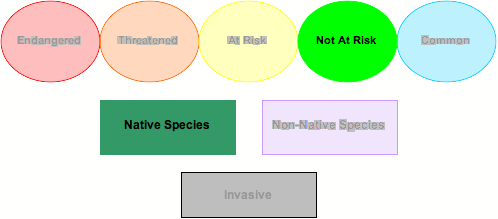
New Pictures! Species abundance diagrams

Over the last couple of days I've been trying to come up with a flashier way to depict if a plant species is native or non-native, it's general abundance around the world, and if it's invasive or not. Many of these are my own opinion since the International Union for the Conservation of Nature (IUCN; the ones that make the international Red List of endangered species) uses a different classification system, but they are based on known actual numbers in the wild.

There might be some discrepancy in what appears to be on the species abundance diagram and what is printed in the text; some context would be required here. One example that comes to mind is Madagascar periwinkle. In Canada because it's so extensively used you would think it would be an incredibly abundant plant. It needs to be mentioned, therefore, that this abundance diagram is related to it's NATIVE range, not necessarily where it exists currently. Madagascar periwinkle is, remarkably, critically endangered in the wild despite it being an invasive species in temperate Canadian gardens and natural areas that back onto residential properties.

I hope you enjoy the new feature; I'm hoping to be able to make these blog posts searchable by species status or abundance, but have yet to find a way to do it easily. Perhaps a feature to come in the near future...that near future it here! I have added a second label cloud and so the clouds now have non-overlapping labels. If you click on a label in the "search by species status" box, it should bring up all of the blog posts that feature that label.

Let me know what you think by dropping me a comment.

King of the Kelp


Species name: "Laminaria" sp. (probably Saccharina latissima)

Common name: kelp, giant kelp, Devil's apron

Location: Nova Scotia

While not truly a plant, kelp is not only of great economic importance but also a great nuisance, especially if you like swimming or boating on the Atlantic coastline in cooler water. Kelp is actually brown algae (that broad term refers not just to members of the genera Laminaria and Saccharina, but also many other species in the group), in the kingdom Chromalveolata (formerly part of the Chromista).  Until recently, the species Saccharina latissima was considered a member of the Laminaria, but modern DNA sequencing paints a different picture.

Unlike a true plant it doesn't have roots to absorb nutrients from the seabed, but rather it absorbs its nutrients from the water through it's "leaf" or blade (not a true leaf, either). The "roots" that anchor the kelp to the sea floor are collectively termed the holdfast, and the "stem" (could be short or long, prominent or not depending on the species) leading up to the blade is called the stipe. The genus Laminaria occurs widely around the world in cold salty water, with their geographic range extending from Greenland all the way south to Cape Cod in North America, and in Europe from the north shores of Russia all the way south to the north of France. There are similar species to the one pictured above that occupy the same niche in the Southern hemisphere, with species ranging from the south tip of Argentina north towards Brazil, and also from South Africa up towards the Democratic Republic of Congo. The full length of this alga can reach up to 4 meters!

Commercially, this species is incredibly important worldwide for various reasons. In fact, you probably use an extract of this alga every day and don't realize it! Historically, this was our major source of iodine to make iodized salt, but that has been replaced with much cheaper methods of iodine isolation from living "green things". Historically it was also burned to make potash, which was used extensively in the glass-making industry. To some extent currently, but also largely historically, it was dried and ground and used as a fertilizer on agricultural fields. Today, we extract a compound from it we term an "alginate" (you can probably guess where that word comes from!) which is added to toothpastes and cosmetics as a binding and thickening agent. Rarely it's used in food (that's not to say it's not edible, it's just not the thickener of choice), but it is starting to make appearances in the vegan food industry. In China and Japan, this is the main ingredient in the soup stock used to make dashi.

Monday, April 23, 2012

Pitcher plants as ecosystems and not just carnivores?!


Species name: Sarracenia purpurea

Common name: pitcher plant

Location: Nova Scotia

Despite there being numerous species of carnivorous pitcher plants around the world, there is only one species in Canada. This species of pitcher plant occupies boggy habitats from Newfoundland all the way across Canada to British Columbia, and to the north through Yukon, Northwest Territories and Nunavut.

The morphology of different pitcher plants is different, but all of them have one thing in common: they all use a trapping mechanism called the pitfall trap. The leaves of the pitcher plant are modified into receptacles that contain a liquid with enzymes that digest insects unlucky enough to fall into the trap. The top of the trap is coated with a wax-like substance that is very slippery, ensuring a higher success of trapping insects. Why would a plant want to capture insects in the first place? Typically carnivorous plants  live in very nutrient poor environments, and require the vast majority of their nutrients to come from sources that don't include the soil that they sit in. An excellent source of nitrogen and phosphorus, two elements required in relatively large numbers by plants, is the insect body since it's composed of mostly proteins (great sources of nitrogen). Various carnivorous plants employ a huge diversity of trapping mechanisms, but all of them converge on the same purpose which is as a method of nitrogen acquisition.

The idea that pitcher plants only have pitchers to capture insects is actually one of the many misnomers of plant biology. The pitchers of a pitcher plant are actually micro-ecosystems full of complex interactions between plants and insects. In Canadian bog systems, pitcher plants are the main breeding grounds for mosquitos and other small flying insects. Here, the interaction between pitcher plants and insects is much more complex than just digesting insects for nutrients. The adult insects lay their eggs in the pitcher plants, and the larvae of these insects swim in the liquid and feed on other insects that fall into the sweet substance. Their excretions are the main source of nutrients for the plant, who absorb the insect larva poop that sink to the bottom of the pitcher. There are also mutualistic bacteria, protists (what I affectionately refer to as the "garbage can of Biology": if it doesn't fit in any other group, it's a protist), and rotifers ("wheel animals") that live in the liquid of the pitcher. They are often the first line of attack for a pitcher plant, and the plants allow these groups of species to start to break down or decay the insects that fall into the trap, releasing the nutrients from the insect for the plant to absorb.

Saturday, April 21, 2012

Spindly Black Spruce


Species name: Picea mariana (formerly Picea nigra)

Common name: Black spruce

Location: Nova Scotia

I took this photo in Kejimkujik National Park on the bog boardwalk leading out to the beach. It was a pretty typical maritime spring day: cool in the morning, warming up quickly and becoming incredibly foggy then the fog burning off by the mid-afternoon. This was one of those rare moments where you could see more than 10 feet in front of your face as a fog cloud was blown out of the way.

Black spruce is a typical plant of the boreal forest in Canada and Alaska. It's a native evergreen tree with a very typical shape: somewhat bushy at the bottom, becoming much narrower and more spindly towards the top. One of the most impressive characteristics of this plant towards the northern part of its range is that its a great indicator of predominant wind direction. Black spruce grows very slowly, and slower still when the wind is pushing against the tips of branches. The "wind side" of the tree has much shorter branches compared to the "sheltered side".

Black spruce is one of the many boreal species that require fire in order for their seeds to germinate in great numbers, and so for that reason this species is especially successful at recolonizing the boreal forest after a fire. Since forest fires are relatively common in this forest zone, stands of boreal forest that are dominated by black spruce are often trees of the same age (as opposed to typical successional forests where there are old and young trees of the same species in the same location). Within the boreal zone, it's an incredibly common tree and is at no risk of becoming a threatened or endangered speices.

Black spruce trees grow slowly and never attain a very large circumference despite the tree's age. For this reason they are not valuable lumber trees in the construction business. They are, however, a major source of pulp for the paper industry in Canada. As cultural importance, the black spruce is the provincial tree of Newfoundland and Labrador in Canada.

Friday, April 20, 2012

Lupine: the state flower of Texas


Species name: Lupinus sp.

Common name: Lupin, lupine

Location: Nova Scotia (second photo from Wikipedia showing the flowers of various ornamental species)

The lupine (or lupin, as this plant is referred to outside of North America) is native to a wide variety of locations from all continents. Now, various species can be found worldwide and only a few can be distinguished by leaf shape and leaf characteristics alone (this isn't one of them--hence "Lupinus sp."). Lupines are part of the bean family, and have characteristic bean flowers and also share the most sought-after characteristics of beans as agricultural crops: they have high concentrations of protein and oil in their seeds, and have symbiotic bacteria in their roots that fix nitrogen. This biologically-available nitrogen is then released to the plant in return for sugars and oxygen, where it can be used by the plant in photosynthesis to make more sugar (and in respiration to make energy). For this reason, lupines are very popular in some agricultural systems to be planted alongside crops that require large amounts of nitrogen fertilizers like corn and wheat. These types of plants are referred to as "green manure". There are about 280 species in the genus Lupinus, and the Texas Bluebonnet (Lupinus texensis) is the state flower of Texas.


Certain species of lupine can be eaten, but others are quite toxic. If you don't know what species is growing in your back yard, it is best not to try to consume it. Mediterranean dishes are ones that are most likely to contain lupine seeds: in Portugal and Spain they are consumed dry-roasted like peanuts with beer, in Lebanon they are served as a pre-dinner snack and called "Termos", in the Andes (OK, so not part of the Mediterranean) they are called "tarwi" and eaten like any other bean, in Germany they are often ground and used as a meat substitute. The "bitter" varieties of lupine have high concentrations of toxic alkaloids in their seeds which can cause a temporary paralysis in the lower limbs, muscle decay or atrophy of the buttocks (which can be permanent), and cell death in motor neurons (which would lead to permanent paralysis).


Like most plants that have very broad geographical ranges, there are ornamental species of lupine that have been introduced to North America over the years (accidental or on purpose) that have escaped and have become invasive. There are certain areas in the southern USA that are completely covered by lupines in roadside ditches and sometimes even growing up in the front lawn. While the flowers are incredibly attractive, if they're growing where you don't want them it's definitely not ideal. 


One last special characteristic to note about these plants is that they are an important food crop for the larvae (i.e. caterpillars) of some butterfly species, and the flowers can serve as important nectar sources for many pollinating insects (including some butterflies). If you are going to create a butterfly garden, adding lupines would be a great idea; just make sure you're planting native species that are food sources for the native butterflies that will be visiting your garden or you might be disappointed in the results!


Thursday, April 19, 2012

Tulipmania!


Species name: Tulipa sp. (probably Tulipa gesneriana)

Common name: tulip

Location: Nova Scotia

I took these photos when my friend Tanya and I were in Nova Scotia for a conference in May one year. The tulips there were in full bloom (they were a little past their prime in Ontario, but it's cooler in NS so it was a nice colourful surprise), along with the rest of the late spring wildflowers and cultivated flowers.

Tulips have a long-standing tradition of being one of the most popular ornamental flowers to humans worldwide. The Dutch were the ones that got the ball rolling during the Ottoman Empire (weren't you disappointed, too, to learn that this wasn't named after the invention of the footstool?) in the mid-1500s. Officially, the first documented case of planting tulip bulbs in Europe was in 1559 in Germany, with the bulbs arriving in the Netherlands in 1593 (the bulbs being planted at Leiden University). On the books, 1594 is the first tulip flower year for Holland, and these first flowers were the ones that led into Tulipmania and the commerical tulip flower trade.

Tulips do grow from bulbs and take many years of growth to build up the storage tissue in the bulb before they are prepared to flower. If you were to grow a tulip plant from seed, depending on the variety it would take between five and eight years to wait for a flower to appear. That's a lot of waiting, and an amount of time most people are not prepared to invest into an ornamental garden. So how is it that we put bulbs in the ground and they flower in the spring? Well, someone else has done the waiting for us. In fact, Holland is still the biggest grower and exporter of tulip bulbs worldwide (they've had a lot of practice!), and they dig up the bulbs that have formed every year and sort those by size. The bulbs big enough to flower the next spring are sent for export and sale, while the ones too small to produce a flower are set aside to be planted again. By the time you buy a bulb in the store, it has been deemed by the experts to be ready for flowering. If you do plant bulbs and not all of them flower, don't despair! Give them another year and I'm sure you'll be happy with your efforts. If you've been paying attention, you should be able to point out based on the third picture that tulips are monocots (click here for a refresher course in monocots vs. dicots, look at the third paragraph), since they have flower parts in multiples of three: three petals, three sepals (since they look so similar, we call them tepals like in Easter lilies), six stamens and three lobes on the stigma.

Tulipmania is often regarded as the first economic bubble in human history: tulip prices in 1637 skyrocketed to almost 10 times the annual salary of a skilled tradesman (that would be like you walking into a garden store with the keys to a ferrari, leaving the ferrari and taking a marigold plant home with you), then suddenly crashed. For those people that "cashed in" on the tulip market and sold everything, they also lost everything. To get fancy patterns on tulip tepals, the bulb must be infected with a virus called the Tulip Breaking Virus, or TBV. This is what causes the streaks of colour running vertically along each tepal. Since the virus must be in the bulb to cause the colour pattern, this pattern can only be seen in the mother plant and not in the seeds that plant produces. For this reason, "broken" tulips are relatively rare, and at the time of Tulipmania they were incredibly valuable. The most rare variety, called Semper Augustus, was not only a broken tulip but also a black tulip. To see a black flower is incredibly rare in nature, and for it to also have white streaks running through the tepals made them especially sought-after; so much so that there's a documented case of someone offering 34 acres of land for one Semper Augustus bulb.

The bubonic plague is also tightly tied to the story of Tulipmania: in 1637 the tulip trade came to a grinding halt since no buyers of tulip bulbs showed up to February tulip auction. The speculation for why this is the case is that the plague was rampant during this time, and there was widespread fear over catching it in populated places. Since tulip auctions always drew large crowds, the crowd just decided this time to stay home. By May of that year, the price of tulips was back down to baseline levels, and have remained relatively stable even today.