Showing posts with label petals. Show all posts

Tuesday, September 17, 2013

Snowdrops sometimes turn into trees?


Species name: Halesia carolina (=? Halesia parviflora)

Common name: snowdrop tree, little silverbells

Location: Western University campus

To say that this plant has "a bit" of confusion surrounding the proper Latin name would be an understatement. There isn't just a bit of confusion, there's a whole lot of confusion. Linnaeus (the grandfather of modern taxonomy) was the one that first described this species, and even he admitted later that based on his "vague" description of the species he might not recognize it if face-to-face with it again. I guess that doesn't say much; some of the first biologists interested in assigning proper names to every living thing on earth often gave two, three, sometimes even four separate names to the same organism after forgetting they had already described it and with no Google Images to make the task easier, I don't blame them!

When the original description of a species is somewhat vague and someone else comes along later describing that species and assigning a new name, sometimes this new name becomes the official name. This happened for a while with this species, when Andre Michaux came along and not only provided a much more eloquent description of the species which contained more information, but also deposited a "voucher specimen" (or a portion of dried plant material kept in a dried and pressed plant library called a herbarium) that was much more informative than Linnaeus' specimen. In order for a specimen to be deemed "valuable" or "informative" to a herbarium and to future researchers, you need to be able to see a few key characteristics: either intact flowers or fruit but preferably both, both the front and the back of the leaves, an intact branch or portion of the branch showing the leaf arrangement on the branch, and any other important characteristics of the plant that could be used to distinguish species. If you just press a leaf or two and call it a new species, all green glossy leaves start to look the same after a while! The fact that Michaux's specimen contained both the fruit (of the previous year, which don't dislodge from the branch until the end of the flowering period the next spring) and the flowers as well as some leaves means it was much more valuable than half a fruit and four leaves. BUT. Life as a taxonomist isn't always that easy, especially if you're trying to "one-up" Linnaeus. Most taxonomists today concede that Linnaeus' description and specimen are "good enough" and so his name takes precedence (also because it is older). Regardless of the proper Latin name for this species, the status of the species and the native range doesn't change. The native range has now become highly fragmented due to the urban expansion of large cities; the snowdrop tree used to occupy a large range from Mississippi all the way southeast to Florida and northeast to North Carolina in the United States, but now only occupies a few small pockets in this area where intact forests remain. It is now widely planted around the world as a small ornamental tree, but this doesn't help the regeneration of the natural population. Given more deforestation (due to continued urban expansion or natural disasters like Hurricane Katrina), this tree species will almost certainly be at risk of extinction.

So what's so special about this tree? Well...it's pretty. And that's about all I've got. It's not a particularly outstanding tree for ornamental value, although it does have pretty white flowers (that don't usually have a very strong scent) in the early spring before the leaves emerge, then the unusual four-sided fruits that contain the seeds in the late summer through to the next spring. It's not a particularly good food source for any native Canadian animals since they don't recognize the fruits as being edible (that is, if they're edible at all; a single website states the fruits are edible and taste like cucumbers when still green but I don't recommend you experiment). The tree is incredibly slow-growing and rarely is taller than 10 meters in height. The tree often starts branching very close to the ground, giving it a bushy appearance, meaning the wood is also less than desirable for lumber purposes. The wood can often take on a very "knotty" appearance when grown in the presence of cicadas; they tap into the tree for the sap during the late summer (they use the tree's sap an energy source to make that buzzing sound). The tree goes a bit crazy trying to repair the "tap wounds" from the cicadas, and you end up with giant bulbs of woody tissue protruding off the main trunk and large main branches. Here in Canada the same thing happens, but often as a result of damage by other insects (which is strange, because we also have cicadas. Maybe they don't know they should be drinking snowdrop tree sap in Canada?). These protrusions make the tree look especially creepy at night because of the strange shadows the limbs cast.

Apparently this tree not only has an incredibly showy display in the spring with the flowers (which I'm ashamed to say I've never noticed despite this tree being right outside the building I work in), it also has a spectacular fall colour display. The leaves turn almost a neon yellow, which makes it stand out from all other yellow-turning trees before losing its leaves to overwinter. If I manage to catch the tree before it goes from "green to dead" (as I suspect many trees will this year with our first frost that we had last night...), I'll post an update with the fall colour and (if I remember this long down the road) another update in the spring when the tree is full of flowers.

The common name of this tree, for once, is actually something I can get behind. If you're familiar with early-flowering wildflowers, you will probably know and love snowdrops, sometimes called silver bells. If you've ever looked at them closely, they look an awful lot like the flowers on this tree except smaller and a clear difference between the petals and the sepals (sepals stick straight outwards, and the petals point down towards the ground). If you've never seen this tree before but have seen snowdrops, it will look a bit like you've picked a bunch of snowdrops and crazy-glued them to the branches of the tree to give it some colour. "Snowdrop tree" is indeed exactly what it looks like!

Tuesday, July 16, 2013

A joy for travellers to see


Species name: Clematis x jacksonii

Common name: clematis, traveller's joy

Location: My house (London, Ontario)

Clematis plants are some of the most interesting plants to me because of their quirkiness and eccentricities. They don't follow the "aesthetic rules" that most flowering plants do, and that's definitely one of the things that makes them so cool. This species, a hybrid between two Asian species then hybridized again with a common garden species popular in the late 1700s in gardens in Europe (the history of this garden hybrid is unknown, but likely from Asian ancestors, too). Due to the fact that this plant is a hybrid it technically carries no weight according to the IUCN Red List of endangered and threatened species, but I can vouch for the fact that this plant is not likely to spread, nor is it likely to reproduce and escape from the garden. We moved into our house in March of 2006, and I've never witnessed this plant producing seeds (which are actually quite spectacular; they're like dandelions with a bad hair day). Not good if you're the plant, but great if you're the gardener that doesn't want to clean up after the plant!

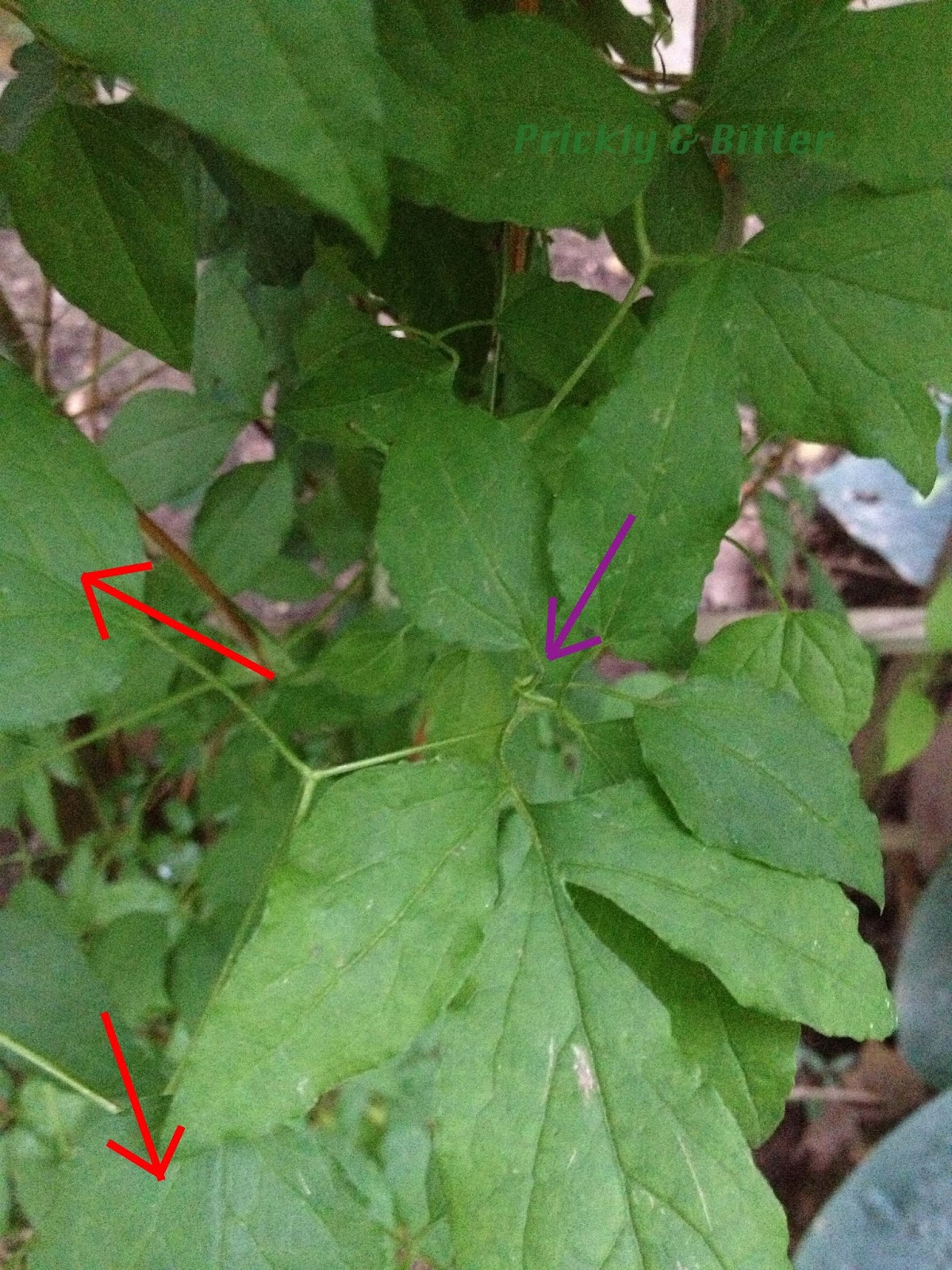
The second image shows the twice-compound leaves, which branch twice into three. The leaves are produced oppositely on the stem (the purple arrow points to where the petiole, or the "leaf stalk", attaches to the stem and you can see that there's another leaf growing off the stem in the same place in the opposite direction), and each petiole divides into three at a single point (you can see the path the petiole takes in yellow). From there, the petiole divides into three again, and at the end of this division there are three leaflets (red arrows). Sometimes leaves can do some strange things and not obey the rules. Instead of producing a leaflet at the end of the petiole, sometimes the leaf turns into a modified structure for climbing: a tendril.

In general, there's a lot of misconceptions about "specialized" plant organs used to attach plants to houses or climb up support structures. Peas are well-known for their tendril producing abilities, and clematis vines should be, too. Clematis vines produce very little growth from their old stems; they much prefer just to send up new shoots from their rhizomes just under the surface of the soil. If you consider just how much this plant has grown in a single growing season, obviously the height of the vine would produce too much weight for the plant to handle on a skinny non-woody stem. To help hold it upright, tendrils are produced to wrap around support structures. These tendrils originate from the leaf, and if you cut straight through a tendril and make a very thin cross-section and look at it under the microscope you'd notice that a tendril has the structure of a rolled-up leaflet. Pretty neat! These tendrils have another secret ability: they respond to touch. Have you ever wondered why a tendril coils? It's not because one side is produced "smaller" than the other and so it spirals to compensate for the lack of space. It's actually the plant that senses a suitable object is touching the tendril and has been for long enough to provide support, and the tendril will start bending towards that object as it grows. If you're REALLY patient (and I mean you would give a saint a bad name with your level of patience) and have a lot of time on your hands, take a tendril that's grasping at something to curl against, and hold your finger against it for maybe 30-60 minutes. Try to move as little as possible, but a little movement is OK. After your hour is up, you can walk away and return to your clematis the next day. What happened to the tendril? I bet it will have super-coiled around itself and made a mass of curly tendrily mess. There was a signal that the plant received when your finger was against the tendril that said "SUPPORT!!! COIL QUICKLY!!!" and it responded--just too late to be useful. You've now manipulated a plant into reacting to your touch. Pretty cool! See, manipulating plants for your own amusement can be fun...

The flowers of this plant are also incredibly unusual. There are flowers that produce four petals, five petals, or six petals (the majority seem to produce five). If you think that all of the flowers just had six petals and some lost a few before I took pictures of them, I also managed to find one of each version that was just getting ready to open, so I can definitely exclude that as an explanation. Why does this happen? As far as I know there's no explanation. None. Completely stumped. Our clematis grows in the shade, so I thought perhaps it was just confused and suffering from a lack of sun (these plants definitely prefer full sun or at minimum partial sun to be most happy) but I just looked up pictures of the plant on Google Images and there are people growing theirs in full sun and noting the same phenomenon. Find an explanation for why this happens? Let me know! I've always been interested in learning about why this happens.

Other than their obvious ornamental value, some clematis species (there are over 300 of them) have been used in North America as medicinal plants for centuries. It was used to treat nervous diseases and migraine headaches, but don't get excited about the medicinal properties of the plant in your back yard. Most clematis species are highly toxic, and the sap that's exuded from cut stems is highly allergenic, is phototoxic (meaning it will cause extreme rash and burning when the sap on your skin is exposed to intense sunlight), and can cause internal bleeding if ingested. This plant is best used as an ornamental species and not a backyard medicine. It's also probably best to use gloves when pruning this plant; some people are more sensitive to the toxins in the sap than others, but always better to be safe than sorry. The phototoxic effect can last for years, despite washing the sap off your skin.

Monday, July 8, 2013

Can you help me identify my tree?


Species name: Rosaceae

Common name: you tell me!

Location: my backyard

Shockingly, I have managed to find a tree I can't identify. That might sound like a cocky statement, but that's certainly not how I intend it; if you have the right resources and identification keys you should be able to identify any tree growing in a planted area in a garden (any garden), but I am completely stumped! I've managed to narrow it down to the family based on the flowers: white flowers with five petals and numerous stamens. It should be reminiscent of strawberry flowers (since strawberries are also in the Rosaceae, or the rose family). That is where my abilities at identifying this tree end.

It doesn't matter what species I look at, native or non-native, none of them quite fit. The leaves are similar to serviceberry leaves, but the flowers are different (serviceberry flowers also have five petals, can be white but also slightly yellowish, but the petals are MUCH narrower than in these flowers). It looks similar to a Saskatoon-berry, but the leaves are much too pointy, not broadly rounded at the ends. The flowers look similar to crab apple flowers but the leaves don't have the prominent lobes of the wild crab apple or pacific crab apple, and don't have the correct leaf shape for the common apple or the siberian crab apple. Cherry leaves, also trees in the Rosaceae, are the widest at a point above the mid-line of the leaf (so if you were to cut a leaf in half cross-wise, the top half of the leaf would have the widest point, not the bottom half like would be the case with these leaves). It could be a pin cherry, but I've never seen the bright red berries that are characteristic of this species. Choke cherries are similar species, but the flowers are arranged in dense elongated clusters at the tips of the branches, which is not the case with the tree in my back yard. Canada plum is another possibility, but this species has characteristic thorn-tipped dwarf shoots which my tree doesn't have. This characteristic (or lack thereof) also eliminates all hawthorns, but they also have very different leaves with defined larger teeth, as well as the smaller serrate teeth (sometimes called "double dentate").

So what DOES this plant have? Well, aside from what you can see in the images (surprisingly enough, that leaf picture actually tells an interesting story, although I don't know if it means anything biologically). The leaves are always arranged in threes on the tips of short-shoots off of branches, even at the top of the tree. This tree is growing in a heavily-shaded area, and only the top of the tree would ever receive direct sunlight. Also interestingly, hardly any of the flowers develop into fruit, yet there are always tons of insects around the flowers scavenging for nectar and pollen while they are open (the flowers have no noticeable scent that I could discern). I went back to this tree (pictures originally taken May 26th of this year), and there's only one tiny fruit on one branch that I could see; it was about the size of a pea and completely green. I'll go back and update this blog if it grows and turns colour before it disappears in the hands of a bird or squirrel.

Here's your challenge for the day: help me identify it! Have you ever seen a tree like this before? Do you have one in your backyard? Do you work at a greenhouse and sell this tree? I'm almost positive it's a non-native species (only because of its lack of fruit production, implying it might have some sort of specialized pollinator that we don't have in Canada) but I might be off the mark. Someone tell me this is an incredibly rare species! :) Any and all help welcome.

Saturday, March 16, 2013

If the spines don't get you, the latex will!


Species name: Euphorbia milii var. splendens

Common name: crown of thorns, Christ plant

Location: Dominican Republic

The crown of thorns is native to Madagascar, as are many species of Euphorbia. There are an estimated 100 species in the genus, but I have my doubts that they all belong. There seems to be a group of about 40 species that are native to Madagascar (some are critically endangered, some or more common but all are at risk due to habitat destruction), another group that are native to mainland Africa, and then yet another group that are native to Europe and South America (to see an example of the morphological variation in the family, read all about the chenille plant HERE). The plants native to Madagascar are very similar to the one pictured above; small-ish brightly-coloured flowers, very thick green leaves that are concentrated at the tips of the stems, long spines, and are relatively low to the ground. The ones native to Africa are trees; some can be up to 35 feet tall but otherwise similar to the Madagascar euphorbs. The plants native to Europe and South America are the weird ones; they're the round, "blobby" euphorbs that look absolutely nothing like their African "relatives". It wouldn't surprise me at all if there ended up being multiple genera within Euphorbia and a lot of renaming of species in the years to come. There are currently four sub-genera, but even those don't quite seem to be natural groups, at least to my untrained eye. I'm going to lay my bets on there actually being six genera within Euphorbia. We'll see if I'm right; I'll re-evaluate this blog if there's ever a genus-wide systematic DNA analysis that's performed.

The crown of thorns is a species that has a rather unique common name, due to its hypothesized role in Christian and Catholic beliefs. The story goes that when Christ was nailed to the cross, he was also forced to wear a crown made of a very thorny plant; whenever there's a painting depicting Christ's crucifixion, his head is always bleeding from the thorns digging into his forehead and scalp. It is believed based on geological evidence and stories passed down through generations (as well as artifacts discovered in Mosques and in underground burial tombs) that this plant was transported to the Middle East very early on; as many as 5,000 years ago. The story goes, then, that this plant is the source of the thorny branches that made up Christ's "thorn crown" during the crucifixion. The story of Br'er Rabbit, Br'er Fox and Br'er Bear courtesy of Disney also revolves around a dense thicket of thorns (I only know this because of the ride Splash Mountain at Walt Disney World in Florida...), and it's highly likely that these are some sort of euphorb (the story is based on folk tales told by African slaves after first being transported to the United States, so its doubtful the plants making up the Brier/Briar Patch would be American species) or other African spiny species.

All euphorbs are highly toxic. Some are more irritating only to the skin, while others produce noxious fumes from their latex (the white milky substance that is released when any part of the plant is damaged, as you can see in the third picture) and can cause severe respiratory problems. If ingested, this species won't kill you but will most definitely make you sick (vomiting, diarrhea and severe dehydration as a result of these two). African species can cause death just from contact with the latex, let alone ingestion. It's amazing the kinds of defence systems that some plants have evolved! Unsurprisingly, it is rare to find any kind of insect or other animal herbivore munching on these plants as a snack.

The flowers of this plant are quite neat, and you can actually gauge the age of the flower bracts by their colour. What we see as "flowers" aren't actually flowers at all. The two "petals" are modified leaves called bracts that contain chromoplasts instead of chloroplasts, which give the bracts their red to pinkish hue. These bracts change colour as they age, and the rate at which they change colour depends on the amount of sun they're exposed to and how long the bracts have been fully-developed. They usually start off a bright pink or red, then gradually fade to completely green before the fruit is mature, then the bracts fall off. Those small yellow patches on the very inside of the flowers are the true flowers; the fruit of these plants is rarely larger than a few millimetres across and is red when mature.

Sunday, March 3, 2013

A hippopotamus of a bulb


Species name: Hippeastrum sp.

Common name: "amaryllis"

Location: Ontario

Since I'm still not done going through all of my plant pictures from the Dominican, I figured I would profile a plant from my house! Every year, my grandma gives an amaryllis bulb to every family and there's a friendly competition to see who can get the first flower, the tallest flower stalk, the shortest flower stalk, a bulb that doesn't grow (this always seems to go to my uncle Steve, who couldn't get a weed to grow even if he tried), and the most number of flowers. There are no prizes other than the right to brag to everyone that you know that you're better and/or worse at growing a bulb than the rest of your family. Apparently this is fun...

The plant that has the common name of "amaryllis" actually isn't an Amaryllis at all. The common ornamental species of Hippeastrum (there are approximately 90 species in the genus) are native to tropical and subtropical regions in the Americas, from about Mexico and the Caribbean south to the northern half of Argentina. The appearance of the flowers of this genus can be wildly different, but they all have three things in common: the plants are called "bulbous perennials" (they flower every year from a bulb and live for many years), the flower stalk is the first green part to emerge from the bulb, and all of the flowers have 6 tepals (3 petals and 3 sepals which are indistinguishable from each other once the flower is mature). The true Amaryllis, however, is native to South Africa and is starting to become more and more common throughout the world as ornamental species. The two genera are morphologically similar, but they can be easily distinguished if two species are side-by-side. They were both thought to originally belong to the genus Lilium, which contains all of the "true" 6-tepaled lilies, but DNA sequencing has shown that this is definitely not the case (it was no longer believed to be the case, even before their genes were sequenced; all lilies are highly toxic and have very different growth morphologies than either the amarillii or "amarillii"). There are significantly more issues with the taxonomy of these two genera, but I'm not going to get into that; if you want to read about the issues, you can read the "taxonomy" section of the Wikipedia article of Hippeastrum HERE.

One of the aspects of the indoor amaryllis that makes it such an ideal houseplant is the ease of growing it: put the bulb into some soil (it can be significantly less soil than you think should be able to support how big the plant will actually get), put it in a window, and water it once a week. Seriously! That's it. Some bulbs take longer than others to flower the first time because of the amount of nutrients it managed to acquire the season before; if it doesn't flower right away, give it some time and perhaps put it into a sunnier, less drafty window. The roots will become well-established and will funnel nutrients to the bulb, allowing the flower stalk to start to emerge. It is green when it first starts growing, producing sugars for the rest of the plant to use as fuel for growth. Not long after the flower stalk emerges from the bulb the leaves will start to grow, and within a few weeks you should have something that's starting to look very much like a traditional amaryllis. The varieties and cultivars used for their ornamental value and packed in boxes in November and December are usually grown for their enormous flowers and very long flower stalk; this is typically not how the plants would look in nature (and the last image should give you a hint why if you're observant). The height of the flower stalk and the weight of the flowers is far too much for the plant to handle on its own, and you're going to need to resort to staking up your plant unless you want soil all over the floor! Once the flower stalk is done flowering, you might be lucky enough to get seeds produced, which you can plant in new pots and get new plants growing from seed. Be warned, however, that the offspring will likely look nothing like their parents; genetic recombination that occurs during fertilization means that genes will be shuffled and some that produce the ideal flower and plant morphology of the bulb you bought in the box will be lost.

Once the flower stalk dies, clip it off at the base and allow the leaves to continue to grow and produce sugars that are stored in the bulb (this is where it's important to ignore all information about how to properly grow an amaryllis that's on the box). The leaves will gradually yellow and start to decay; that would be a good time to pull them off the bulb (they should detach very easily at the bulb). Eventually, you'll be left with just a bulb in a pot. Water the bulb very sparingly (as in, not at all or once a month at most) until December rolls around again, and then water it whenever you remember, but no more than once every couple of weeks. Once it's ready, it will start to grow a new flower stalk. Water once a week, and voila! A new flower. Don't get discouraged if it doesn't flower again the second year; some varieties can only afford to flower every other year because of the number of resources it requires to produce the flowers.